CRIT: the four-step prompt that turns AI into a real sales partner

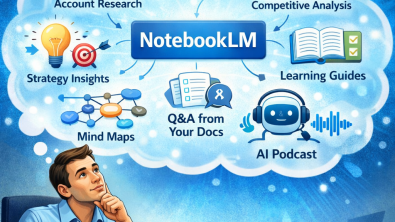
Don’t have time to read? Listen to this 5 minute podcast here: https://www.linkedin.com/smart-links/AQEw1Vd6JmDCaQ
Most sellers are using AI. Very few are using it well.
The problem is not access to tools. It is how those tools are instructed.
When AI is treated like a search bar, the output is predictable, generic, and easily replicated. The moment your competitors can generate the same email, pitch, or account plan in seconds, differentiation disappears. That is where the CRIT methodology comes in.
CRIT is a four-part framework that turns AI from a passive assistant into a strategic thought partner. For sellers, sales leaders, and partner owners, it provides a repeatable way to think better, prepare better, and execute with precision.
What CRIT is and why it matters
CRIT stands for CONTEXT, ROLE, INTERVIEW, TASK.
It is not a prompt template. It is a decision-making discipline.
CRIT forces you to slow down just enough to clarify intent, surface assumptions, and guide the AI toward outcomes that reflect your market, your customer, and your commercial reality. Instead of generic outputs, you get work that sounds like you and supports the way you sell.
For sellers, CRIT solves three persistent issues:
- AI outputs feel generic and interchangeable
- Messaging lacks commercial sharpness
- AI accelerates activity but not deal quality
CRIT fixes this by keeping strategy human while letting AI scale execution.
How to implement CRIT in your daily sales workflow
CRIT works best when you treat it as a single structured instruction, not four separate prompts. The goal is to give the AI a complete brief before you ever ask it to produce output.
Step 1: Write the full CRIT prompt before submitting
Open your AI tool and structure your prompt exactly like this:
CONTEXT
ROLE
INTERVIEW
TASK
TOP TIP:
Use Shift + Enter between each section. This allows you to create spacing and think through each element without accidentally submitting the prompt half-finished. Treat it like drafting an internal sales brief, not sending a message.
This simple habit dramatically improves output quality.
Step 2: Anchor the CONTEXT in commercial reality
CONTEXT is where most sellers underperform.
Strong CONTEXT includes:
- Who the customer is
- Where you are in the deal
- The business pressure they are facing
- The outcome you are driving
Example:
“I am preparing for a first executive meeting with a manufacturing CIO focused on cost containment and skeptical of SaaS pricing.”
If the CONTEXT is weak, the AI guesses. If the CONTEXT is strong, the AI reasons.
Step 3: Use ROLE to control perspective and tone
ROLE defines how the AI thinks.
Instead of asking for help, assign expertise:
- Act as a skeptical CFO
- Act as a sales coach
- Act as a board-level advisor
This instantly changes the quality of challenge and the commercial sharpness of the response. ROLE is how you prevent AI from sounding generic.
Step 4: Use INTERVIEW to surface blind spots
INTERVIEW is the most powerful and most skipped step.
By asking the AI to question you before responding, you force clarity in your own thinking.
ALWAYS USE THIS:
“INTERVIEW: Ask me three questions, one at a time, to gain better clarity.”
This step turns AI into a coach, not a copywriter.
Step 5: Define a precise TASK
TASK is not about asking for content. It is about defining outcomes.
A strong TASK includes:
- A specific deliverable
- A clear audience
- A quality bar
Example:
“Create a one-page executive narrative that positions this solution as a cost-reduction lever, not a technology upgrade.”
Precision here determines relevance.
The real benefits of CRIT in sales
Teams that adopt CRIT consistently see:
- Better meeting preparation with fewer surprises
- Sharper messaging aligned to buyer economics
- Faster ramp-up for new sellers and partners
- Scalable quality without sacrificing judgment
CRIT does not make you faster at typing. It makes you better at thinking.
Make CRIT your default
The sellers who win with AI will not be the ones who prompt more often. They will be the ones who prompt with intent.
CONTEXT. ROLE. INTERVIEW. TASK.
Use it every time.
CTA: Listen to this 5 minute podcast here! https://www.linkedin.com/smart-links/AQEw1Vd6JmDCaQ
About the author
Benedict Russell is a Global Partner Development Executive responsible for scaling global GTM programs across all motions. He helps shape Siemens’ digital selling and AI strategy, embedding best practices that accelerate SaaS adoption and recurring revenue. Previously, he drove partner coverage and expansion, adding 300+ partners to the Siemens ecosystem.