The next generation of sales playbooks won’t be documents
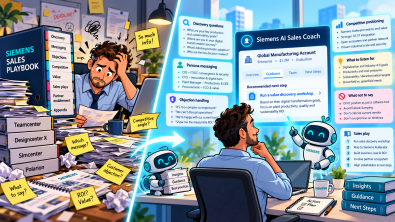
A company can spend weeks building a genuinely good sales playbook.
It might contain discovery questions, persona messaging, competitive positioning, objection handling, value propositions and repeatable sales plays. It gets reviewed, approved and eventually published as a PDF, PowerPoint or asset in an enablement platform.
Then a seller has a customer meeting in 20 minutes.
They do not want to search through 30 pages trying to remember where the relevant objection handling sits. They want to know what matters for this customer, this persona and this conversation.
That is why I think the 30-page sales playbook is becoming an outdated interface for modern selling.
The problem is not necessarily the content.
It is how sellers consume it.
Most sales organizations already have a significant amount of knowledge available. The harder question is whether the right knowledge reaches the seller at the moment they actually need it.
A playbook might explain how to sell to five different personas, handle ten objections and run several sales plays. But a seller preparing to meet one VP of Engineering does not need all of it.
They need the relevant 10%.
Context changes everything.
Different personas need different positioning. Different stages of an opportunity require different questions. Competitive situations change what matters. What is useful in an early discovery conversation may be completely irrelevant during a late-stage evaluation.
Static playbooks remain valuable because they create structure, consistency and governance. However, expecting sellers to read, remember and manually navigate all that knowledge is becoming the weak point in the model.
What an AI-powered sales playbook actually is
This is not simply uploading a PDF into a chatbot and asking it questions.
A useful AI-powered sales playbook needs to understand how different pieces of sales knowledge connect, including:
- Sales methodology
- Buyer personas and industry context
- Products and solutions
- Discovery questions
- Objection handling
- Competitive positioning
- Value messaging
- Sales plays
- Opportunity stage
The playbook remains the governed source of knowledge.
AI becomes the interface between that knowledge and the seller.
Instead of asking, “Where is the section on handling this objection?”, a seller might say:
“I am selling into a manufacturing account. I am speaking with the VP of Engineering. They believe their current process is good enough and do not see urgency to change. Based on our sales playbook, how should I approach the conversation?”
The difference is subtle but important.
The seller is no longer searching for content.
The content is being applied to the situation.
Why this matters for sellers
The value is not giving sellers more information. Most organizations already have plenty of that.
The opportunity is helping sellers apply the right information.
Done well, that could improve meeting preparation, consistency and the adoption of sales methodology. It could also make existing enablement content far easier to use during live opportunities.
There is another benefit that I think is particularly important.
Good sales organizations accumulate enormous amounts of institutional knowledge. Experienced sellers know which questions expose real urgency, which objections usually hide a different concern and which signals suggest an opportunity needs to be challenged rather than progressed.
Playbooks attempt to capture that knowledge.
AI potentially makes it easier to access.
Practical ways sales teams can use it
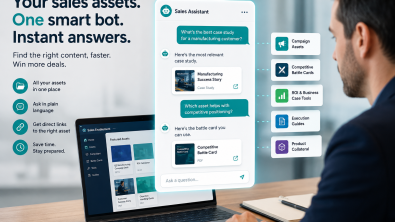
Meeting preparation is an obvious starting point. A seller provides the account, persona, meeting objective and known situation. AI surfaces the relevant messaging, discovery questions and likely objections from the approved playbook.
For objection handling, the seller can enter the objection they are hearing and ask for the approved response, useful follow-up questions and signals to listen for.
Opportunity coaching takes the idea further. Rather than simply retrieving content, AI can use the organization’s methodology to challenge assumptions, identify missing information and suggest what the seller should investigate next.
It can also help with sales play selection. Describe the customer situation and AI can identify which existing play is most relevant and explain the reasoning.
This is where the experience starts to move from AI assistant toward AI sales coach.
The bigger opportunity
Over time, the interaction could become increasingly contextual.
The AI could understand who you are selling to, where you are in the deal, what the customer has already said, which methodology applies and what information is still missing.
Eventually, agentic systems may begin surfacing some of that guidance proactively.
But there is an important caveat.
AI does not automatically make sales guidance better.
Poor sales guidance delivered through AI is still poor sales guidance.
The role of enablement becomes more important, not less
If anything, this model raises the bar for enablement.
The quality of the experience depends on the quality of the underlying playbook, methodology, competitive information, product knowledge and governance.
AI can make that knowledge easier to consume. It cannot compensate indefinitely for weak content.
That means enablement teams potentially move from simply publishing content to designing the knowledge system that sits behind seller execution.
A simple way to get started
I would not start by trying to rebuild the entire enablement organization around AI.
Start with one strong playbook.
Choose the sections sellers use most frequently. Make them accessible in an approved AI environment. Define a few common seller scenarios and test whether AI consistently surfaces the right guidance.
Then improve both the instructions and the underlying playbook based on what sellers actually ask.
A simple CRIT prompt could look like this:
CONTEXT
Describe the opportunity, customer, persona, deal stage and situation you are dealing with.
ROLE
Act as an enterprise sales coach using the supplied sales playbook as your primary source of guidance.
INTERVIEW
Ask me up to three questions, one at a time, if important information is missing before providing your recommendation.
TASK
Based on the playbook and my situation, provide the most relevant positioning, discovery questions, objection handling, what to listen for, what not to say and the recommended next action.
For years, sales playbooks have been built around one assumption: the seller reads the content and applies it.
AI creates another possibility.
The seller describes the situation and the playbook comes to them.
That does not replace sales methodology, enablement or seller judgment. It potentially makes all three easier to apply when they matter most.
Take one existing sales playbook and test whether AI can make it easier for a seller to use in a real opportunity.
About the author
Benedict Russell is a Global Partner Development Executive responsible for scaling global GTM programs across all motions. He helps shape Siemens’ digital selling and AI strategy, embedding best practices that accelerate SaaS adoption and recurring revenue. Previously, he drove partner coverage and expansion, adding 300+ partners to the Siemens ecosystem. Read Benedict’s most recent blog here.