How to use AI to expose the gaps in your MEDDPICC qualification

Most sales teams know whether the MEDDPICC fields in an opportunity are complete. The more important question is whether the information entered into those fields is actually supported by customer evidence.
A decision process might be documented, but has the customer confirmed how the decision will be made? A champion might be identified, but are they actively influencing colleagues when the seller is not in the room? Metrics might have been entered, but did they come from the customer or were they calculated internally to support the business case?
This is where MEDDPICC can create a false sense of confidence. The framework itself is not the problem. The problem begins when completing the fields becomes the objective and the quality of the evidence becomes secondary.
AI can help sellers and managers inspect what sits behind the qualification. However, it must be used to challenge the available information, not to invent convincing answers for the gaps that remain.
What AI-supported MEDDPICC actually is
AI-supported MEDDPICC involves giving AI the available opportunity information and asking it to evaluate the evidence behind each part of the framework:
- Metrics
- Economic buyer
- Decision criteria
- Decision process
- Paper process
- Identified pain
- Champion
- Competition
The input could include CRM fields, meeting notes, customer emails, call transcripts and the seller’s own assessment. AI can then compare the sources, identify inconsistencies and organise the information into three important categories:
- Confirmed customer evidence
- Reasonable inference
- Unsupported seller assumption
That distinction matters more than simply producing another red, amber or green score.
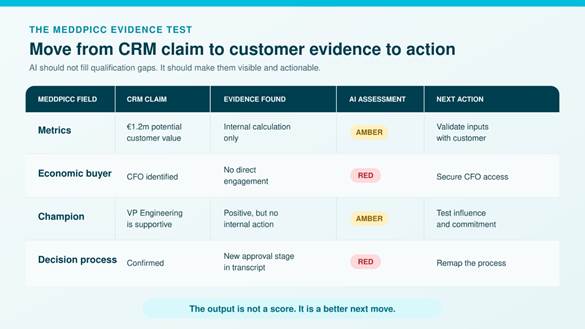
If a seller states that the VP of Engineering is the champion, AI should not accept the label because it appears in the CRM. It should look for evidence that the person has provided internal guidance, facilitated access to other stakeholders, advocated for change or taken action to help the opportunity progress.
If the economic buyer is marked as identified, AI should test whether the person actually controls the relevant budget, understands the proposed business value and has participated in the decision. Knowing someone’s name is not the same as having access to the economic buyer.
The purpose is not to make every MEDDPICC category appear complete. It is to understand what is known, what is assumed and what must happen next.
Why this matters for sellers and managers
For sellers, AI can make MEDDPICC more useful between customer interactions. Instead of reviewing it as a checklist before a deal review, the seller can use it to determine which assumptions need validating, which stakeholder is missing and which question would most improve the quality of the opportunity.
This changes the focus from field completion to deal progression. A missing metric is not simply an empty CRM box. It is a signal that the seller may not yet understand the scale of the customer’s problem or have enough evidence to build a credible financial case.
For managers, AI can make deal reviews more objective and productive. Managers often need to inspect an opportunity using a combination of CRM data, seller commentary and their own judgement. When time is limited, the conversation can become a status update rather than a genuine examination of deal quality.
AI can prepare an evidence-based assessment before the review, highlighting contradictions and areas where the CRM appears stronger than the supporting information. The manager can then spend more time coaching the seller on the actions that matter, rather than collecting information that should already be available.
This has potential implications for qualification discipline, coaching consistency and forecast confidence. However, AI should not be allowed to decide whether an opportunity will close. It cannot see customer politics, private conversations or information that has never been captured. Its value is in identifying where confidence appears to be running ahead of evidence.
How sales teams can apply it
Before a deal review, the seller can ask AI to assess each MEDDPICC category and show the evidence supporting its conclusion. This makes it more difficult to hide weak qualification behind a positive rating or a confident verbal update.
After a customer meeting, AI can compare the latest transcript or notes with the previous assessment. It can identify which assumptions were validated, what new risks emerged and whether the opportunity materially progressed. Another meeting on the calendar does not necessarily mean the deal moved forward.
Managers can use the same output to structure coaching around action. Rather than asking, “Who is the economic buyer?”, they can ask, “What evidence shows that this person controls the decision and what access do we still need?”
Enablement teams could also use anonymised scenarios to help sellers practise recognising weak evidence. That would move MEDDPICC training beyond definitions and towards the judgement required to apply it in a real enterprise opportunity.
From AI analysis to agentic deal inspection
The more significant opportunity begins when AI is connected to the systems where opportunity evidence is created. This is also where the distinction between conventional AI analysis and an agentic workflow becomes important.
Asking AI to review a CRM record is not automatically agentic. It is a one-time analysis triggered by a user. An agentic MEDDPICC workflow would continuously monitor authorised opportunity information, detect meaningful changes and initiate an appropriate response without waiting for the seller to run another prompt.
For example, imagine that a seller changes the champion field from amber to green. An AI agent could review recent meeting transcripts, emails and CRM activity to determine whether any new evidence supports the change. If it finds no evidence of internal influence or active advocacy, it could flag the rating for review and recommend what the seller needs to validate next.
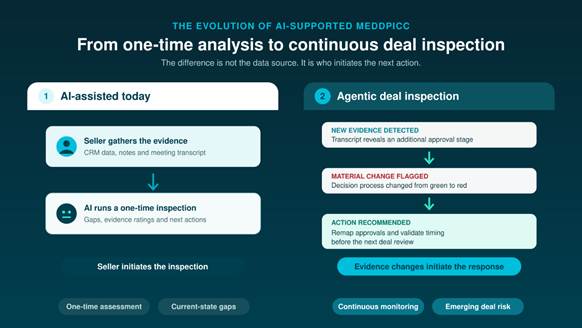
A meeting transcript might reveal that an additional approval stage has been introduced. The agent could recognise that the recorded decision process is now incomplete, assess the potential impact on timing and prompt the seller to update the opportunity.
The same workflow could identify that no meaningful interaction has taken place with the stated economic buyer, that a key stakeholder has become less engaged or that the customer’s decision criteria have shifted towards an area where the current value proposition is weak.
Subject to the organisation’s governance, permissions and workflow design, an agent could:
- Monitor CRM changes, transcripts, emails and meeting notes
- Compare new evidence with the existing MEDDPICC assessment
- Identify contradictions or unsupported field changes
- Alert the seller when a material qualification gap emerges
- Recommend the next question, stakeholder or action
- Prepare an updated evidence summary before a deal review
This moves AI from answering questions about an opportunity to continuously inspecting how the evidence changes over time. The commercial value is not that the agent completes more administrative work. It is that sellers and managers can identify material deal risk earlier and respond before it affects the forecast.
There are important dependencies. The workflow requires reliable data, clear access controls, agreed definitions of acceptable evidence and human oversight. If those foundations are weak, an agentic system could create more alerts without improving decision quality.
The strongest system will not be the one that updates the greatest number of CRM fields. It will be the one that identifies the few changes that genuinely affect deal strategy, customer progression and forecast confidence.
A simple way to get started
An agentic workflow may require integration and governance, but sellers can test the underlying approach today using one active opportunity and the CRIT prompt below.
Context
I am assessing an enterprise software opportunity using MEDDPICC.
I will provide the available CRM information, meeting notes, customer communications and my own assessment of the opportunity.
Treat every statement as a claim to test rather than a fact to accept. Distinguish between confirmed customer evidence, reasonable inference and unsupported seller assumption. Do not invent information to complete a MEDDPICC category.
Where sources contradict one another, identify the contradiction clearly. Where information may be outdated, flag it for validation.
Role
Act as an experienced enterprise sales leader conducting an objective MEDDPICC deal inspection.
Challenge vague language, optimistic interpretation and unsupported qualification. Do not agree with my assessment merely because it sounds plausible or because a CRM field has been completed.
Focus on the strength of the evidence and what must happen for the opportunity to progress.
Interview
Before completing the assessment, ask me up to five clarification questions, one at a time.
Focus your questions on missing evidence, contradictions and qualification gaps that could materially affect deal strategy, progression or forecast confidence.
Do not attempt to fill the gaps on my behalf.
Task
Assess the opportunity against each MEDDPICC category.
For every category, provide:
- The current assessment
- The evidence supporting that assessment
- What is inferred but not confirmed
- Any contradictions or unsupported claims
- The most important unresolved qualification gap
- The next customer question or seller action
- A red, amber or green rating with a clear justification
Then provide an overall deal inspection covering:
- The three greatest risks to the opportunity
- CRM fields that appear stronger than the supporting evidence
- Assumptions that require direct customer validation
- Changes since the previous assessment, if one is provided
- Priorities for the next customer interaction
- Questions the sales manager should ask during the deal review
Finish by identifying the three actions most likely to improve qualification and deal progression. Do not predict whether the opportunity will close unless there is sufficient evidence to support that conclusion.
MEDDPICC should help sales teams confront uncertainty, not hide it behind completed fields. AI can make that inspection faster and more consistent, while agentic workflows could eventually make it continuous.
The underlying discipline does not change. Qualification should be based on customer evidence, not seller confidence.
Use the CRIT prompt to stress-test one active opportunity before your next deal review.
About the author
Benedict Russell is a Global Partner Development Executive responsible for scaling global GTM programs across all motions. He helps shape Siemens’ digital selling and AI strategy, embedding best practices that accelerate SaaS adoption and recurring revenue. Previously, he drove partner coverage and expansion, adding 300+ partners to the Siemens ecosystem. Read Benedict’s most recent blog here.