How to build a simple business base for LAER maturity

Partners do not need an advanced financial model to justify investing in Customer Success. They need a clear view of revenue at risk, margin leakage, expansion potential, and the operating cost of reactive lifecycle management.
“How do we recover the costs associated with implementing a Customer Success team?”
This one comes up constantly, and the interesting word in it is “recover.” It presumes a sequence: spend first, earn it back later, hope the payback period is short enough that nobody panics halfway through. That’s a reasonable way to think about buying a machine and a poor way to think about this.
So let me push on the premise before answering it. Your first phase isn’t a team. It’s naming who owns each stage of the lifecycle and putting an hour a month on the calendar to review it, and the cost of that is mostly awkwardness about who does what. There isn’t much to recover, because you haven’t spent much. Recovery becomes a real question at the point where you’re weighing dedicated headcount, and by then you’ll have data instead of a hypothesis.
Worth answering directly anyway, because it’s where this decision usually gets made.
Which activity pays back when
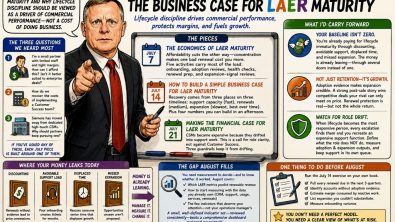
Recovery comes from three places on three different timelines, and each traces to a specific piece of work.
The fastest is support capacity, and it comes from onboarding discipline. A checklist that gets the first 30 days right removes the questions that generate avoidable tickets over the next 11 months. You’ll see it inside a quarter or two, and it arrives as recovered technical capacity rather than as revenue, which makes it easy to overlook when you’re the one writing the business case.
Slower and larger is renewal outcomes, from adoption reviews and health checks. Fewer accounts reaching renewal without evidence means less discounting and fewer emergency saves. The catch is timing. It only shows up as renewals come due, so if you start in July the effect spreads across the following twelve to eighteen months. Promise yourself a payback inside two quarters on the strength of renewals and you will miss.
Slowest to start and best over time is expansion, from whatever you use as an expansion-signal review. Once somebody is close enough to your accounts to notice the second use case or the new department, proposals go out that wouldn’t have. That revenue carries your best margin because you already paid to acquire the customer.
There’s a fourth effect that doesn’t fit the recovery frame and is worth naming anyway. You will win deals you’d otherwise lose, because “here is exactly how we get you productive and who owns it” is a differentiator a competitor can only answer with price. You can’t model it cleanly. It’s real, and I’d put it in your business case without assigning it a number.
Four numbers you already have
Now the business case itself. You can assemble this in an afternoon with a spreadsheet.
Renewal exposure without adoption evidence. Pull every renewal due in your next three quarters. For each, ask one question: if this customer asked today to see what they got for their money, could you produce something? Not whether you believe they got value. Whether you could show usage data, a training record, a documented outcome, a named user who’d go on record. Sort into two piles and sum the annual value of the pile where the answer is no.
That figure is not a churn forecast and you shouldn’t treat it as one, since plenty of those accounts will renew. It measures how much of your recurring revenue is heading into a negotiation without evidence, which is a narrower claim and a harder one to argue with. It’s also the number that tends to stop a partner meeting, because most firms have never added it up. Split it by contract size if you can, because exposure concentrated in three large accounts is a different problem from exposure spread across a long tail.
Margin consumed by reactive work. Take a quarter of your support tickets and have someone who knows the product sort them into three piles: genuine defects and environment issues, questions better onboarding would have prevented, and everything else. You want the size of the middle pile, multiplied by average handle time and a loaded hourly cost. Then list the accounts over the last year that needed you or a principal to step in, estimate those hours, and note separately what they displaced.
You won’t love your own estimates here. Write down a range instead of a point, note that it’s rough, and move on.
Expansion you couldn’t substantiate. Go through the last year for accounts where additional scope was plausible but never proposed, or was proposed and stalled. You’re looking for a specific failure: the conversation was available, you had no outcome evidence to anchor it, so it either didn’t happen or went out cold and died. Pick your two or three clearest examples rather than trying to be comprehensive. Three credible ones beat a large number you don’t believe.
Onboarding variance. Look at your last twenty engagements and find the spread between fastest and slowest time to a working, adopted deployment. Long projects compress project margin directly, and they push the customer’s first real experience of the product closer to their renewal date, which shortens the window in which value can accumulate.
Setting it against the ask
Total the four, label the whole thing an estimate, and put it beside what you’re actually proposing to spend. That second figure is usually smaller than expected, because the first tranche is an ownership map, a monthly review, an onboarding checklist, and a health check template.
A shape I’ve seen, and these are placeholder magnitudes rather than benchmarks: a firm with a few million in recurring revenue finds several hundred thousand in renewal value carrying no adoption evidence, a low-six-figure annual drag from avoidable support and rescue work, and two expansion opportunities worth six figures combined that never got proposed. Against that, phase one is redistributing lifecycle responsibilities across roles you already pay for and standing up a monthly review. A business case with that shape doesn’t need a sophisticated model. It needs somebody to write the numbers down.
Present the business case as a loss, not a gain
One structural note, and it applies whether you’re taking this to co-owners, a board, a sponsor, or just to your own judgment on a Sunday afternoon.
A business case built as “here is the return we’ll generate” invites scrutiny of assumptions that post-sale attribution genuinely can’t defend. A case built as “here is what we’re currently losing, and here’s the modest cost of stopping some of it” is reporting rather than forecasting. The losses already happened. Nobody has to believe a projection.
If you’re the sole decision-maker, this discipline still matters, maybe more. Nobody is going to stress-test your optimism for you.
Where I’d deviate is the expansion and new-business side. Put those in as upside with no figure attached, framed as what becomes possible. You’re already skeptical of growth claims in other people’s proposals. Don’t make one in your own.
Two things to write down honestly
Your first pass will overstate some things and understate others. The support triage is subjective. The expansion estimates are optimistic. Note that in the document, because a case that names its own soft spots survives questioning better than one performing precision it doesn’t have.
The second is scope. This justifies a first step, not a five-year program. Get agreement on the ownership map and the review rhythm, run them two quarters, then revisit with real numbers instead of estimates.
The second version of this business case is much stronger than the first. The only way to get to it is to ship the first one.
Build a simple LAER maturity business case with the numbers you already have. Give yourself an afternoon and a deadline, not a project plan.
About the author
William McInnis is a Global Partner Development Executive at Siemens Digital Industries Software, where he focuses on global go-to-market programs, partner operations strategy, customer success, renewals, and Siemens’ XaaS transformation. With more than 25 years of experience across Accenture, Siemens, Autodesk, Microsoft, and Lockheed Martin, William has led global programs spanning customer success, cloud adoption, solution delivery, business integration, and enterprise transformation. He is especially focused on helping partners adopt LAER-based customer engagement practices that improve customer outcomes, renewal performance, and sustainable growth.