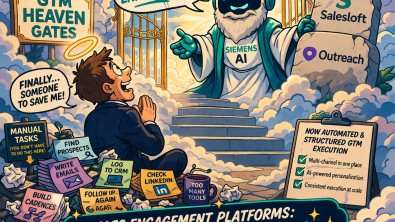
Digital selling was the first step… AI is what actually makes it work
Digital selling has already transformed how sales teams operate. The shift from manual selling to platforms like Outreach.io, Salesloft and LinkedIn Sales Navigator improved scale, visibility and consistency.
But it did not remove effort.
It redistributed it.
Sellers still spend a significant amount of time:
- Searching for accounts
- Building lists
- Writing outreach
- Preparing for conversations
Digital selling improved productivity.
AI is now amplifying it.
What digital selling looked like before AI
The traditional digital selling workflow is structured, but heavily manual.
It typically follows this motion:
- Identify target accounts in LinkedIn Sales Navigator
- Build account and lead lists manually
- Use Cognism or ZoomInfo to extract contact data
- Import into Outreach.io or Salesloft
- Write emails and messaging manually
- Execute across email, LinkedIn and calls
This model works.
But it has clear limitations.
It depends heavily on individual seller effort.
It creates inconsistency in quality.
It slows down execution.
Most importantly, it does not scale well.
Where AI changes the workflow
AI does not replace this workflow.
It enhances each step within it.
Instead of manually executing every stage, AI reduces the effort required and increases the quality of output.
The new workflow becomes:
- Use AI to identify target accounts based on ICP, industry or SIC codes
- Build and manage those accounts as structured lists within LinkedIn Sales Navigator
- Identify leads within those accounts directly in LinkedIn
- Extract contact data using Cognism or ZoomInfo
- Generate outreach messaging using AI
- Create structured sequences aligned to use cases
- Prepare for meetings using AI-generated summaries and insights
- Execute through Outreach.io, Salesloft or CRM platforms
The tools remain the same.
The execution model changes.
What AI in digital selling actually is
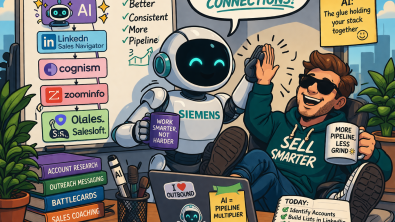
AI is the layer that connects and enhances your existing sales stack.
It does two things simultaneously.
It takes inputs from your tools and turns them into usable outputs for execution.
It also generates inputs for your tools, improving how those tools are used in the first place.
This is the key shift.
AI is not a step in the workflow. It is a system that improves every step.
Typical inputs into AI:
- Account and lead insights from LinkedIn Sales Navigator
- Contact data from Cognism or ZoomInfo
- Internal use cases, messaging and positioning
- Sequence frameworks from Outreach.io or Salesloft
From these inputs, AI can generate:
- Account summaries
- Personalised outreach
- Multi-touch sequences
- Call plans and discovery questions
- Competitive positioning
- AI-powered call simulations, allowing sellers to practise cold calls before engaging real prospects
At the same time, AI also creates inputs for your tools:
- Identifying target accounts based on ICP, industry or SIC codes
- Enabling those accounts to be built and managed as account lists within LinkedIn Sales Navigator
- Supporting lead identification within those accounts directly in LinkedIn
- Enabling efficient contact data extraction from those lead lists using Cognism or ZoomInfo
- Creating ready-to-use sequences for Outreach.io or Salesloft
This is where the previous blogs connect and come together.
Account research → AI identifies target accounts
LinkedIn → accounts and leads are structured into lists
Data enrichment → contact data is extracted via Cognism or ZoomInfo
Outreach → AI generates messaging and sequences
Sales coaching → AI enables realistic call practice and refinement
Together, this becomes a single system.
Why this matters for sellers
The advantage is no longer having access to digital tools.
Most teams already have them.
The advantage is how effectively they are used together.
AI drives three measurable improvements:
Speed
Sellers move from hours of preparation to minutes.
Quality
Outreach becomes more relevant and structured.
Consistency
Best practices can be scaled across teams.
For SMB sellers, this increases activity without reducing quality.
For Enterprise sellers, this improves depth without slowing pipeline creation.
The result is more efficient outbound execution and higher conversion potential.
Practical ways sales teams can apply this
There are a few immediate use cases that create impact.
AI-driven account identification
Use AI to generate target account lists based on ICP, removing the need for manual searching.
Automated outreach creation
Generate tailored messaging aligned to industry, persona and use case.
Sequence development
Build structured cadences that reflect real customer problems rather than generic templates.
Meeting preparation
Create account summaries, hypotheses and discovery questions in seconds.
These are not future-state capabilities.
They are available now using the tools already in place.
A simple way to get started
You do not need to change your sales stack.
Start by enhancing how it is used.
Step 1
Define your target segment
Industry, persona and use case
Step 2
Use AI to identify and qualify accounts
Step 3
Build those accounts into lists within LinkedIn Sales Navigator
Step 4
Extract contact data using Cognism or ZoomInfo
Step 5
Generate outreach and sequences using AI
Step 6
Execute through your existing platforms
Step 7
Refine based on performance and reuse what works
The broader shift
Digital selling improved how sales teams execute.
AI is now improving how they think and prepare.
The combination of both creates a new model.
One where tools are no longer used in isolation, but as part of a connected system.
This is the real shift.
Not more technology.
Better execution. If you want to see how this works in practice, explore the AI tools and workflows shared across this series and apply them to your own outbound motion.
About the author
Benedict Russell is a Global Partner Development Executive responsible for scaling global GTM programs across all motions. He helps shape Siemens’ digital selling and AI strategy, embedding best practices that accelerate SaaS adoption and recurring revenue. Previously, he drove partner coverage and expansion, adding 300+ partners to the Siemens ecosystem. Read Benedict’s most recent blog here.