Bridging formulation science and blending performance in lubricant manufacturing
The lubricant industry faces a persistent and very practical challenge: how to move from promising laboratory formulations to robust, repeatable plant‑scale production without losing performance, time, or margin. New base stocks, increasingly complex additive packages, sustainability pressures, and tighter quality windows all amplify this challenge—especially in large, multi‑site lubricant manufacturing organizations.
For formulation leaders, manufacturing engineers, and technology managers in the energy sector, the key question is not whether digital tools can help, but where they add credible value – and where chemistry, experimentation and plant experience must remain firmly in control. When applied pragmatically, an integrated simulation approach can help bridge gaps between formulation science, scale‑up and production, while respecting real‑world validation constraints.
The challenge: Three tightly coupled stages, traditionally managed in silos
Lubricant development and manufacturing usually unfold across three stages:
- Formulation and screening in the laboratory
- Scale‑up from bench to blending equipment
- Routine production under variable operating conditions
Each stage generates essential knowledge, yet that knowledge is rarely connected in a systematic way. Assumptions are re‑made during handovers, data is fragmented, and issues often appear late – during scale‑up trials or even in routine production campaigns.
A connected simulation strategy aims to reduce these discontinuities—not by replacing experimentation or operator judgment, but by narrowing uncertainty, exposing risks earlier, and improving decision quality across stages.
Stage 1: Molecular‑level insight for informed formulation choices
Every lubricant starts with chemistry. Molecular modeling and molecular dynamics can provide insight into base‑oil–additive interactions, relative viscosity trends, diffusion behavior and sensitivity to temperature or pressure.
Crucially, these tools are most valuable as screening and learning mechanisms, not as substitutes for laboratory testing.
Used appropriately, molecular‑level insight helps teams:
- Compare formulation directions and eliminate unproductive paths early
- Understand relative trends across base stocks or additive packages
- Focus experimental effort where uncertainty is highest
Laboratory validation remains essential. However, by reducing blind alleys and sharpening experimental focus – particularly when working with unfamiliar base stocks or new additive chemistries – molecular insight can shorten iteration loops and improve R&D efficiency without overstating predictive power.
Stage 2: Scaling up with manufacturing reality through multiphase CFD
The transition from lab formulation to plant blending is where many lubricant programs encounter cost, delay, or quality risk. Mixing is not simply fluid agitation; it is a coupled thermo‑mechanical (and sometimes thermo‑chemical) process involving:
- Highly viscous, temperature‑dependent liquids
- Multi‑phase systems with dispersed solids or immiscible components
- Shear‑sensitive additives
- Heat generation during dissolution and mixing
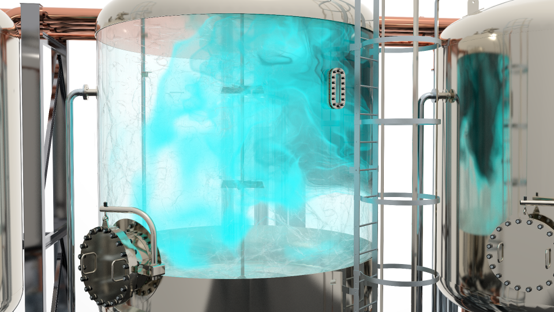
Multiphase CFD makes these effects visible inside real tank geometries and impeller configurations—before physical trials or capital changes are made.
Practically, it helps answer questions such as:
- Will solids disperse fully within acceptable blend times?
- How sensitive is homogeneity to viscosity or temperature drift?
- Are shear levels compatible with additive stability?
- What is the real trade‑off between energy input, blend time, and quality?
When properly validated against plant measurements – torque, temperature profiles, sampling results, or residence‑time behaviour – CFDs value lies in reducing scale‑up surprises, de‑risking equipment changes, and avoiding costly off‑spec batches, rather than chasing theoretical optimization.
Stage 3: Decision support in production via reduced‑order models
High‑fidelity CFD models are not designed for daily operational use. Reduced‑order models (ROMs), derived from validated simulations and calibrated with plant data, provide a practical bridge between engineering insight and production decision‑making.
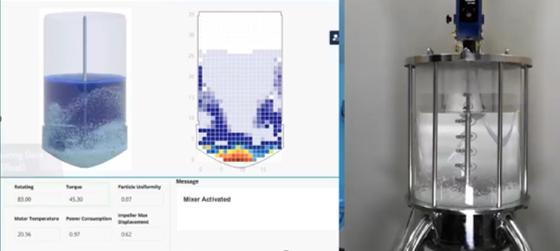
In practice, these models are most effective when deployed as decision‑support tools. For example:
- Advising on parameter adjustments when raw‑material properties vary
- Anticipating blend completion behaviour under changing conditions
- Enabling rapid what‑if analysis before executing changes
- Highlighting emerging risks that warrant human intervention
Successful implementations keep operators, engineers, and product stewards firmly in the loop. Trust is built incrementally – starting with monitoring and advisory modes – long before any form of closed‑loop optimization is considered.
The integrated value: Connecting knowledge, not replacing expertise
When applied consistently, a connected simulation approach links insights across the lifecycle:
- Molecular‑level understanding informs realistic fluid‑property assumptions
- CFD translates formulations into manufacturable processes
- Reduced‑order models carry validated physics into day‑to‑day operations
The primary benefit is not technical novelty, but organizational learning. Models improve over time, assumptions become explicit, and experience that once lived only in people’s heads becomes reusable and transferable.
Just as importantly, the business case is grounded in risk reduction: avoiding off‑spec batches, minimizing re‑blending, protecting additive integrity, and increasing confidence when formulations, raw materials, or equipment change.
What’s the pragmatic adoption path?
Most organizations progress through this capability in stages:
- Phase 1: Apply multiphase CFD to a known blending constraint or quality issue and validate against plant measurements
- Phase 2: Introduce reduced‑order models for monitoring and advisory decision support on a single production line
- Phase 3: Scale across products and campaigns, embedding insights into standards and procedures
- Phase 4: Use molecular modelling selectively for strategic formulation challenges
Closing perspective
The energy transition is accelerating change in lubricant chemistry and manufacturing complexity. Organizations that succeed will be those that combine deep chemical expertise, disciplined experimentation, and thoughtfully integrated digital tools.
Simulation does not replace formulation judgment or plant experience – but when applied carefully, it can make both more effective.
What’s your experience with integrated simulation strategies? I’d love to hear how other CAE leaders are approaching the formulation-to-manufacturing challenge, particularly around multiphase mixing and scale-up.
Learn more about this approach
Learn more about this integrated simulation strategy, which leverages Siemens’ comprehensive portfolio spanning Simcenter (for molecular dynamics, multiphase CFD, and thermo-chemical modeling), Amesim (for system-level modeling), and Industrial AI solutions—creating a seamless digital thread from lab to plant floor.