Managing electronics design complexity: The simulation-driven approach
Table of Contents
The electronics industry is under unprecedented pressure. Consumer expectations for faster, smaller, and more complex devices keep rising, competition intensifies, and skilled engineering talent becomes harder to find. According to industry analysis, 41% of electronics manufacturers say customer satisfaction is their main market concern, yet many struggle to meet these demands without sacrificing product quality or time-to-market.
The question for anyone responsible for product investment isn’t just “can our engineers handle this?” It’s “what does it cost us if they can’t?”
According to Aberdeen research, the answer is significant. Organizations that have adopted integrated simulation-driven and test solutions report:
- 75% decrease in product development time through early validation and reduced iteration cycles
- 90% success rate in meeting product quality targets by catching issues before manufacturing
- 85% of products are hitting cost targets by optimizing designs virtually rather than through expensive physical prototyping
While these improvements are driven by engineering practices, their impact is felt directly in cost, schedule, and product performance. They show the difference between organizations that lead their markets and those that are constantly trying to catch up. The rest of this blog explains how they achieve that.
Top 4 challenges electronics manufacturers face:
Today’s electronics manufacturers face four critical industry pressures that are reshaping how products are designed and developed.
- Consumer expectations and competition: These drive the need for constant innovation. Consumers expect devices that are more powerful, more efficient and more reliable than ever before.
- Competitive pressure: Manufacturers face intense pressure to differentiate their products and reduce time-to-market. The electronics design automation market is projected to reach $21.5 billion by 2032, growing at 7% annually, reflecting the industry’s urgent need for advanced design solutions.
- Talent scarcity: The semiconductor and electronics industry needs an estimated 1 million additional skilled workers by 2030, yet finding and retaining engineering talent remains difficult. Your existing teams must work smarter, not just harder, to deliver complex designs within compressed timelines.
- Sustainability: Mandates are no longer optional. Energy consumption in data centers and connected devices is projected to increase by 37% by 2030. Electronics manufacturers must design for lower power consumption from the earliest stages of development, evaluating sustainable alternatives without extending timelines or inflating costs.
These pressures create a perfect storm: more complex products, faster, with fewer resources. Traditional design approaches that rely heavily on physical prototyping and late-stage testing simply cannot keep pace.
The multi-physics reality: Where the risk is highest
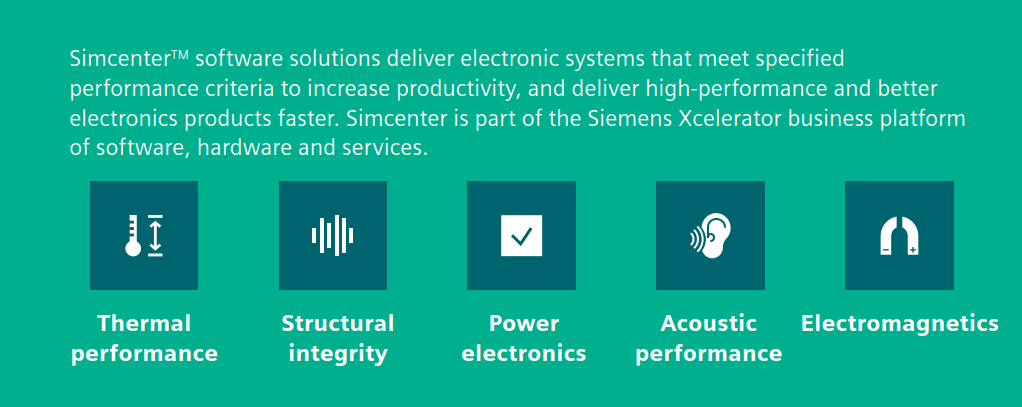
Modern electronic systems don’t fail for a single reason. They fail when multiple performance domains interact in unexpected ways. Thermal issues cascade into structural problems. Electromagnetic interference affects acoustic performance. Power electronics reliability depends on thermal management. This is the multi-physics reality of contemporary electronics design and it’s where budget overruns and schedule slippage are born.
Thermal performance: The foundation of everything
As electronic components shrink and performance increases, the heat generated within these systems intensifies dramatically. Overheating reduces performance, shortens device lifespan and creates reliability issues that cascade throughout the entire system.
Simcenter helped us to find what we believe is the lowest cost cooling solution for the product.
Ferdinand Sluijs – Technology Manager, NXP
Rather than discovering thermal problems during physical testing, when changes are costly and time-consuming, simulation allows teams to prevent overheating, improve energy efficiency and ensure stable operating conditions from the concept phase forward. When thermal constraints are understood early, higher-performance designs become possible without the expensive late-stage rework that erodes margins.
Structural integrity: Building devices that last
Electronic devices must withstand real-world usage: accidental drops, vibrations, temperature cycling and mechanical stress. A cracked smartphone screen represents not just a cosmetic failure but potential internal damage that compromises functionality and triggers warranty costs, returns and reputational damage.
Simulation enables teams to perform comprehensive structural analysis and examine thermal and stress responses early in the design process. Critically, by acquiring physical test data for validation, teams gain confidence that their virtual models reflect real-world behavior, not just theoretical predictions. As Bill Matz, CEO of Electronic Cooling Solutions Inc., puts it:
Simcenter tools are extremely valuable because they shorten the design process significantly.”
Bill Maltz, CEO, Electronic Cooling Solutions Inc.
Power electronics reliability: Ensuring long-term performance
Reliability failures in power electronics converters, regulators and power management circuits can be catastrophic, leading to product recalls and damaged reputation. Simulation-driven validation ensures that designs deliver the highest possible long-term reliability by testing power modules under realistic operating conditions before a single physical prototype is built.
Acoustic and electromagnetic performance: The interconnected challenge
Consumer expectations for audio quality are rising. Research shows that 73% of consumers prioritize sound quality improvements with each device purchase. Simultaneously, electromagnetic compatibility has become critical, particularly in sensitive applications like medical devices and communication systems where interference can compromise safety and performance.
These challenges are deeply interconnected. Acoustic performance depends on structural design, which affects thermal management, which influences electromagnetic behavior. An integrated simulation and test approach gives teams a holistic view of product behavior, reducing the need for physical prototypes and enabling informed design decisions that balance all competing requirements.
The value of simulation and test: From simulation to certainty
A modern simulation strategy depends on how effectively it connects with real-world test data. Simulation on its own delivers predictions. When those predictions are validated with physical test data, teams can rely on them to make real design and investment decisions.
Siemens Simcenter is built on this principle. It brings together advanced multi-physics simulation with real-world test and measurement capabilities, so that virtual models are continuously validated against physical reality. Teams can use test data to calibrate simulation accuracy, identify edge cases that models alone might miss, and build a verified performance record that supports confident investment decisions.
This distinction is important in practice, because it determines whether simulation results can be trusted and reused across engineering programs. Download our comprehensive eBook to learn more.
The four key principles of simulation-driven design that deliver results
- Model the complexity: Validate electronic design performance early to balance competing requirements and evaluate sustainable design alternatives at lower cost. Early simulation delivers insights that inform better decisions throughout the development cycle.
- Explore the possibilities: Use simulation and model-based product definition to quickly generate and assess design variants. Underpin simulation fidelity with real-world test data to ensure accuracy and confidence in results.
- Go faster: Develop better designs faster using reduced order modeling technology, workflow automation and AI-driven usability enhancements. In many cases, simulation-driven design allows teams to improve both speed and quality, rather than trading one for the other.
- Stay integrated: Integrate simulation models and product data to link processes and enable close collaboration between engineering teams. When thermal engineers, structural analysts, electromagnetic specialists and acoustic engineers work within a single platform, innovation accelerates and design conflicts are resolved faster.
The digital twin: Your long-term platform advantage
For budget holders looking beyond the current product cycle, the most strategically important capability in this approach is the digital twin.
A digital twin combines simulation models with test and field data, allowing teams to refine and optimize a product throughout its lifecycle. It isn’t a one-time analysis tool. Rather than being used once, a digital twin becomes a reusable asset that supports future programs and ongoing decision-making.
With a digital twin, your organization can:
- Reduce dependency on physical prototypes across successive product generations, compounding cost savings over time
- Accelerate future development cycles by reusing validated models rather than starting from scratch
- Make confident platform decisions based on verified performance data, not engineering estimates
- Predict and prevent field failures before they become warranty claims or recalls
- Respond faster to regulatory and sustainability requirements by understanding design trade-offs virtually
By investing in digital twin capability, organizations can reuse validated models and data across products, increasing the long-term return on their engineering investment. For a budget holder evaluating where to direct engineering investment, the case for acting now rather than later is clear.
Conclusion: Solving design complexity with simulation
The complexity of modern electronics design demands a new approach. Physical prototyping alone cannot deliver the speed, quality and innovation that markets require. The Aberdeen data makes the business case plain: 75% faster development, 90% quality success rates, 85% hitting cost targets. These are the results of organizations that have connected simulation with testing, integrated their engineering workflows and built digital twin capabilities as a long-term platform.
For many organizations, the focus has shifted from whether to adopt simulation-driven design to how quickly it can be implemented effectively.
Learn more about Simcenter:
Download our comprehensive eBook, “Simulation-driven electronic systems design,” to learn how leading manufacturers are addressing today’s toughest design challenges and achieving measurable results with simulation-driven design. You’ll discover transformative insights into optimizing thermal performance, assessing structural integrity, validating power electronics reliability, ensuring electromagnetic compatibility, and implementing integrated simulation workflows with Simcenter.
Ready to discover fast, accurate electronics thermal analysis? Request a demo.
FAQs: What others are asking about simulation-driven design.
What is simulation-driven design?
- Simulation-driven design uses advanced multiphysics simulation to validate product performance early in the development cycle, enabling engineers to discover and address issues before physical prototyping and manufacturing.
How does simulation reduce development time?
- By validating designs virtually, engineers can iterate faster, reduce the number of physical prototypes needed and catch issues early when changes are less expensive and time-consuming.
What is a digital twin?
- A digital twin is a virtual representation of a physical product that integrates simulation models, test data and real-world performance information. It enables continuous optimization and predictive insights throughout the product lifecycle.
Can simulation replace physical testing?
- Simulation complements physical testing by reducing the number of prototypes needed and focusing physical testing on validating simulation results and exploring edge cases that simulation has identified.
How do I get started with simulation-driven design?
- Start by identifying your most critical performance challenges (thermal, structural, acoustic, or electromagnetic), then implement simulation tools that address those specific needs while integrating with your existing design workflows.