Blog series: Smart factory insights: Opcenter IPL in Action, Part 3

Part 3: Mastering intralogistics challenges in electronics manufacturing
Table of Contents
In our previous posts, we explored how Opcenter IPL revolutionizes manufacturing operations and the power of reduced side inventory. Now, let’s tackle the heart of electronics manufacturing success: overcoming intralogistics challenges that can make or break your production precision.
The daily reality of electronics manufacturing
Every electronics manufacturer knows the scenario: Materials arrive at your facility and from that moment a complex choreography begins. Tracking these materials through their journey, monitoring their consumption, reporting changes and maintaining accurate inventory levels is a delicate balance. When any part of this chain falters, the impact ripples through your entire operation.
Real-world impact
Consider TSMC, the world’s largest semiconductor manufacturer supplying chips to major US technology companies. As they expand operations across multiple global locations including Japan and Arizona, their intralogistics challenges amplify. TSMC Chairman Dr. Mark Liu emphasizes this complexity:
“Every region we go to, we’re not just replicating a fab – we need to build a semiconductor ecosystem […] The manufacturing process today is very complex. We work with materials suppliers, substrate suppliers, and many types of equipment suppliers” 1
This illustrates why mastering intralogistics isn’t just about internal efficiency – it’s about maintaining competitiveness in a globally connected supply chain.
Five key areas demanding attention
Today’s electronics manufacturers must excel in:
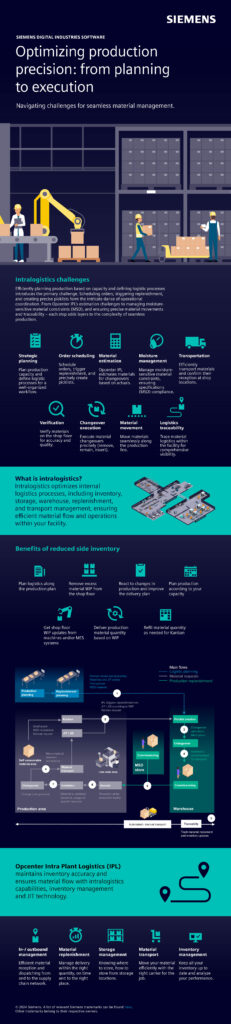
- Material registration and seamless facility integration – Orchestration of efficient material flows begins as materials arrive to the facility where each reel and package of material is identified and traceability collected. Integration with the supply chain through collaboration and automation of material reception processes is key for efficiently establishing control of the inventory at the point of origin in the facility.
- Real-time tracking of material movements across all stations – Manufacturing and logistics processes can be complex requiring multiple levels of warehousing and storage, buffers, production lines, cells, transport resources, and so on. Smart, connected material flows require up-to-date information of material movement with detailed position information, driving a need for a constant flow of information collected efficiently from operators and automatically from automation.
- Precise consumption monitoring in logistics and production areas – precise information about how materials are used is required to accurately predict and automate replenishment and logistics flows. The rate of consumption, usage, and spoilage at each resource is needed.
- Accurate reporting of material changes and inventory availability – the status of each material package including expiration, floor life, and moisture sensitivity is needed to plan and execute precise production processes
- Continuous monitoring of inventory levels with actionable insights – avoid inventory bottlenecks and increase the inventory turn rate leveraging detailed inventory execution information
The Opcenter IPL advantage
Opcenter IPL tackles these challenges through an integrated approach that transforms complexity into clarity. By implementing real-time monitoring systems and advanced tracking solutions, manufacturers can maintain constant visibility of their materials’ journey. This visibility isn’t just about knowing where things are – it’s about understanding how materials flow through your facility and identifying opportunities for optimization.
Beyond problem-solving: Creating competitive edge
What sets leading manufacturers apart isn’t just solving these challenges – it’s turning them into competitive advantages. Through proper implementation of Opcenter IPL’s capabilities, what once were hurdles become steppingstones to enhanced efficiency and precision.
Now that we’ve explored how to master intralogistics challenges, our next installment will show you how to take these solutions further. We’ll examine how creating seamless workflows can enhance your production efficiency, turning these optimized material flows into measurable performance gains. From reducing bottlenecks to streamlining operations, you’ll discover how to build on your improved intralogistics foundation to achieve new levels of manufacturing excellence.