From reactive to predictive – Two semiconductor CEOs walk into a coffee bar: Part 1.
Revolutionizing semiconductor manufacturing with smart capabilities, advanced analytics, proactive processes and AI for secure, sustainable production.
An uncommon conversation over coffee…
CEO 1: Thanks for joining me – I’ve been wanting to ask what kind of challenges you’ve been having in the fab lately?
CEO 2: Hah…you might as well ask me what kind of problems haven’t we been having? (laughing) But seriously, the main issue is we’re not able to solve issues fast enough. Seems like we’re always reacting to problems instead of being proactive.
CEO 1: Interesting you would say that.
CEO 2: Why’s that?
CEO 1: (Taking a sip) You know, I’ve been thinking, what makes a smart semiconductor foundry smart?
CEO 2: As in smart manufacturing?
CEO 1: Yes. But a fab is not smart just because we have some smart people on the floor…
CEO 2: No…
CEO 1: But maybe we do become smarter by adding intelligent machines that can collect and share data.
CEO 2: Correct, but we’ve always had those (takes a sip) …and they’re important, but that doesn’t make the fab smart, does it?
CEO 1: No, it doesn’t.
CEO 2: So, what makes it smart?
CEO 1: My team thinks the first step is for the fab to be smart enough to not just react to problems after they occur, but to proactively address the root cause of problems before they escalate.
CEO 2: True, that’s smarter than just reacting…
CEO 1: But to take the next step you need data. To go from being proactive to being predictive, you need data analytics to forecast potential failures…
CEO 2: Yes, I agree, it all starts with reliable, current MES and sensor data.
CEO 1: True, and what is the data forecasting?
CEO 2: And how does the fab know what the data is forecasting?
CEO 1: It’s more than just having a few intelligent machines. When you take a step back and look at all the pieces, isn’t it about what makes the whole fab smart?
CEO 2: The whole fab – that’s a big thought.
CEO 1: It is. If you think of a fab as if it were a human brain – with a collection of neurons and a lot of information – what empowers the fab to think ahead and predict a problem before it occurs?
CEO 2: It must be able to collect data to see what the fab’s current status is and then compare it to a model of what it knows the status should be, so it can recognize that something is wrong that could cause a problem ahead.
CEO 1: Good point, so let’s agree to start with a basic requirement for great data that allows us to model our process accurately…
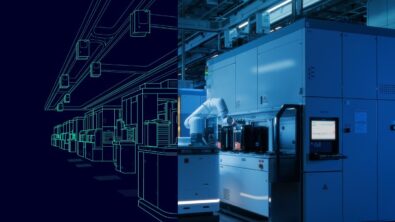
CEO 2: (Takes another sip) Sounds like what you get with a comprehensive digital twin – a physics-based digital model that gathers data to simulate exactly how your process operates.

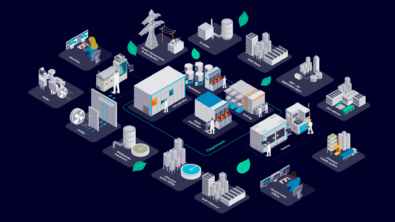
CEO 1: Exactly. A foundry digital twin contains all the big data coming from all the connected fabrication equipment, controls, sensors and actuators across each workstation – collected from MES, IoT, enterprise systems, facilities and utilities, even the supply chain.
CEO 2: As I understand it, the digital twin really is a virtual model of your semiconductor manufacturing processes and systems, including your plant, your batch production, your individual cells, even human/robotic interaction, representing every step…
CEO 1: Ideally, yes, with a digital twin you can accurately model your whole process. The key is continually updating it with MES data from the floor.
CEO 2: With fresh data, the twin could help you identify production issues that aren’t up to the standard of your model?
CEO 1: And by comparing runs, you can see where the process is trending to spot performance that may be degrading over time – back to what I was saying about the fab being able to think ahead and predict a problem before it occurs.
CEO 2: That’s getting smarter.
CEO 1: Yes, it is (takes a sip) …but it’s not real thinking yet. To really be smart the fab needs to evolve beyond just predicting failures to using the data to prescribe preventive actions.
CEO 2: Now that’s interesting.
CEO 1: Yes, it really is. But that’s a topic for another day. I’ve got a meeting back at the fab.
CEO 2: Hey, we’re just getting to the good part – you’re going to keep me in suspense?
CEO 1: Can’t help it, I have a fire to put out!
CEO 2: Still reacting, huh?
CEO 1: Of course, but we’re reacting smarter. Coffee same time next week?
CEO 2: Sure. See you then.
For more insights about smart manufacturing for semiconductors, visit www.siemens.com/us/en/industries/semiconductors/smart-manufacturing.html