Siemens brings electrical and mechanical design together with Capital 3D electrical design
Siemens unveils new 3D electrical design workflow for electromechanical innovation/E systems that differentiate the world’s most sophisticated products
As electrical systems grow more complex, the gap between electrical and mechanical design is harder to ignore. For engineering teams, that gap often leads to late-stage rework and costly production delays. What’s needed is a way to bring both disciplines together earlier in the process, before design decisions are locked in.
Siemens has taken a major step toward closing that gap in its CapitalTM software. The new 3D Electrical Systems feature brings wiring design and physical harness routing into a single, shared environment to streamline the design workflow.
By connecting ECAD and MCAD in a much more meaningful way, 3D Electrical Design enables teams to validate designs early and collaborate more effectively, paving a faster path to production.
The challenge: disconnected workflows in an increasingly complex world
In complex industries such as automotive and aerospace, products electrification, connectivity, and advanced software systems are driving a surge in wiring density and system interdependencies. This complexity isn’t just a design challenge – it’s a process challenge.
Traditional workflows separate electrical design (ECAD) and mechanical design (MCAD), forcing teams to work in silos and reconcile differences later in the process. But this approach creates friction at nearly every stage. Electrical designs are often developed without full awareness of physical constraints, while mechanical teams lack visibility into wiring intent.
In addition, teams must pass data back and forth between tools and often manually. By the time issues such as routing conflicts, space limitations, or mismatched components surface, they are far more difficult and expensive to fix.
To understand why these challenges persist, it helps to look at how the traditional workflow actually plays out in practice.
The old way: parallel workflows
Enhance and expand generative electrical design with AI-driven solutions
For years, ECAD and MCAD collaboration has been constrained by tool boundaries. Even when data could be exchanged, the lack of a shared working environment made true collaboration difficult. Electrical engineers worked in Siemens Capital software, while mechanical engineers used Siemens Designcenter NX software.

Although designers were able to exchange data between the two systems, the experience was fragmented. For example, you often needed to keep multiple windows open to view the same design from different perspectives. Even then, context was lacking or incomplete. Aligning electrical and mechanical intent required constant cross-checking and manual validation.
The new approach: a unified 3D electrical design workflow
By integrating Siemens Capital with Designcenter NX and Teamcenter, Siemens has created a unified, model-based workflow that spans domains. With 3D Electrical Design, engineers can now open their MCAD environment and immediately see electrical system data in full 3D context, without having to switch tools.
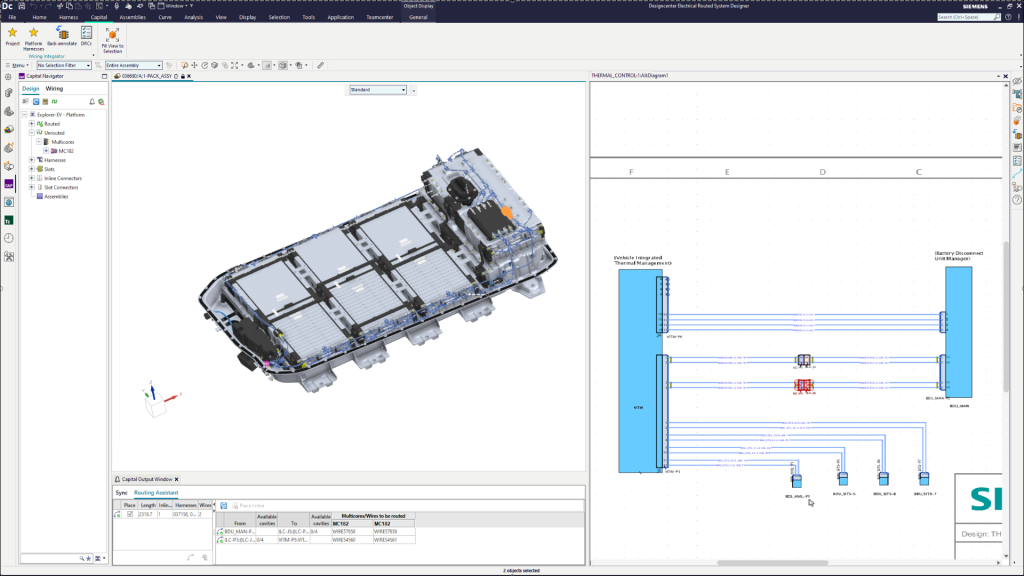
This new workflow fundamentally changes how teams collaborate and how decisions are made throughout the design process. Instead of waiting for downstream checks, engineers can evaluate electrical designs in the context of physical geometry from the start. This makes it much easier to spot routing conflicts, space constraints, or integration issues while they are still relatively simple to resolve.
The impact is significant: fewer late-stage changes, less rework, and a more predictable development cycle.
Let’s take a closer look at the benefits:
- Collaboration without disconnect: With this new workflow, electrical and mechanical engineers can work concurrently in the same 3D context. Each team has visibility into the other’s work, which reduces misunderstandings and accelerates iteration. Instead of handing designs off and waiting for feedback, teams can align in real time.
- A stronger digital thread: With Teamcenter managing product data and changes, information is consistent across the entire development process. This continuity reduces the risk of version mismatches and ensures that all stakeholders are working from the same, up-to-date data. It also strengthens traceability, making it easier to understand how decisions evolve over time and how changes impact the overall system.
- Productivity gains without disruption: Mechanical engineers can continue working in NX, now with full visibility into electrical systems. There’s no need to switch applications or learn entirely new workflows just to understand how wiring fits into the design.
- Built for increasing complexity: As engineers adjust to centralized architectures, greater software integration and more complex electrical systems, they need a more integrated approach to design. By combining 3D visualization, cross-domain collaboration and model-based workflows, Siemens is addressing that need.
- Better visibility and informed decisions: When electrical systems are fully visible within their physical context, engineers can evaluate trade-offs more effectively and ensure designs are both functional and manufacturable. This level of insight leads to greater confidence throughout the development process and reduces the likelihood of costly surprises later on.
Taken together, these capabilities shift teams from reactive problem-solving to a more proactive, integrated approach to design.
Capital 3D electrical design
Empower users with Capital advanced electrical design capabilities directly in a unified 3D
For manufacturers developing electrically complex products, the benefits of 3D Electrical Design in Capital are tangible. Development cycles can move faster because they can identify issues earlier and keep the cost of rework and late-stage rework to a minimum. Collaboration improves because teams are no longer separated by tools or data silos – and engineering teams can focus on innovation rather than coordination.
Contact us to explore how Siemens Capital connects electrical and mechanical design in a unified 3D environment, and how you can reduce risk while accelerating innovation.
Ready to streamline electrical systems development?
Discover how Capital enables integrated electrical design, manufacturing and service.
Table of Contents