How shift-left memory contention analysis protects performance and schedule

By Chun-Hsiang Chang – Senior Product Engineer, Calibre Design Solutions, Siemens EDA
Memory is the bedrock of reliability and performance for today’s SoCs, AI accelerators, and high-performance computing platforms. Yet, as complexity grows and integration tightens, memory contention has emerged as a persistent threat to system throughput and safety.
Left unchecked, memory contention is more than a technical nuisance—it becomes a strategic risk. It can sap project momentum, delay market entry, threaten compliance and turn high-value silicon into a cautionary tale of missed opportunity. Adopting a “shift-left” approach—one where schematic-level memory contention checks move risk detection ahead of layout—has emerged as a best-in-class strategy. Let’s explore why.
Memory architectures: An evolving landscape of opportunity—and risk
Ask any engineer responsible for today’s advanced SoCs or compute engines: memory isn’t just DRAM or SRAM anymore. Modern designs incorporate custom DRAM, high-bandwidth memory (HBM), embedded nonvolatile flash, specialized VRAM for graphics and bespoke memory blocks for AI acceleration. These architectures bring capability, but with that comes increased surface area for integration risk. Figure 1 illustrates data flow and signal sharing among CPU, GPU, SRAM, HBM, VRAM and LPDDR5 on a modern SoC.

Each architecture introduces new needs, from DRAM refresh cycles and SRAM latches and gating, to multi-rail power domains and increasingly sophisticated control protocols. As integration deepens—bringing together multiple memory types with distinct voltages, dense periphery logic and aggressive timing closure—the opportunity for domains or logic to inadvertently compete for control of a node quietly grows.
In this context, contention means more than just “two drivers fighting.” It can manifest wherever control logic, address decoders or power switches allow multiple activation paths to a single net, node or resource. In HBM, for example, an insufficiently isolated address path might activate multiple banks. In SRAM, an enable signal crossed with power gating logic can drive simultaneous access. In VRAM, multi-controller architectures and advanced cache compression add new resource sharing and latency challenges. Because of these architectural differences and the way peripheral control logic interacts, unintentional contention becomes a very real risk—a risk that often remains invisible until late in the design cycle.
Why shift-left? A strategic methodology for modern projects
Many teams still rely on top schematic simulation or chip-level testing to detect memory contention. The problem with this approach is simple: by the time errors are found, design constraints have crystallized, flexibility has vanished and the costs of corrective action multiply. Revisions can mean late-stage rework or even a full hardware re-spin, potentially costing thousands of dollars and adding weeks or even months to your schedule.
Taking a shift-left approach to memory contention means addressing these hazards at schematic, before layout and physical verification. At this early stage, changes are fast, easy and relatively risk-free. Issues can be corrected while design intent is still malleable, allowing teams to minimize the impact on project schedules and avoid time-consuming downstream ripple effects.
Shifting left isn’t just a tactical move—it’s a deeper business advantage. Consider the downstream costs:
- Fixing schematic issues takes minutes; re-spinning hardware can cost thousands, plus schedule weeks or months.
- Performance regressions due to late-fix memory contention can’t always be fully resolved, risking competitive differentiation.
- Certification or functional safety compliance—essential for automotive and aerospace—can fall through if unpredictable contention hits chip failure.
Early, automated detection of memory contention is the definition of proactive risk management.
Schematic-level analysis: From invisible risks to actionable insights
With today’s advanced tools, schematic-level analysis brings formerly invisible risks into clear view. Siemens Insight Analyzer allows engineers to run detailed, state- and connectivity-aware contention analysis directly at the transistor-level schematic within established design environments like Cadence Virtuoso.
What does this allow your team to do? Rather than waiting for simulation vectors or chip-level verifications, engineers can analyze the full logic, power domain, and memory connectivity graph to:
- Identify simultaneous driver conflicts across memory banks, bus connections and peripherals
- Detect subtle rail contention caused by multi-domain power gating—an especially common scenario as designs grow in complexity and demand aggressive timing closure and power optimization.
- Uncover challenging edge-case logic races that testbenches may never toggle
- Efficiently target newly introduced logic or integrations—using “black box” techniques to skip repeated, already-validated SRAM or DRAM structures
As the industry continues to develop memory-rich designs across AI, data center and automotive applications, having the ability to home in on both core arrays and the custom periphery logic becomes crucial for maintaining throughput and minimizing schedule risk.
Real-world examples: Where schematic contention analysis makes the difference
It’s illuminating to see how contention emerges—and how schematic analysis can eliminate it—before silicon is committed.
In a typical SoC, multiple CPU and GPU modules interact with different memory types—each with their own row/column decoders and interconnects. At each interface, especially where controller logic or power switches interact, an accidental overlap of enable signals can cause two outputs to drive the same bus, or two power rails to connect to the same net. These risks often hide until late simulation or—even worse—hardware bring-up.
Now, look at a classic automated analysis scenario:
Figure 2 shows a simultaneous activation of two power switches from different supply rails onto the same net. This type of rail contention—where PFET pullup paths are both enabled inadvertently—may be practically impossible to spot in simulation, but could cause irreparable hardware damage if left undetected. Schematic-level checking pinpoints these scenarios with both specificity and clarity, highlighting the paths and enabling rapid root-cause resolution.
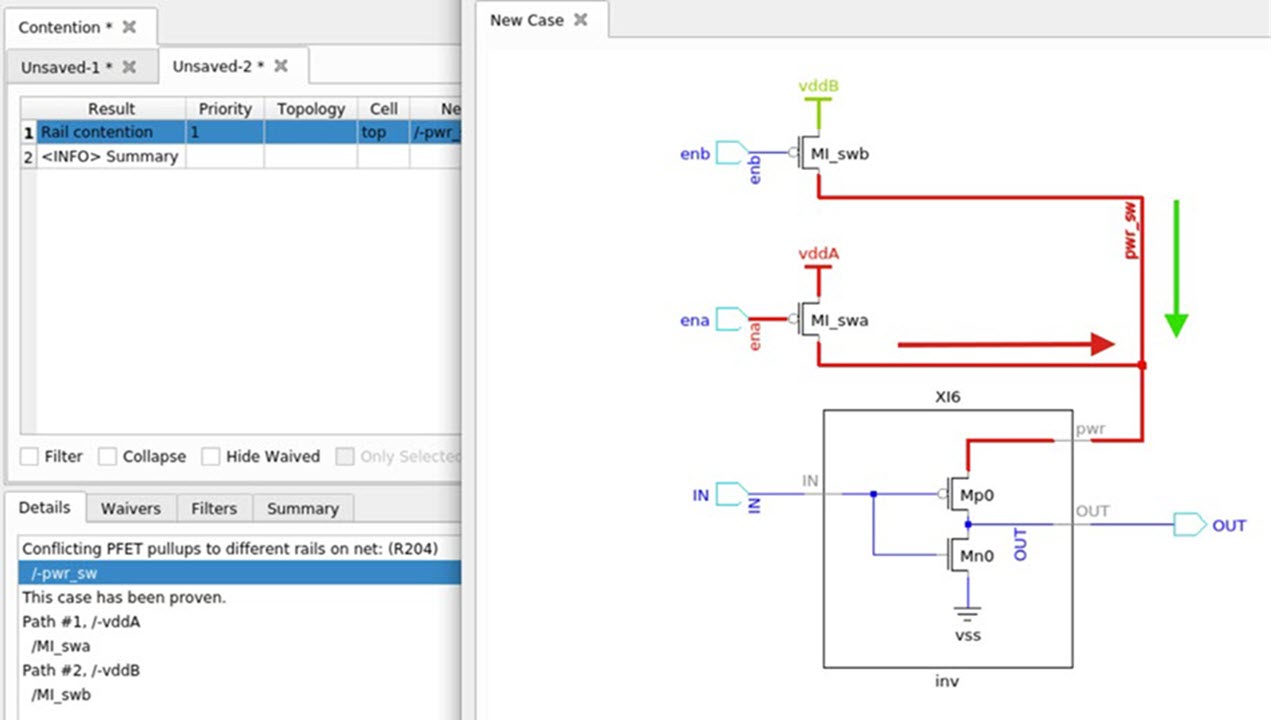
Insight Analyzer in action quickly surfaces scenarios like simultaneous activation of two power switches from different rails onto the same output. This sort of subtle hardware bug can be virtually impossible to spot in simulation, and correcting it post-silicon could mean costly redesigns. Schematic-level analysis identifies it early, highlights the specific paths, and enables rapid isolation and fix.
Logical contention is no less insidious. When multiple asynchronous clock domains drive a shared signal, unpredictable and potentially hazardous indeterminate “X” logic levels can be introduced. Through careful schematic-level analysis, the tool traces these interactions across clock crossings and state-machine boundaries, providing detection and prevention long before physical design is locked in.
Focus your risk reduction where it matters
A strategic advantage of modern schematic analysis is its ability to let teams “black box” repetitive memory structures to focus on where risk is greatest. In many systems, DRAM and SRAM macros are reused hundreds of times. Insight Analyzer lets designers exclude these previously verified segments during analysis, focusing effort on new or evolving interfaces, cache management blocks and integration bridges.
This targeted approach yields two key benefits:
- Accelerated validation – Engineers get actionable results in minutes, not hours or days, even for large netlists.
- Reduced signal noise – Teams home in on non-obvious, integration-induced risks rather than redundantly checking known-good circuitry.
The outcome is a streamlined workflow: schematic-level design intent checks signal issues early, while engineers still have architectural flexibility.
A strategic investment in schedule, reliability and innovation
For engineering teams and project leaders, the choice to implement schematic-level, shift-left memory contention analysis is an investment in predictability, reliability and engineering efficiency. Teams adopting this approach find that project predictability improves: by identifying and bounding delays and corner-case risks ahead of implementation, they are can set realistic performance and safety budgets well before the physical design process complicates matters.
Resource efficiency also rises, because engineers spend less time battling late-stage surprises and more time focusing on innovation where it delivers the highest ROI—whether that’s advanced memory caching strategies, improved arbitration logic, or sophisticated integration features.
Equally, development schedules compress, as early risk detection helps organizations glide smoothly through integration and validation phases, escaping the “trap” of late-breaking, high-cost bug fixes that so often stall projects in their final mile.
In the final analysis, shift-left schematic analysis with Siemens Insight Analyzer transforms memory design from a reactive process—one plagued by troubleshooting and unexpected fire drills—into a proactive discipline rooted in engineering certainty and best practice.
Conclusion: Build a foundation for robust silicon
For engineers teams, schematic-level memory contention checking is more than a technical enhancement. It is now a cornerstone methodology for achieving first-pass silicon success. As memory architectures diversify and integration becomes ever more intricate, risks naturally move upstream. Proactively addressing them with advanced, automated tools such as Siemens Insight Analyzer is the surest route to delivering robust, on-time silicon and preserving hard-won engineering investment.
For further examination on this topic, we have an in-depth white paper available: Shift-left schematic memory contention analysis, that explores the methodology, real-world examples and strategies for implementing schematic checking in your flow.