Autonomous simulation: From design intent to validated results in less than 60 seconds

When the simulation setup disappears from the designer’s workflow
Imagine finishing a design in your CAD tool and receiving a validated simulation report minutes later. No mesh generation. No boundary condition assignment. No solver configuration. Just a question and an answer via a fully autonomous simulation.
Simulation has evolved steadily over decades. From command-line solvers to graphical pre-processors. From manual meshing to automated mesh generation. From scripted setups to template-driven workflows. Each step simplified the workflow, but always with the engineer in charge of setup decisions. Material selection, face identification, boundary condition types, discretization parameters: all requiring expert knowledge and experience.
This prototype removes that last bottleneck entirely.
The pre-processing barrier
Despite decades of advancement, simulation is still gated by expertise. Setting up a finite element analysis demands decisions most designers aren’t equipped to make: defining loads, constraints and boundary conditions, selecting the right mesh resolution, and choosing appropriate material models. This reliance on specialist knowledge creates a bottleneck – forcing designers to either wait for simulation experts or bypass validation altogether.
Once the a simulation expert takes over, manual mesh generation and model setup dominate end-to-end simulation time. In many organizations, pre-processing alone consumes more hours than the actual solve. For the simulation market to continue growing, it must shift toward both democratization and autonomy. Making simulation accessible is not enough. Simulation must become self-sufficient.
A co-pilot that thinks like a simulation expert
We built a prototype that embeds a simulation co-pilot directly into the Siemens Designcenter NX environment based on the Designcenter Performance Predictor. The designer completes a part, provides the design requirements in natural language, and asks the co-pilot to validate. From there, the agent takes over.
Three capabilities work together to make this possible:
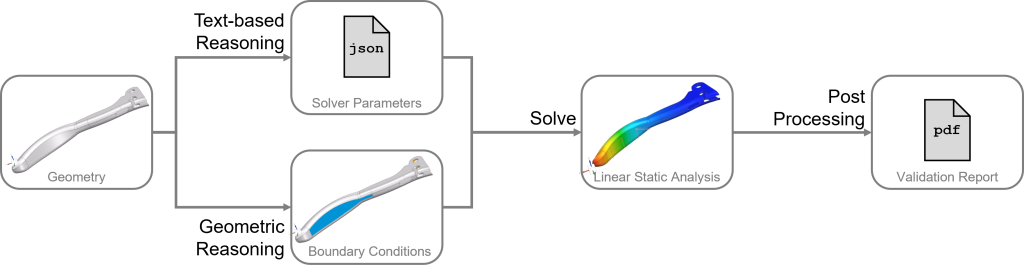
Geometric reasoning. The agent interprets CAD geometry to identify the correct faces for boundary condition placement. Based on high-level requirements such as loads, constraints, and operating conditions; it maps intent to geometry, recognizing mounting interfaces, load paths, and symmetry planes. This semantic understanding of shape is the critical bridge between natural language inputs and a solver-ready model.
Headless solver. A solver that requires no manual configuration and no explicit meshing decisions. It operates as a self-configuring service, similar to how simulation is evolving toward autonomous microservices that configure and supervise themselves without human intervention.
Agentic orchestration. The AI agent reasons through the full workflow as a chain of decisions: select material parameters, identify faces, assign boundary conditions, choose discretization parameters, execute the solve, and generate a report. Unlike a copilot that merely suggests, this agent executes. It is closer to the emerging category of agentic AI that autonomously executes multi-step engineering workflows.
Demonstration: A validated design in less than 60 seconds
To put this prototype to the test, we chose a simple bike lever as an example. The workflow is as follows:
- The designer creates the bracket geometry in Designcenter NX.
- Once satisfied with the design, the designer asks the copilot: “Please create a performance predictor study on this part, simulating 200 pounds in the Y-direction. The bike handle is made out of aluminum and the simulation should have a resolution of 2mm.“
- The agent identifies the mountings and load application faces through geometric reasoning.
- The FEM simulation is configured autonomously, i.e., an appropriate material model is selected, boundary conditions are assigned to the identified faces, and appropriate simulation parameters are defined.
- The Designcenter Performance Predictor delivers simulation results within seconds through GPU acceleration.
The designer never needs to configure the simulation himself. The entire loop, from question to validated answer, happens in less than a minute completely within the CAD environment.
The future is frictionless automation
This prototype points toward a future where simulation becomes invisible infrastructure. Rather than a separate discipline requiring handoffs and specialist knowledge, validation becomes an integrated step in the design process, as natural as checking dimensions.
The implications extend beyond individual designers. When simulation operates as a self-configuring engine, it can serve as a real-time validation layer across entire product development workflows. Design iterations that once required days of expert setup compress into minutes of autonomous operation.
We are witnessing the next step in simulation’s evolution. Not just faster solvers or better interfaces, but the disappearance of the setup itself from the designer’s workflow. Validated designs at the speed of thought allowing the designer to focus on creating iconic designs and less worrying but the complicated details.
References
- M. Bonner, The role of Generative AI in simulation tool automation: From zero to hero, The Art of the Possible, July 2025.
- D. Hartmann, R. Bornoff, How to sustain the ongoing evolution of industrial simulation?, The Art of the Possible, June 2024.
- R. Bornoff, How do you engineer GenAI Solutions? Siemens and the ELFMo Project, The Art of the Possible, July 2025.
Disclaimer
This is a research exploration by the Simcenter Technology Innovation team. Our mission: to explore new technologies, to seek out new applications for simulation, and boldly demonstrate the art of the possible where no one has gone before. Therefore, this blog represents only potential product innovations and does not constitute a commitment for delivery. Questions? Contact us at Simcenter_ti.sisw@siemens.com.