Topics in AI Systems: Part III — GNN+LLM Architecture and Implementation Patterns
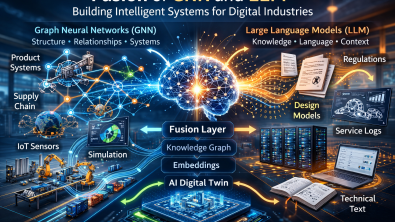
In Part I of this series, we explored why fusing Graph Neural Networks (GNNs) and Large Language Models (LLMs) is essential for solving complex problems in digital industries. In Part II, we reviewed what characteristics of major GNN and LLM models developers should consider when planning fused solutions. In this final article, we move from why and what to how. We introduce practical reference architecture and implementation patterns for building GNN+LLM systems in real industrial environments (see Figure 1). The key message of this article is simple: GNN+LLM fusion is not a single model; it is a system architecture.
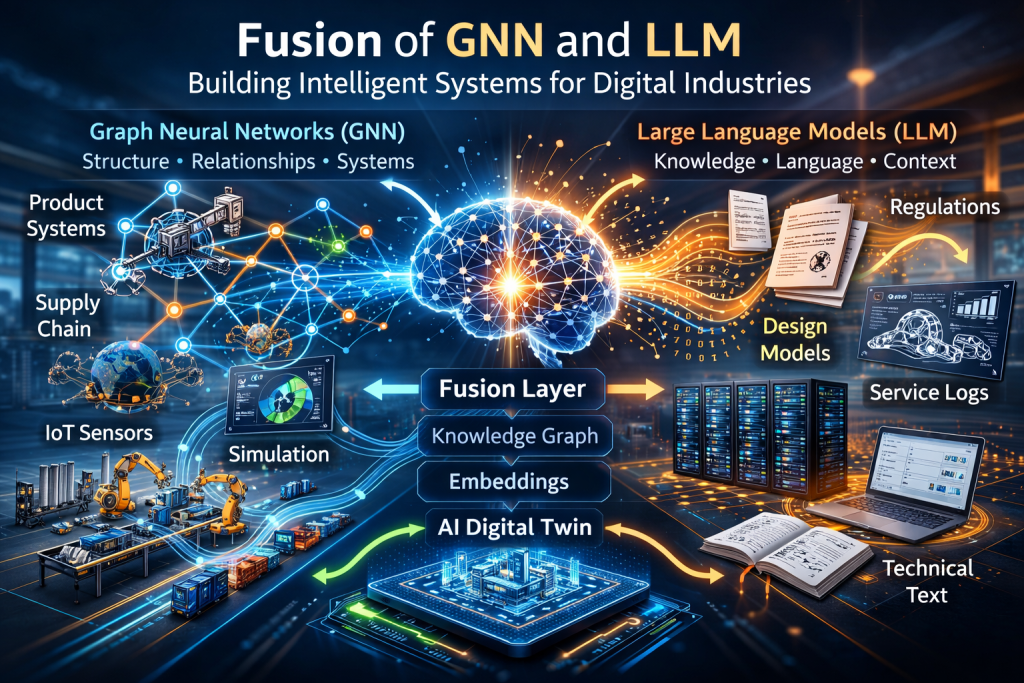
Figure 1: High-level GNN+LLM reference architecture illustrating how fusion helps human workers.
I. From AI Models to AI Systems
In research papers, fusion often appears as a clever model design. In production, fusion becomes a multi-layer platform integrating data pipelines, knowledge graphs, analytics, retrieval, reasoning, orchestration, and user workflows. Industrial AI succeeds or fails based on system architecture, not model selection.
In this article, we introduce a reference architecture that aligns with the digital thread and digital twin vision used across aerospace, automotive, industrial machinery, and electronics. A practical fusion platform (i.e., reference system architecture for Industrial GNN+LLM fusion) typically consists of seven layers:
| Layer | Purpose |
| 1. Data Sources | Engineering, MCAD/ECAD, lifecycle operational data, etc. |
| 2. Knowledge Graph | Unified digital thread representation |
| 3. GNN | Structural reasoning and analytics |
| 4. Retrieval | Grounded knowledge access with the latest data |
| 5. LLM | Reasoning, explanation, and interaction |
| 6. Orchestration, Traceability | Tools, governance, and automation |
| 7. Application | Engineering copilots and workflow automation |
Each layer plays a distinct role in connecting system structure with engineering knowledge to assist the human worker.
Layer 1 — Data Sources: The Digital Thread
Fusion begins with the digital thread (i.e., the connected lifecycle data of a product or production system). Typical industrial data sources include:
- Product structures and BOMs
- Requirements and change requests
- MCAD/ECAD and simulation results
- Product & Manufacturing Information (PMI)
- Manufacturing planning and execution data
- Supplier and supply chain relationships
- Service and maintenance records
- Engineering documentation and standards
When these data sources remain siloed, AI systems struggle to produce trustworthy insights for humans. Fusion requires bringing these sources together into a unified representation.
Layer 2 — Knowledge Graph: The Bridge Between Worlds
The knowledge graph is the central meeting point of GNNs and LLMs. It connects:
- Components
- Requirements
- Simulations
- Suppliers
- Documents
- Manufacturing processes
- Service events
This graph becomes the structural backbone of the digital twin: LLMs understand language, GNNs understand relationships, and the knowledge graph connects both.
Layer 3 — The GNN Layer: Structural Reasoning
In production systems, GNNs do not generate text; they generate relationships and insights about system structure. Typical industrial GNN tasks include:
- Design change impact analysis
- Failure propagation prediction
- Component similarity detection
- Supply chain risk analysis
- Anomaly detection across fleets or factories
- Relationship discovery in product and lifecycle data
These outputs provide structured context that can guide retrieval and reasoning.
Layer 4 — Retrieval: Where Fusion Becomes Real
Retrieval Augmented Generation (RAG) becomes significantly more powerful when guided by graph insights. A typical fusion workflow:
- User asks a question about a subsystem.
- The GNN identifies relevant components and relationships.
- Retrieval systems fetch documents and records linked to those nodes.
- The LLM produces a grounded response based on verified sources and latest information.
This combination dramatically improves relevance, traceability, and trust.
Layer 5 — The LLM Layer: Reasoning and Interaction
The LLM acts as the natural interface between engineers and complex data, and the assumption here is that it has been already fine-tuned for the application in mind. Typical roles:
- Explaining analysis results
- Summarizing engineering knowledge
- Answering technical questions
- Generating reports and workflows
- Assisting with decision making
In fusion systems, the LLM becomes the communication and reasoning layer, not the sole source of intelligence.
Layer 6 — Orchestration, Governance, and Traceability
Enterprise deployment requires more than models. Critical capabilities include:
- API orchestration and workflow automation
- Tool integration with engineering platforms
- Security and trustworthy access control
- Auditability and traceability of outputs
- Human-in-the-loop validation
In regulated industries, traceability and trust are not optional. Fusion architecture must support explainable and verifiable outputs and ensure that final decisions are made by a human.
Layer 7 — Application Layer: Engineering Copilots and Automation
When the lower layers are in place, organizations can build new classes of applications:
- Engineering copilots
- Manufacturing assistants
- Service intelligence tools
- Supply chain risk advisors
- Automated reporting and analysis workflows
- …
These applications turn AI from a research capability into daily productivity tools for workers.
Figure 2 illustrates the high-level architecture and data flow between the seven layers. Note that the knowledge graph is built out of the data sources, and the GNN and retrieval read from that graph to feed data to the LLM. The GNN might have the ability to modify the graph as well. Many iterations of this data flow happen as the application users provide reinforcement learning and information is updated
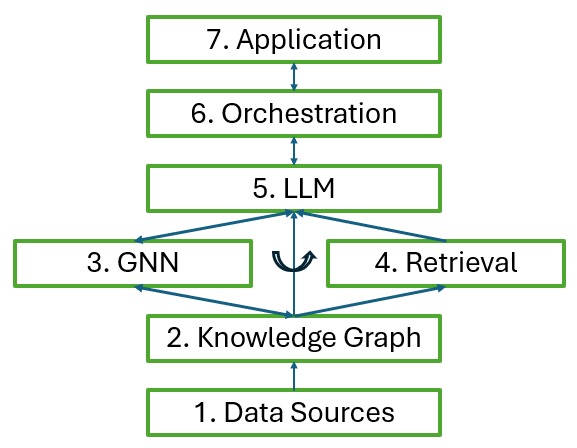
Figure 2: Depiction of seven layers in the reference architecture for fusion of GNN+LLM.
II. Implementation Patterns in Digital Industries
Several recurring patterns will emerge across organizations as a result of GNN+LLM fusion:
Pattern 1 — Engineering Copilot
Goal: Assist engineers with system understanding.
- GNN identifies relevant subsystems;
- Retrieval gathers related documentation; and
- LLM provides grounded explanations and answers.
Benefits:
- Requirement traceability
- Design rationale exploration
- Certification preparation
Pattern 2 — Change Impact Analysis
Goal: Understand consequences of design changes.
- Engineering change proposed;
- GNN predicts affected components and processes; and
- LLM generates impact reports and recommendations.
Benefits:
- Faster change cycles
- Reduced downstream risk
- Improved cross-team communication
Pattern 3 — Manufacturing Optimization Assistant
Goal: Improve production efficiency.
- Production line modeled as a graph;
- Temporal GNN detects bottlenecks or anomalies; and
- LLM explains root causes and suggests actions.
Benefits:
- Reduced downtime
- Faster troubleshooting
- Knowledge-capture from operations data
Pattern 4 — Service Intelligence Assistant
Goal: Improve maintenance and fleet performance.
- Fleet telemetry feeds a dynamic graph;
- Temporal GNN detects patterns and anomalies; and
- LLM supports troubleshooting and root-cause analysis.
Benefits:
- Predictive maintenance
- Faster field service support
- Reduced lifecycle costs
III. Adoption Roadmap
Each organization can evolve these patterns through multiple phases over a period of time:
| Phase | Focus |
| Phase 1 | Build knowledge graph and RAG foundation |
| Phase 2 | Add GNN analytics for structural insights |
| Phase 3 | Introduce engineering copilots via LLM |
| Phase 4 | Automate workflows and decision support |
Starting small and expanding iteratively reduces risk and accelerates value creation.
IV. Common Pitfalls and Lessons Learned
Successful programs often share similar lessons:
- Avoid starting with complex agents before data readiness.
- Invest early in knowledge graph and retrieval foundations.
- Prioritize governance and traceability from the beginning.
- Focus on high-value use cases and trustworthiness before scaling.
We emphasize again that fusion succeeds when it is treated as a system rather than mere selection of AI models.
V. Ethical and Legal Considerations in Safety-Critical Systems
While GNN+LLM fusion reduces hallucination risks through structural grounding as discussed in Part 1, this architectural pattern does not eliminate the need for rigorous safety engineering. The GNN’s verified product graph ensures LLM responses remain tethered to physical system constraints (e.g., a turbine blade cannot be “moved” in ways violating its CAD-defined mating surfaces). However, risks remain in:
- Incomplete Knowledge Graphs: Missing node relationships may lead to plausible but invalid inferences.
- Emergent Behaviors: Novel system behavior could happen outside the training data distributions.
- Cascading Errors: Incorrect GNN embeddings could propagate to LLM reasoning chains.
For safety-critical applications, such as production of aerospace systems, it is recommended that we ensure:
- Human-in-the-Loop Monitoring and Validation: Mandatory engineer approval for critical decisions
- Uncertainty Quantification: Confidence scoring for both GNN topology predictions and LLM outputs
- Redundancy Checks: Cross-verification against first-principles physics models
This fusion architecture shifts AI safety from pure model alignment to system-level verifiability, which is a necessary evolution for industrial AI adoption and creation of effective and trustworthy AI Systems.
VI. Conclusions
Across this three-part series of articles on the fusion of GNNs and LLMs, specific to Digital Industries, we explored:
- Part I: Why combining structural reasoning and language understanding is essential;
- Part II: What major GNN and LLM model families are available to developers; and
- Part III: How practical architecture and proper implementation patterns could lead to successful industrial deployments.
The convergence of GNNs and LLMs enables a new class of AI systems that can understand both the structure of engineered systems and the knowledge surrounding them. Such a fusion brings AI closer to the daily workflows of engineers, planners, and service teams, supporting better decisions by workers across the entire product lifecycle.
As digital threads and digital twins continue to mature, the integration of GNNs and LLMs will play a central role in transforming how complex systems are designed, built, and maintained. Hopefully, this three-part series will play a small role in such a transformation of Digital Industries. Note: This document was prepared with the help of AI, and An important correction to the original draft was made by my colleague Matthew McMinn.


