The power of agentic production systems
Customization. A word that, in the consumer products industry, can be synonymous with both increased market share and exponential complexity increases. Offering a product to a customer customized exactly the way they want it can be a powerful motivator for sales yet, ensuring quality, availability and brand integrity at the same time creates compounding challenges beyond those found in production lines that adhere to the maximum of “any color, as long as it’s black”.
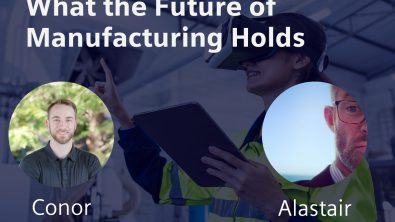
In a recent podcast, host Conor Peick was joined by Alastair Orchard, head of Digital Enterprise Thought Leadership for Siemens Digital Industries, to discuss the benefits and challenges of highly customized production processes and products from the all-important quality to how much human involvement is truly required in an ‘autonomous’ factory.
Check out the full podcast here or keep reading for some of the highlights of that conversation.
Challenges of adaptive production
Building products across a network of smaller factories, each producing the right product to meet local demand, offers companies unrivaled flexibility when it comes to meeting customer expectations. However, in doing so, it also increases the difficulty of ensuring product quality and adherence to brand philosophy. Alastair highlights the importance of the digital world in ensuring quality in distributed manufacturing, with digital design techniques and optimizations in the digital world helping ensure that products can be manufactured to spec regardless of the factory used or what materials are sourced.
These type of adaptive production systems also open the door for greater personalization as well. Since the factories are already designed to produce goods on demand, it’s easy to allow consumers to customize the final product before it is even produced. Of course, excessive customization can create undue strain on supply chains or cause a product to no longer embody a brands philosophy. With that in mind, even when offering a wide range of customization, ensuring they are within a range that makes sense as a manufacturer is also important.
Powerful digitalization tools like the digital twin and AI are also key to ensuring that everything from adaptive machines to adaptive cells and networks make sense. Deploying these systems in a way that provides optimal coverage for consumers, access to proper supply chains and logistics as well as that the products being produced at a given factory actually make sense on the scale of the entire network all require a strong digital backbone that can optimize and analyze the network as a whole. A digital twin of the adaptive network along with AI provides just that intelligence.
Understanding the human factor
For all the power of flexible automation, the human factor is still important as well since, as Alastair puts it, “what’s the point of having a fully autonomous cell if it then takes 100 people to kind of look after it?”. When it comes to building flexible automation systems, understanding how humans will interact with the final result is just as important as any other step in the planning process. While this will likely take many forms, one way this will be achieved is by empowering operators with AI tools.
Connecting AI copilots with data outputs and readings, maintenance manuals and dashboards means a single operators can have quick and easy access to all the critical information for an entire autonomous production site, or even multiple sites. Alastair describes copilot systems as a powerful AI use case that is increasingly well known by both users and AI systems themselves to the extent simply providing ChatGPT with a PDF manual for a toaster oven and tell it it is a copilot will have it offering everything from technical support to recipes.
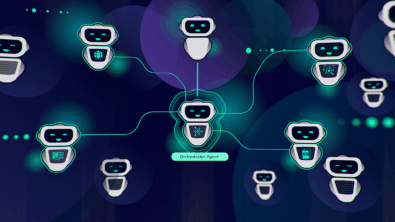
With the rise of copilots and now agentic AI, a small team of operators can now easily watch over a massive amount of production capacity largely operated by autonomous systems and monitored by AI agents which bring key insights and problems to the attention of human operators rather than the need for preventative maintenance or careful monitoring of reports and logs. Combining agentic automation with the data available within the digital twin and other tracking systems, it becomes possible for production systems to autonomously and adaptively manufacture just the right goods for any time and any place.
The future of autonomous production still has many hurdles to overcome yet, is looking bright nonetheless. As digitalization continues to advance the power of flexible agentic driven production will redefine the manufacturing landscape and the billion dollar brands of today may be a billion 1 dollar transactions of tomorrow, each one highly customized to fit the needs of a single consumer.
Siemens Digital Industries Software helps organizations of all sizes digitally transform using software, hardware and services from the Siemens Xcelerator business platform. Siemens’ software and the comprehensive digital twin enable companies to optimize their design, engineering and manufacturing processes to turn today’s ideas into the sustainable products of the future. From chips to entire systems, from product to process, across all industries. Siemens Digital Industries Software – Accelerating transformation.