The intersection of data fabrics and agentic AI – Podcast Transcript
Connecting enterprise data is a necessary, yet challenging, step in the process of developing Industrial AI solutions to their fullest potential. Data fabrics are a key way to address this challenge, offering connection and context to enterprise data and credibility to AI-generated results. These three elements will, together, be necessary building blocks for developing highly autonomous AI agents in the future, paving the way for users to orchestrate complex workflows across multiple domains.
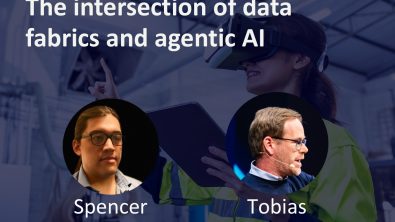
In this episode, host Spencer Acain is joined by Tobias Malbretcht, Head of Product Management, Data & AI at Siemens Digital Industries to explore the future role of tools like RapidMiner in supporting complex agentic AI solutions for industry and what that will mean for product design and production going forward.
Check out the full episode here or keep reading for a transcript of that conversation
Spencer Acain: Hello and welcome to the AI Spectrum Podcast. I’m your host, Spencer Acain. In this series, we explore a wide range of AI topics from all across Siemens and how they’re apply to different technologies. Today I’m joined by Tobias Malbricht, VP of product management data and AI for Altair, now a Siemens company.
Spencer Acain: So to pick up where you left off last time, we were kind of ending our discussion before on AI agents. So could you tell me what you see the role of platforms like Rapid Miner being and creating AI agents, especially in conjunction with no-code, low-code tools like Mendix, for example. And you know, where will these agents fit into industry and manufacturing as a whole?
Tobias Malbrecht: Yes. So obviously we see a huge demand for agents, right? And like if you look at various studies, like everyone is talking about agents, and nobody wants to miss out on the opportunity that that agents provide. But running agents in production or getting agents into production is really hard. So it’s really fascinating, right? It’s very, very simple to get started with an agent. You take one of the agentic frameworks of your choice, Langgraph or Langchain or whatever is out there today maybe you have some mediocre coding skills and then you do a bit of vibe coding and you have your first agent running within an hour or two, right? But would you really trust your business on that agent? No, of course not, right? So you have like a bunch of things that you need to orchestrate and look at. And again, it basically comes back to the layers that we talked about: context, intelligence, and action, right? Deeper at the bottom, you even have the infrastructure layer. So you need to make sure that you consume hardware without breaking the bank. But then on the data layer, you again you need to be able to make sure that the agent can tap into all the data as context for AI and for decision making. Then on the AI layer, you need to train models, use models, and build efficient and trusted AI. And then on the highest layer, the action layer, you need to make sure that agents are really embodied and integrated with the business processes that AI should drive, right? So there’s really a close connection between all those layers, and RapidMiner helps with the main layers, right? With the data layer and the AI layer as the intelligence layer, and then Mendix supports the application and integration layer, basically, right? So Rapid Miner, that means Rapid Miner has a really central role in supporting the development and the building and the operation like operationalization of agents in in organizations.
Spencer Acain: Yeah, I mean, that sounds exactly like what you’d need to bring agents into a business, you know, like you say, it’s all about trust and you know, you can anybody could vibe code an agent in a couple of minutes or an hour, a couple hours. But you know, you need something that’s robust that has that really works with what you needed to and is secure and is gonna give you the results you need. So that kind of loops us into this next question here, which is of course on security. So, you know, we need ways to validate these AI generated results, and we need you know to make sure that AI has access to the data it’s supposed to have access to, and the people who are using it only have access to the data they’re supposed to have access to. You know, there’s obviously all those kinds of concerns when it comes to using AI in a business, so especially when there’s sensitive data to be considered. So is having something like Rapid Miner, like a data fabric helpful to this at all? Is this does this help with that type of both the security side and the trust angle that come inherent with AI?
Tobias Malbrecht: Yes, absolutely it does. So a data fabric and especially a knowledge graph provided data fabric like we provide in Rapid Miner is a perfect kind of structure and technology to help with security and governance for agents, and that is because it effectively provides that central that central access layer that I talked about earlier, and having this central access layer allows to impose kind of very fine-grained access controls for data access and there is basically no difference if a han would access this data or an agent would access this data, right? It’s kind of the same governance that that you need to provide. And, yeah, a knowledge graph and kind of the governance capabilities that we put around this in Rapid Miner. Allow to apply such security context in a in a very fine grid way so that you can effectively define rules which data should be allowed to be accessed, right? And that may even go as far as like okay, this person because it’s coming from separate a certain country may not access that data in that in in a different country, things like these. So kind of define very flexible rules that are based on the attributes of the data, but also on the attributes of like the accessing entity, whether it’s a han user or whether it’s an agent user, those rules can take attributes of both sides into account, and then yeah, basically restrict or grant the access based on those attributes and whether though the accessing entities like agents and users or whether the data fulfills a certain constraint, and in that regard it’s very flexible.
Spencer Acain: It almost sounds like you’re including kind of security and access rights and stuff like that as another type of context within the framework that you’re storing the data in, like it’s another layer of things that are being included within Rapid Miner, because as even as information that could be used,.
Tobias Malbrecht: Yes, correct. It’s actually if you may want to think it like this, it is actually part of the context, even right, the way how you are allowed to access the data becomes part of the data if you will. I mean, that’s I think it’s a really sensical approach to it, because I mean it’s just a property of the data, so you should be able to store it and look at it like that.
Spencer Acain: So beyond anything we’ve else we’ve already talked about today how do you see data fabrics and tools like Rapid Miner continuing to develop in the future? And you know, what kind of effect will that have on the development of industrial AI going forward?
Tobias Malbrecht: Yeah, so as I mentioned before, we see huge demand for agents, right? So nobody really wants to miss that boat. And obviously, platforms like RapidMiner will incorporate everything yeah, such platforms need to not just toy around with agents, but really allow to put agents in into production and make meaningful decisions, and that’s exactly what we are what we’re doing on the RapidMiner side as well. So that’s yeah, basically encompasses a couple of things. The first one is agent development. So we obviously want to allow a broad range of user personas to develop agents and integrate them wherever they are needed, basically. Then agents should be able to tap into a lot of data and different tools, right? So the power of a generative AI and agents is that it can kind of orchestrate various tools it may allow may be able to tap in. So that access to data and tools becomes very important, and that’s even more so true for vertical use cases, like in the industry, and there you obviously want to enable agents with very specific with very specific tooling. So, as an example, let’s say you would like to support or automate in parts the simulation of a newly designed part of an aircraft, right? Then typically what you do as a user to design that and engineer this part, there are a lot of things that you need to do, physical simulation and those kind of things, right? And those tools they need to be also be available to agents, right? And that’s exactly I think what we also do on the right RapidMiner side do to bridge a lot of those tools and integrate a lot of those tools so that agents can actually tap into all those all those different tools to ultimately solve really hard problems. Then there is the governance aspect that we talked about it. So we obviously need to make sure that agents are making good decisions that ultimately match the expectations and provide consistency and basically operate within the guardrails that like governance frameworks and organizations put around those agents, and lastly, well, there’s likely not just one agent working in isolation, right? So it’s like with humans, humans work together, ultimately, agents will also work together. So we need to kind of reimagine a lot of business processes to change from like orchestrating and managing people to orchestrating and managing agents, and that includes include controlling costs, that includes guiding behavior that includes leading to outcome effectively, right? So a lot of that orchestration will be need to thought through like how that orchestration works with respect to yeah artificial intelligence and how we do that do that with agents.
Spencer Acain: No, I mean you’re absolutely right. You know, it’s gonna be orchestration on a large scale with agents, and it’s the same way you have to orchestrate a lot of people in the business. So I guess is there any final comments or thoughts that you have on AI before we round this out here.
Tobias Malbrecht: Yeah, well, I think in general, there’s really an exciting opportunity, right? On multiple fronts. So obviously, with the advent of generative AI and language models, really the power of AI has increased significantly. Now, how that will be integrated into businesses, and that’s currently like I think the interesting field to be in, right? And with Rapid Manner, we are able to shape that shape that future and how AI can be used within organizations so that they ultimately can perform better, right? And as part of that, as I mentioned earlier in the beginning of our conversation, part of that is really reducing the time you need to invest to get to a decision based on some situation or some data that that you have at your hands, right? So it’s really shaping that process and shaping that future. That’s really an exciting opportunity, and I’m really happy that I’m part of that in yeah, helping to develop Rapid Minor and helping to provide or helping Siemens to provide Rapid Manner as a platform to their customers that ultimately allow those customers to leverage AI, ingrain it into their business, and with that gain the competitive edge in in their markets, which they deeply need.
Spencer Acain: Well, well said, I mean you’re absolutely right. It is an exciting time, and with the with large language models like out now, it’s you know, AI is moving faster than ever. But I think that is about all the time we have for this episode. So, Tobias, thank you for joining me with these great insights.
Tobias Malbrecht: Thanks for having me, Spencer. It was a pleasure.
Spencer Acain: And once again, I’ve been your host, Spencer Acain on the AI Spectrum Podcast. Tune in again next time as we continue exploring the exciting world of AI.
Siemens Digital Industries Software helps organizations of all sizes digitally transform using software, hardware and services from the Siemens Xcelerator business platform. Siemens’ software and the comprehensive digital twin enable companies to optimize their design, engineering and manufacturing processes to turn today’s ideas into the sustainable products of the future. From chips to entire systems, from product to process, across all industries. Siemens Digital Industries Software – Accelerating transformation.