CAD powers sustainable design and a greener future

In a world racing toward carbon neutrality, sustainable design is no longer optional. It is an engineering imperative. Design teams, manufacturers and product developers are rethinking the way products are conceptualized, modeled and produced. And at the core of this transformation is Computer-Aided Design (CAD).
Modern CAD tools have evolved beyond simple 3D modeling to become intelligent platforms that support sustainable decision-making from the earliest design stages. With capabilities like topology optimization, generative design and digital twins, engineers are empowered to create lighter, smarter and more energy-efficient products. This article explores how CAD is driving design for sustainability and how engineers can adopt tools and techniques to align innovation with environmental responsibility.
The growing demand for sustainability in engineering
Global climate goals, such as the Paris Agreement and regional carbon-neutrality commitments, are forcing industries to drastically reduce emissions. Governments and regulatory bodies are introducing environmental standards that manufacturers must meet. Consumers are increasingly choosing products with eco-friendly credentials. All of this has put sustainability front and center in engineering design.
As up to 80% of a product’s environmental impact is determined at the design phase, engineers have a critical role in shaping sustainable outcomes. Choices related to materials, energy use, part complexity and manufacturing processes must be evaluated with environmental performance in mind. CAD tools now offer integrated functionality to help designers make these decisions with greater awareness and accuracy, and to fully support design for sustainability throughout the product lifecycle.
What makes a design “sustainable”?
Sustainable design in CAD goes far beyond minimizing material usage. It involves:
Material selection: Choosing renewable, recyclable or low-carbon materials.
Design for disassembly: Making products easier to repair, recycle or upgrade.
Energy efficiency: Designing components that consume less energy during use.
Reduced waste: Using additive manufacturing and precision machining to lower scrap rates.
Lifecycle thinking: Assessing environmental impacts from raw material extraction to end-of-life.
Designs that incorporate these principles are better equipped to meet today’s environmental standards—and future-proofed for evolving regulations and consumer expectations. When teams actively design for sustainability, they not only reduce impact, they build long-term value and resilience into their products.
How CAD tools enable sustainable design
Modern CAD platforms like Siemens’ Designcenter suite, including NX and Solid Edge, now provide features that actively support sustainable design in CAD workflows. Some examples include:
Built-in material libraries: Including environmental data such as carbon footprint, recyclability and embodied energy.
Integrated simulation tools: Letting engineers test thermal, stress and energy performance early in the design cycle.
Parametric design: Enabling rapid iteration and easy optimization of geometry to meet sustainability criteria.
CAD-driven sustainability isn’t just about analysis; it’s about designing with intent. Engineers can now model and evaluate trade-offs like weight vs. strength, material cost vs. recyclability or performance vs. energy use, all through tools built to enable smarter decisions and deeper design for sustainability across disciplines.
Another emerging capability is NX Design for Sustainability, which enables engineers to assess a product’s environmental footprint based on design inputs like material, weight, and lifecycle data. Siemens’ Designcenter Suite, including NX and Solid Edge, increasingly supports these types of evaluations to align CAD workflows with sustainability targets.

Sustainability in engineering: lightweighting, topology optimization and generative design
One of the most powerful ways CAD supports sustainable design is by enabling engineers to design smarter and with less waste, making key decisions digitally before committing to materials or manufacturing.
Lightweighting is critical in industries like aerospace, automotive and electronics. Lighter components require less material, reduce shipping emissions and often lead to energy savings in product operation. All of these outcomes are direct results of design for sustainability principles being applied at the modeling stage.
Topology optimization tools help designers remove unnecessary material from a part while maintaining structural integrity. This not only reduces weight but also cuts down on raw material use and production costs. Tools included in Siemens’ Designcenter suite allow users to define load cases, constraints and objectives, then automatically generate optimized geometry with design for sustainability at its core.
To ensure these optimized parts still meet real-world performance requirements, engineers can leverage built-in analysis tools such as Performance Predictor and CFD Designer to simulate stress, heat, airflow and fluid dynamics. Mechatronics Concept Designer (MCD) supports early validation of mechanical systems and automation logic—helping to prevent late-stage inefficiencies or energy losses.
Generative design goes a step further by using AI algorithms to explore thousands of design permutations. Based on user-defined constraints such as weight, material and cost, generative design can propose unconventional yet efficient solutions that humans might overlook. This enables radically efficient structures, particularly when paired with additive manufacturing.
Together, these approaches exemplify how CAD is evolving from a passive drawing tool to a proactive partner in sustainable engineering.
Immersive engineering: styling and digital prototyping
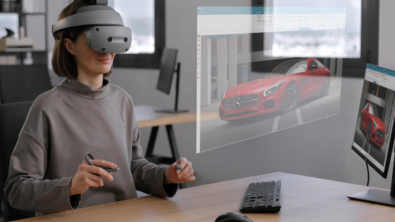
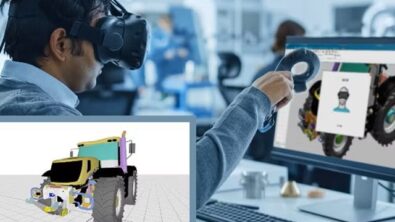
Sustainable design isn’t only about materials or energy use—it’s also about reducing unnecessary physical iterations. That’s where immersive engineering comes in. By combining photorealistic visualization, real-time simulation and advanced rendering within CAD environments, immersive engineering allows product teams to explore design intent, aesthetics and functionality without ever manufacturing a prototype.
Siemens’ Designcenter suite,including NX and Solid Edge, delivers immersive engineering capabilities as part of its core offering. Within the Designcenter suite, engineers can use NX Immersive Designer to step into CAD models in virtual, augmented and mixed reality (using the Sony XR headset), directly modifying designs, evaluating materials and collaborating across teams, cutting the number of physical styling models needed.
Using these tools, designers simulate the way light interacts with surfaces, test ergonomics and assess color, texture and form in realistic environments before creating physical parts. This immersive experience accelerates feedback loops, enabling teams to get styling and usability decisions right from the outset. The result is fewer prototypes, less energy consumption, reduced material waste and fewer emissions—especially when remote teams reduce travel for in-person reviews.
Immersive engineering helps designers get the product right the first time. It reduces the guesswork around form and fit and ensures that sustainability isn’t sacrificed for visual or functional quality. As digital tools grow more realistic and integrated, styling and prototyping in a virtual space will become a standard part of sustainable design workflows.

Digital twins and lifecycle assessment in CAD
A key advancement in sustainable design is the use of digital twins—real-time, digital replicas of physical products. These models integrate sensor data, operational parameters and design intent to provide engineers with a comprehensive view of a product’s performance over time.
With digital twins, teams can:
- Simulate and monitor energy usage throughout the product lifecycle.
- Predict maintenance needs, extending product longevity.
- Identify design flaws or inefficiencies without physical prototypes.
Integrating lifecycle assessment (LCA) tools into CAD platforms further strengthens sustainable design. Engineers can evaluate the environmental footprint of different design choices, from cradle to grave. This includes carbon emissions, water use, toxicity and recyclability. NX Design for Sustainability enhances this by offering real-time insights during design iterations, helping teams course-correct earlier in the development cycle. Siemens’ Teamcenter, for example, integrates both LCA and impact analysis into product development workflows.
AI in CAD: designing smarter, greener products
Artificial Intelligence (AI) is revolutionizing how engineers approach sustainability in CAD. Machine learning algorithms embedded within CAD tools can now:
- Recommend alternative materials with lower environmental impact.
- Predict component failure to avoid overengineering.
- Automate design iterations based on sustainability targets.
In Siemens NX, AI is used to suggest part simplifications and manufacturability improvements. In Solid Edge, AI-driven generative design proposes multiple low-impact design alternatives. These intelligent tools are accelerating innovation while ensuring that sustainability remains a core design parameter.
However, it’s important to acknowledge that AI and generative algorithms themselves consume significant computational resources—raising valid questions about the energy required to run these tools. As the technology matures, optimizing the energy efficiency of AI-driven design workflows will be essential to aligning digital innovation with environmental goals.

Sustainable manufacturing with CAD integration
Designing sustainably doesn’t end at the CAD workstation. The transition from design to manufacturing is critical in ensuring that environmental gains are realized.
Modern CAD/CAM integration allows engineers to:
- Simulate manufacturing processes: Identify and minimize waste before production.
- Optimize toolpaths: Reduce energy consumption in CNC machining.
- Design for additive manufacturing: Eliminate the need for tooling, reduce material waste and enable part consolidation.
When CAD tools are connected to production data, feedback loops can be created to continuously improve design decisions based on actual manufacturing outcomes. This is essential for building a truly circular product lifecycle.
Designing for sustainability and a greener future with CAD
Sustainable design is now an essential competency for every engineer. With the right CAD tools, sustainability is no longer a trade-off—it becomes a design advantage.
By embracing features like topology optimization, generative design and digital twins, engineers can unlock new levels of efficiency, performance and environmental stewardship. As the industry evolves, the integration of AI and lifecycle analytics into CAD will continue to redefine what’s possible.
Whether you’re designing the next electric vehicle, aerospace component or consumer product, the path to a greener future begins with smarter design in CAD.
Sustainable design FAQs
Q: What is sustainable product design in CAD?
A: Sustainable product design in CAD means using tools like Siemens NX or Solid Edge to minimize material use, reduce waste and improve energy efficiency throughout the product lifecycle.
Q: How can CAD software support eco-friendly manufacturing?
A: CAD software supports eco-friendly manufacturing by enabling lightweighting, generative design and digital twins to simulate performance and reduce physical prototypes, lowering material and energy consumption.
Q: What CAD tools are best for sustainable engineering design?
A: Siemens NX and Solid Edge are leading CAD tools for sustainable engineering, offering integrated simulation, topology optimization and lifecycle management features to design greener products.
Q: How does digital twin technology improve sustainability in product development?
A: Digital twin technology improves sustainability by mirroring real-world performance, helping engineers test durability, optimize materials and cut energy usage before physical production.