Realizing the role of agentic AI
The concepts of artificial intelligence and automation go hand in hand, with AI oft envisioned as an autonomous assistant able to handle tasks with little to no human oversight. Currently, AI is not capable of this level of self-directed action however, with the recent advent of agentic AI and the continued improvement of LLMs, the dream of highly autonomous artificial intelligence is looking more achievable than ever.
In a recent podcast, Shirish More, AI Program Product Manager at Siemens and Michael Taesch, Senior Director of Product Management for NX Manufacturing, got together to explore agentic AI for design and manufacturing by first examining what the technology is, then going on to look at its many applications across industry.
Check out the full episode here or keep reading for some of the highlights of that conversation.
What is agentic AI?
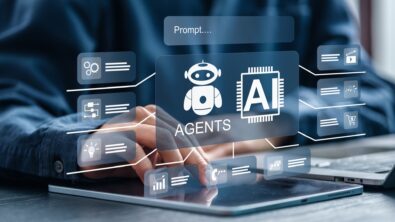
To understand the benefits of agentic AI, it’s important to understand what it is. Today, large language models, or LLMs, are primarily used to answer simple questions, where the user directly instructs the model for each step of a process. While still using LLMs at their core, AI agents build on them with a framework of supporting functionality that allows the agent to, as Shirish puts it, plan, reason and act autonomously towards a goal.
What this means for users is that, rather then just asking a question and receiving an answer, an AI agent could instead be given a task – even a complex one – and be left to complete it autonomously. This level of automation is closer to the ideal of AI, with users directing actions and checking results, rather than manually invoking it one step in a process at a time. With an agentic AI framework in place, multiple agents could also work together to accomplish complex tasks, taking AI from a reactive assistant that can only answer simple questions or do simple tasks, to a proactive teammate that can breakdown complex goals and tasks into individual steps to be worked on by a team of agents.
Agentic AI supports design
Supporting expert users with more powerful, autonomous tools is a clear benefit of agentic AI that will, in turn, have clear benefits; it will allow for the engineering cycle to be shortened, tools to become easier to use and for users to focus more on creative tasks and less on doing menial tasks. However, a less obvious benefit is in the way a powerful agentic AI system can help breakdown silos between different disciplines.
A major challenge in the engineering process is the need for teams of different disciplines to understand how changes they make or how changes other teams make will ripple through and affect the entire design and manufacture of a given product. This comes down to a matter of expertise, an expert in manufacturing probably won’t know anything about simulation or PCB design for example, yet the changes or findings of any one expert can have a major impact on all the others. This is where agentic AI comes into play.
Using a connected framework of agents that spans the entire engineering cycle from initial design to manufacturing, any expert, anywhere in the cycle, could simply query an agent to find out changes in one area of a design may affect the design as a whole. In effect, this creates pocket experts that can quickly answer complex domain-specific questions, breaking down the silos between different disciplines and even allowing non-expert stakeholders to participate in a more collaborative product development lifecycle. With agentic AI, all of this and more could be facilitated through simple, natural language inputs.
Artificial intelligence is still taking its first steps into industry yet, in many cases, is already providing clear benefits. As the technology continues to advance and more complex agentic systems start finding their place as well, those benefits will only continue to grow. With tools getting smarter and more capable in the years to come, experts will increasingly move to an overseeing role as they orchestrate complex automation through natural language, driving the engineering cycle alongside AI as a trusted colleague.
Siemens Digital Industries Software helps organizations of all sizes digitally transform using software, hardware and services from the Siemens Xcelerator business platform. Siemens’ software and the comprehensive digital twin enable companies to optimize their design, engineering and manufacturing processes to turn today’s ideas into the sustainable products of the future. From chips to entire systems, from product to process, across all industries. Siemens Digital Industries Software – Accelerating transformation.