Lattice Boltzmann is the future of CFD. Update now. Transcript
To listen to this podcast on the lattice Boltzmann method click above. For show notes, click here.
Thiago Ribeiro (offstage): Welcome everyone to the Industry Forward Podcast. I’m Thiago Ribeiro, and I am the Global Head of Energy, Chemicals and Infrastructure at Siemens Digital Industry Software.
The topic of the day is the Boltzmann reactor from Latticept. This chemical equipment comes with a bespoke digital twin. It includes the physics-based logic and laser-scanned geometry to ensure operators get the accurate insights they need.
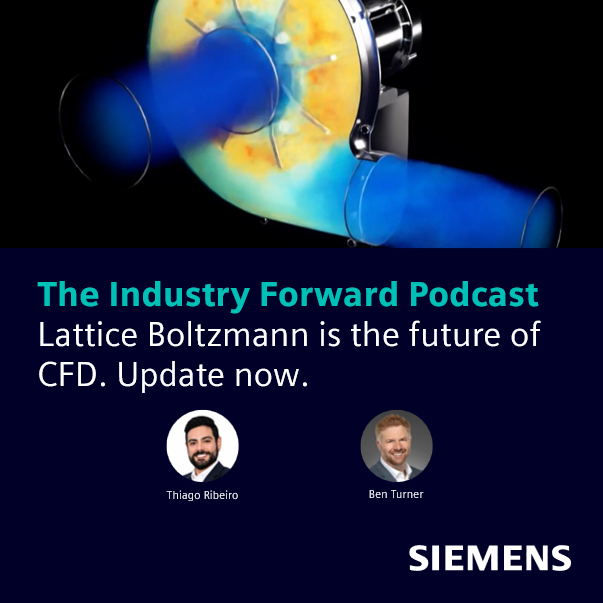
Another aspect that makes this twin stand out is that it uses the lattice Boltzmann method to perform its computations. Because of their native parallelism, these computations work exceptionally fast on modern GPUs. What would take hours, or days, using traditional simulation techniques to compute, these digital twins can do in seconds.
My guest today is Benjamin Turner, CEO and Principal Consultant at Latticept. Ben, good to have you back on.
Thiago Ribeiro: For equipment manufacturing or designing, I mean, you do have a little more time to think about [your] next step. But when you are in operations, you need [answers] really fast to solve the problems that are happening, right?
Benjamin Turner: That’s right.
Thiago Ribeiro: And this different method called lattice Boltzmann, it’s much faster [than traditional simulations techniques] and allows you to get real insights almost in real time. I mean, can you give our audience a little estimation about how fast it is compared to traditional solvers?
Benjamin Turner: Sure. So, it’s basically a ratio of about one hundred to one.
Thiago Ribeiro: One hundred to one!?
Benjamin Turner: Yeah.
Thiago Ribeiro: Wow.
Benjamin Turner: That’s about how much faster it is.
And if you include multi-phase and reaction, I mean, we’re thousands of times faster because it’s not only … inherently parallel, it’s inherently transient.
So, [for] a lot of the hard problems … you know … it’s really even kind of hard to compare sometimes because a lot of [the] previous stuff [that] is done, it’s just been steady state. You’ve got some time average 2D slice through a reactor and you’ve got some vector plots.
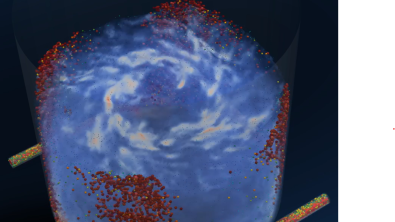
M-Star (Siemens M-Star CFD) gives you fully volumetric 3D time accurate measurements. You can literally watch the particles move around. So, not only is it so much faster, it’s so much more physics rich because you can literally see how the particles circulate. You can see if they’re getting stuck on the wall.
I mean, it’s just incredible.
But yet, to give you an example, I can do mixing simulations on the phone in 15 minutes.
Thiago Ribeiro: On the phone?
Benjamin Turner: On the phone, yeah.
Thiago Ribeiro: Oh my God!
Benjamin Turner: Yep, that’s…
I won’t say I’m the best salesman. When you have M-Star, it’s easy to be a good salesman, because you can pull up the software. I don’t have to show videos.
I can literally pull up the software, drop in a reactor, add an impeller, some non-Newtonian rheology and some particles and some bubbles. And we can do multi-phase simulations on the phone that would probably be a PhD thesis.
I mean, just some crazy stuff. And that’s just, we call them scrap simulations. I delete the results because I can do them so quickly.
Thiago Ribeiro: Wow.
And do you believe that this [levels] of playing [field] between startups and incumbents?
Benjamin Turner: Yeah, it’s certainly a force multiplier because, [for] me as just a small company. I can compete with very large companies because one, I [already] have more insights on the equipment than most people do in advance.
So right now, if you go to a reactor company, they’re probably not going to do CFD (computational fluid dynamics) on your reactor. I mean, if they even do a heat transfer analysis, you found a good reactor company. But we can do basically the entire process.
So, if someone says, “why, you’re just a couple of guys, why would I buy a reactor from you? I could go to this other shop that’s been around for 100 years.”
Because I have data, I have technology, I have, “you can literally see that mine’s [going to] work and the other one might not.”
And we’ve used all this technology, basically, like I said, it’s force multipliers. We’re taking all of this [from] our engineers, and we’re multiplying their intelligence. We’re multiplying their ability to solve problems by using all [these] advanced tools in Siemens Toolkit.
Thiago Ribeiro: This is interesting.
So, you perceive this technology to be something that would make, and I will use the word, it democratizes technology.
And I know you don’t like this term (referencing a previous podcast), but I will repeat it. Both Laugh.
Benjamin Turner: A lot of syllables, yeah (referencing the same podcast).
Thiago Ribeiro: Honestly, because sometimes people talk to me, “hey, those technologies, they’re great, simulation, digital twins, artificial intelligence. But they’re not really suitable for smaller companies.”
But you’re telling me otherwise. You’re telling me that they’re not just affordable, but a source of competitive advantage?
Benjamin Turner: That’s exactly right. Yeah, totally.
So, most of the simulations we run are just [on] gaming GPUs (graphics processing units). I use the RTX 4090 (The NVIDIA® GeForce RTX™ 4090) in my office. I have a cluster too, but most of the simulations I do are just [on] a $1,000 GPU. I mean, that’s not prohibitive for a small business.
Like you said previously, this goes a lot beyond reactors. I mean, that’s just what we started with. But in the future, I see every unit operation basically coming with its own M-Star Siemens digital twin.
So, if you have these complicated inter-unit operations that may have effect on each other, you can simulate the operation of those two equipment together.
So, you’re exactly right that this allows small companies or smaller companies to do analysis and get insights that they just wouldn’t be able to do without hiring a very expensive consultant or investing a ton in hardware and know-how that [they] may not get a return on really.
I mean, everyone’s used the, at least you and I have both used the older CFD software. You really need to be kind of a PhD to understand what’s going on, right?
Thiago Ribeiro: True.
Benjamin Turner: And that’s, we’re trying to get rid of that. At least mitigate as much as we can.
Thiago Ribeiro: Yeah, for new startups, they can create a new process and start digitally from beginning.
Benjamin Turner: That’s right.
Thiago Ribeiro: But for incumbents, it’s a little more complicated now. Because you need to overcome the current processes and the prejudice that traditional solvers have.
Benjamin Turner: That’s right, yeah.
Thiago Ribeiro: Because those, again, those traditional solvers, they’re hard to use. You need a PhD. The learning curve is very long.
And [what] you’re telling me [is] that we do have, right now, a path with M-Star. That we can rethink all the processes from early phase design to operation in a much easier way.
Is that right?
Benjamin Turner: That’s right. Yeah.
There’s definitely PhDs in the back end. John Thomas (M-Star’s original cofounder) is a PhD. and I think some of his team are as well. Those are the guys that validate all the physics.
But then the point here is we’re trying to use mechanistic models that work together.
Not to get too in the weeds of CFD software. We don’t want to have all these random numbers that you have to type in just to get the simulation to solve. Like, if you’re in the simulation typing in random numbers, just trying to get an answer, it’s like you’ve kind of already lost the battle. You know what I mean?
Thiago Ribeiro: Yes!
Benjamin Turner: You want to type in the numbers that are important to you and get the numbers out that are important to you, not getting stuck in the weeds of actually solving this.
Imagine if you had to type in some magic password into [Microsoft Excel] just to get it, you know, get the answer out. I mean, that’s literally what most CFD solvers are now, right? You have to know the magic words just to get the answer.
We’re trying to make the answer as easy as possible and make it in a way that not only is user friendly, but it can actually add value.
We don’t want to promise a bunch of pictures and stuff because we know that the insights are going to be valuable because people are doing it now.
Thiago Ribeiro: Yeah, there’s a running joke for decades that CFD stands for: colors for directors. Both laugh.
Benjamin Turner: Colors for directors, yeah!
Thiago Ribeiro: Yeah, exactly.
So, we’re trying to avoid that. We’re trying to create real value out of this.
And it changes the paradigm a little bit. And honestly, my biggest concern when I’m talking to C-level is explaining to them that the power that is beneath all of those algorithms is about using data wisely, right?
So, there’s a lot of buzzwords here and there about digital twins, simulation, AI. But in the end, it’s about making the data readily available to [whomever] needs it, in an easy way. That you don’t need like, a super expert every time you’re running and you’re troubleshooting a problem.
Benjamin Turner: That’s exactly right. Yeah, that’s… we all have…
And I brought up the previous CFD method because that really is, we joke, but … there is a lot of truth in colors for directors.
Now, M-Star makes beautiful colors, by the way, but that’s not the point. Thiago Laughs.
But if you think about, like a 2D slice of a reactor that’s got an agitator in it, you already can tell that’s kind of wrong. I mean, there’s no such thing as a steady state mixing operation that doesn’t even exist.
Thiago Ribeiro: Exactly, right.
Benjamin Turner: So, it goes back to “all models are wrong.” Okay, but our models are becoming more and more righter and they’re faster.
So, we’re … leveraging all this NVIDIA GPU technology to make the simulations faster, more accessible to people that aren’t PhDs, that aren’t domain experts in the specific turbulence model, right? So, they can make actual insights in production. That’s the whole point.
We want to make chemicals, we want to make products as fast, as profitable as possible. And use the existing data. We want to leverage the existing data we have to make more money at the end of the day. I mean, that’s really what the goal here is, right?
The point here, and a lot of people get caught up in that, we’re not here to make plots and pictures, and we’re here to run business, right? That’s the whole point. We sell software to make money. That’s the whole point at the end of the day.
You want the client to take the software, incorporate it into their business model so they can make more money. And M-Star makes that pretty easy.
And me building on top of M-Star makes it even easier. Now you don’t even need to know much about reactors because I built all that into the web app. You can just type in what, and even it’s got a little AI assist tool.
Even if you don’t know what material you should use, you can ask it and it’ll suggest what material you should use, and it’ll suggest which heat transfer media you should use.
So yeah, we’re trying to take your input data, your raw chemical … feed and trying to give you a reactor that will give you the best product, the most reliable operation in the long run by using all the technology. We’re trying to bake all that technology into a system, from the beginning to the end that someone can use in the future.
Thiago Ribeiro: Perfect. I remember that my PhD supervisor once told me that “all models are wrong, but some of them are useful.”
Benjamin Turner: That’s right.
Thiago Ribeiro: Yeah. But for them to be useful, it needs to represent exactly what we’re trying to represent.
Benjamin Turner: That’s right.
Thiago Ribeiro: So, we used to make a lot of old assumptions using traditional CFD solvers Because, again, even with those assumptions, they would take sometimes days, weeks, or months to run.
And we don’t have the time in real operations. We want to be fast, we want to be accurate, we want to solve real problems and add value to operations.
Benjamin Turner: Yeah, perfect examples like sparging gas, gas sparging in a reactor where you’re injecting bubbles in the bottom. This is really one of M-Star’s killer applications.
And, simulating all those bubbles and how mass transferred across the bubble. M-Star actually keeps track of the mass transfer across each individual bubble at each time step. It keeps track of each particle in space, the force on every particle at every time step.
I mean, the amount of data that the solver basically just discards, because it doesn’t even have a hard drive to save it on. I mean, is what’s really crazy to me.
So yeah, not only. And it’s another thing. Not only are we talking about making this faster and easier, this information is righter. Like it’s more accurate. So, the models are getting closer and closer to reality because we’re leveraging all of this computing technology.
Yeah, I mean, could you even do a multi-phase? A multi-phase mixing simulation with reactions, I mean, how long would that have taken you previously?
Thiago Ribeiro: I don’t want to know. Both Laugh.
Benjamin Turner: So, I’ve had one client on the phone end up becoming a friend of mine. He said, “you know, I’m actually kind of scared of this. Like I’ve spent years learning how to do all this and you just redid it in 15 minutes on the phone.”
Thiago Ribeiro: I mean, I told you this yesterday, right?
I was like, “I spent so many years of my life mastering this technology, and what is shown to me is that I didn’t need to invest that much time because right now it’s much easier and accessible to everyone.”
Benjamin Turner: Yeah, and so…
Some people … took it, laughed it off and said, “okay, this is the new way, we’re just going to learn it.”
But a lot of people have almost an existential crisis. Like, “there’s no way that this can be right because I didn’t know about it.” You know, like, “how can this, there’s no way that this can be right because I’ve spent 20 years on this other method. This new method almost completely invalidates what I’ve done previously.”
So that’s … It’s an interesting … I won’t say it’s political, but you certainly see people push back against it just because it seems like it shouldn’t be possible. But it totally is.
Thiago Ribeiro: One hundred percent.
I mean, people were against calculators when [they] first came out, right? And now everybody uses them. People are like, “AI as well.”
I mean, I understand the shock. But the genie is out of the lamp, and it’s not coming back. Now we have this technology. This is the reality.
You either face, it or you lose competitive advantage.
Benjamin Turner: Yep, and that’s exactly what’s going to happen.
If you don’t take advantage of it, someone else will.
Yeah, I mean, and that’s what you’re going to be up against. [If] you’re not the guy that buys the fancy reactor that comes with its own digital twin, then your competitor will, and they’ll make 20 percent more chemicals than you will in a faster time, and they’ll have less reliability problems, you know.
So, yeah, the technology is here, and it’s moving incredibly fast.
I mean, that’s probably the best part about M-Star. [We] don’t use AI, but we use the same hardware as AI. So, we’ve kind of been swept up in this wave of hardware advancement.
So, it’s like, even if we don’t improve the speed of [the] M-Star solver. It just gets faster because NVIDIA just keeps getting faster and faster. So, we’re just swept up in this wave.
So even just what I could do three years ago has become, you know, a factor of 10 literally in just three years because there’s more RAM (random-access memory), there’s more cores and just they’re just stuffing as much as I can into these cards now.
So, it’s just incredible.
Thiago Ribeiro: Yeah, and since we’re talking about AI. I mean, there [are] a lot of discussions about physics informed neural networks, right?
And this makes a lot of sense when we are thinking about traditional solvers, right? When we’re thinking about something that takes days, weeks, or months. If I have any other methods that can leverage artificial intelligence to make it faster, if so great.
But here, and I don’t know if you agree with my assessment, it is that, we already have something that is already fast and accurate enough to create value for organizations.
Yes, AI is great and Siemens has a lot of AI technology that is really helping and impacting our customers. But in the case of M-Star, I mean, it’s ready. We don’t need to do anything. It’s just open the box, plug and play, and start using it.
Benjamin Turner: That’s exactly right. Yep. Yeah. You don’t. Yeah.
AI is great if you’ve got a bunch of data that you want to fit some model to, but the idea that, “we’re going to, we’re going to run all these CFD models and then we’re going to train the model so that we can run the CFD.”
M-Star can just run the simulation. I mean, why would we waste all that time running these, training this model? We can run it in, you know, hours. First, it would take you a lot longer to train all the AI.
So yeah. I see all these AI training tools and I’m kind of thinking like you might be missing the point here. We could have just jumped right to using a new CFD technology and just solving the problem directly instead of trying to approximate it with [AI].
Thiago Ribeiro: A hundred percent.
Thiago Ribeiro (offstage): Well, that was a fantastic chat. Thank you, Ben.
Today, we dove deep into the incredible speed and accuracy of the Boltzmann reactor from Latticept. We discussed how its digital twin, powered by the lattice Boltzmann method, is truly revolutionizing chemical process simulations.
It’s amazing to see how this technology is making advanced insights accessible and helping businesses, big and small, operate more efficiently and profitably.
Again, thank you Ben for joining me today. And of course, a big thank you to all of you, our listeners, for tuning in to the Industry Forward podcast.
Until next time!
To learn more about lattice Boltzmann, click here.

Thiago Ribeiro – Global Head of Energy, Chemicals and Infrastructure at Siemens Digital Industry Software
As Global Head of Energy, Chemicals and Infrastructure at Siemens, Thiago defines strategy, investment priorities and go-to-market guidance that drive profitable growth and long-term customer value.
Thiago has almost two decades of experience in chemical engineering and the energy industry. He has led large-scale digital transformation for companies worldwide, such as in the United States, Canada, Europe, the Middle East, South America and Asia.
Connect with Thiago on LinkedIn

Benjamin Turner – CEO and Principal Consultant at Latticept
As CEO and Principal Consultant at Latticept, Ben runs the Siemens M-Star CFD reseller. The company also acts as an equipment supplier that pairs its physical products with out-of-the-box, complete digital twins.
Ben has almost two decades of experience in mechanical and chemical engineering. He has worked in all tiers of industry including the development of pharmaceutical cell therapies, polymerization reactors and thermal oxidizers.
All trademarks are property of their respective owners.