Get with the program: Industrial AI won’t suddenly vaporize – Transcript
Listen to the podcast on industrial AI above. Or read the transcript below. For show notes, click here.
John Nixon: Hello and welcome to the Industry Forward Podcast. Where we discuss key industry trends and transformative technologies that reshape how we make and move products. I’m John Nixon, Global Vice President of Process Industries at Siemens Digital Industries Software.

Today, we are going to discuss industrial AI with Fred Husman, the Senior Program Manager for SkyIO. Much of Fred’s work centers around optimizing and digitalizing manufacturing clients, like Constellation Brands, so they are prepared for the AI future.
Constellation Brands, in case you don’t know, produces various beers including Modelo, Corona, Pacifica and Victoria. They are undergoing a huge digital transformation where, with the help of SkyIO and Siemens, they aim to produce a digital twin of their whole operation. This will enable the company to unite its historic and real-time data so it can all be used by [industrial AI] systems.
Fred, welcome back to the show.
John Nixon changes the topic.
Ah, before we dive in, let’s start with a question we like to ask [all] our guests.
Everyone building the future has at least one go-to sci-fi reference or experience. What’s yours and is it more inspirational or cautionary?
Fred Husman: Yeah, so first I would say I’m not a sci-fi guy. I’m not going to pretend on that one. So, I’m a Braveheart guy. I’m a Tombstone guy.
But, if this is an AI type question, I think, you know, AI, the adoption of AI is both, you know, inspirational and cautionary. For those that embrace AI, and that goes for the individual and the company, they’re going to separate from the pack.
And for the, and the cautionary part is if the individual or the company doesn’t use AI, they’re going to be left behind.
John Nixon: Right. No, I agree with you.
What I don’t agree with you [about] is your sci-fi answer, but we, you know, we’re going to continue the podcast under duress. That’s fine. Fantastic.
No, but I actually like your references there and everything. So, and I—Tombstone, who doesn’t like that, right? I mean, come on.
John Nixon changes the topic.
I want to kind of, look ahead now.
So, I know you packed it in your luggage, right, before you came and joined me on the show today. The crystal ball that you must carry with you; I want to get your prediction on the next three to five years.
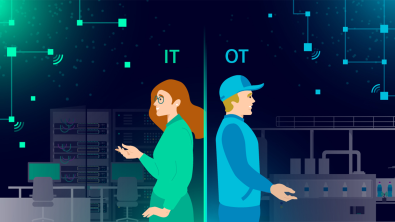
You know, what do you see evolving for digital twins, for AI. And you might, again, be more focused on the OT layer (operational technology). But what do you see? And this is for Constellation Brands and really for the [whole] process industry. What does it look like in the next three to five years?
And my stock portfolio depends upon your answers. Go! Both Laugh.
Fred Husman: Yeah, right.
Well, you know, [industrial AI] is a game changer. You’ve got to use it.
But the key is knowing what you can use it for and what you can’t use it for. And right now, that data extraction out of the OT layer, AI is not helping us with that.
But then there’s certain things on the IT layer. AI is cutting the cost to implement something by 90 percent. So, something that would take 100 hours, we’re doing it in 10 hours now.
Like if it’s just a single interface or a single program, like a C# program, you can get AI to kind of write that code for you. You still got to check it. But [what] might have took you 100 hours, now it’s only taking you 10, stuff like that.
But figuring out a way to get 20,000 tags out of a Siemens PCS7 batch system (a reference to a project discussed in a previous podcast), AI is useless for that right now. And I think it’s because … the current automation systems, Siemens is just one example, but they’re not one controller that has the entire automation, system in it.
So, for [Constellation Brands,] they’ve got a complex batching system that makes spirits —very flexible. And so, you’ve got function blocks, and functions in the controllers … inside of them, they have code of statement list or structured control language or even ladder logic. And then you’ve got those blocks in continuous function charts. And then separately,
- You’ve got sequential function charts.
- You’ve got a separate route control database.
- You’ve got a separate batch database.
There’s no way to explain that. We’ve quit trying to explain how that works to AI. It doesn’t get it.
John Nixon: Right. Right.
Fred Husman: Now, if you ask AI, “hey, can you help me harvest this data? Out of these controllers with industrial edge,” its answer is always “yes.” AI thinks it can do everything. So, you have to know what to use it for.
But I think there’s going to be an evolution in the industry that you will eventually have the automation layer kind of all-in-one system that [industrial AI] can interface to, but we’re not there yet. So, the automation layer has to change before AI is going to be able to help you at that layer.
Right now, it’s kind of AI is going to help you once you’re in the data lake. Then it can do anything.
John Nixon: Right. Okay, you know that makes total [sense].
So, people will not necessarily see it in the headlines, but there’s—if I listen to you carefully—it’s like a quiet evolution in the OT layer is going to occur over the next, let’s say, half decade. Where we’ll find greater assistance from [industrial AI] at that level versus where it is today.
Which is it’s really not there to help us [today] because we have these disaggregated systems throughout the factory floor. And you need something that’s more coherent for AI to be able to tap into and pull data from.
I get you.
Fred Husman: Yes. I think that’s right.
But I think the impact of [industrial AI] on the operation of the plant is going to be tremendous.
So, you’re going to get to the point where you have all your historical data, real-time data for your entire enterprise in one database. And you’ll have an AI agent that can, you know, help the operator at every step along the way.
So … you’ll have operators straight out of school that, because they embrace AI, they’ll become one of your best operators within months. And they will be more valuable to the company than an operator that’s been working there for 20, 30 years, but refuses to use AI.
So, you just have to use AI. I mean, so that’s the story. And that’s the individual and the company.
John Nixon: I often use this example with streetlamps. There was whale oil, there was kerosene, there was electricity, right?
And so, when whale oil was first used for streetlamps, it was replaced by kerosene when we [discovered] what was called rock oil. Which, we [all know now] comes from the ground as crude oil.
And then eventually, streetlamps became electric. And we’re even seeing greater and greater electrification. And the interesting thing was [that] humans at each one of those stages had to become more sophisticated.
There was, the well-oil fishermen and [that] whole value chain. Then there was the whole crude creation, right? That whole industry came to life and what it took to extract kerosene, deliver it, and then, you know, put it in streetlamps.
Now you have to be a fully licensed electrician [if] you’ve got to work on streetlamps. I mean, so the knowledge intensification for the human species as we evolve. As you talk about AI, yes, it might displace some. I would say, and you make the point that it’s those who don’t embrace AI, right?
Like if I didn’t become a licensed electrician and I worked, you know, putting kerosene in streetlamps, well then, I’m [going to] be out of a job. Guess what? I need to become more sophisticated.
So, you know, the way I look at it is, “There’s a natural demand for greater sophistication. Because [industrial AI] is a force multiplier, and there’s a greater expectation for humans in their performance. Which, okay, great. Let’s all do that, right? Let’s become more sophisticated.”
Fred Husman: Yeah, and I think, you know, you see some people embracing it and some not. Like a lot of these commencement speeches at the university graduations, as soon as the speaker mentions AI, you know, a lot of the students boo.
They’ve got to get with the program. [Industrial AI] is not going away.
Booing, it is not going to make it go away.
They need to figure out how to use it, and that’s how they can separate from the past.
John Nixon: And I’ll show my bias here, and maybe you share the bias with me because we work—I work at Siemens, you work with Siemens.
You know, I look at industrial AI. I look at AI as a component to what I need to do. I need to do design. I’ve got some AI to assist me. I need to do simulations. I have AI to assist me. I need to deliver equipment and inspect it. I have AI to assist in the inspection.
You know, as you go through the life cycle, I see specifically, very specific trained AI in those phases as you go along. And in your case, at the OT level, we’ve got a whole evolution that needs to occur there so that I can bring it there.
But I again don’t see it as this kind of everybody’s worried about singularity and it’s just basically going to do everything. AI to me is very similar to humans, ironically it was created by humans, in that you have to train AI. So, people have to think about that.
To your point earlier, we’ve got to have this, we need to have a data lake that [industrial AI] can pull from. Well, that AI has to be trained on what to pull, how to interpret it, how to actually render insights from it and turn it into value.
But I’m not going to use the AI I put on, like, say, a low-code app for telling me which restaurant to go to tonight, right? Because I’m in the mood for, you know, Americana or something like that.
That AI is not going to be able to help me with the OT level aggregation and insights that need to be derived from Constellation Brands’ brewing.
So, for me, there’s tremendous modularity around AI, if you will.
Fred Husman: Yeah, I think it’s kind of like knowing what you can use it for and what it’s not going to help you for.
And even … at my house it was just a couple weeks ago, I have a weird footprint on my house, and I had bad Wi-Fi coverage. So, I put in a mesh network from NETGEAR®. And it had … a few TVs that would just randomly disconnect. They work for a while and then they wouldn’t work. So, I was troubleshooting it and spent hours on it.
[Then] I was like, “wait a minute why don’t I just ask AI about this?” And then in two seconds, it’s like, “you probably have eco-mode ‘on’ on your VIZIO TV.” And I did, and I changed it, and then everything worked. John Laughs.
It’s just, it just shows you. So now more and more, if I ever struggle with something, I say, “wait a minute, can AI help me with this or not?”
John Nixon: Right. Yeah, right.
Fred Husman: But a lot of times the answer is no!
John Nixon: Oh, fantastic. Both laugh.
Well, it’s true too. I mean, you know, there, you know, all things have their limitations.
In this case, we have to, to your counsel, as I’m listening to this, it’s not fixing everything. … [industrial AI] has a lot of growth in front of it.
But even with that, it still will be used in a very specific way with different applications for different personas. I see it, for me, and my bias is a positive one, I see it as an aid to the work.
Fred Husman: Yeah, an agent.
John Nixon: Not necessarily always the replacement.
Fred Husman: I think it will get to the point though where in the operations that that the AI agent will be assisting the operator all through the day.
To the point where they tap the operator on the shoulder and say, “hey, this batch is running right now, is about to get away from you. You need to go do something.”
John Nixon: And you know, that is a very good use of AI. That’s what we want from it … going forward.
Well Fred, thank you so much for joining us on the podcast. It’s always a pleasure to have your insights!
Today, we had a fascinating conversation with Fred Husman about industrial AI. We explored how it’s a gamechanger for the process industry and why embracing it is crucial for both individuals and companies.
We delved into the current limitations and the exciting future of AI. We also highlighted the need for a “quiet evolution” to fully unlock the potential of AI around the OT layer.
One thing is clear, however, industrial AI will become an indispensable agent. It will assist operators so they can drive unprecedented efficiency.
That’s all for this episode of the Industry Forward podcast. Thank you for tuning in. And I hope this podcast helped you process your process industry questions. Always puntastic. Alright, have a good one.
To learn more about industrial AI, click here.

John Nixon – Global Vice President of Process Industries at Siemens Digital Industry Software
As Global Vice President for Process Industries at Siemens, John leads a global team that helps process industries leverage digital solutions that enhance efficiency, accelerate innovation and achieve sustainability goals.
John has over three decades of experience in strategy, operations and technology deployment for energy, chemicals, life sciences and CPG. He is well versed in the operational and business pressures of industry, including regulatory demands, decarbonization, talent gaps and the push for innovation.

Fred Husman – Senior Program Manager at SkyIO
As Senior Program Manager at SkyIO, Fred manages process control projects using Siemens automation platforms. He has designed complete automation and network architectures for customers in the brewing, semiconductor, and chemical manufacturing industries.
Fred has over 35 years of experience automating projects in the Process Industries. He spent the first 15 years of that time as a Project Engineer working on commissioning and startups. For the last 20 years, he has focused more on Project Management.
All trademarks are property of their respective owners.