Hidden industrial AI secrets from beer, bees and more – Transcript
Listen to the podcast on industrial AI above. Or read the transcript below. For show notes, click here.
John Nixon: Welcome to the Industry Forward Podcast. Where we discuss key industry trends and transformative technologies that are reshaping how we produce and facilitate products. I’m John Nixon, Global Vice President of Process Industries at Siemens Digital Industries Software.
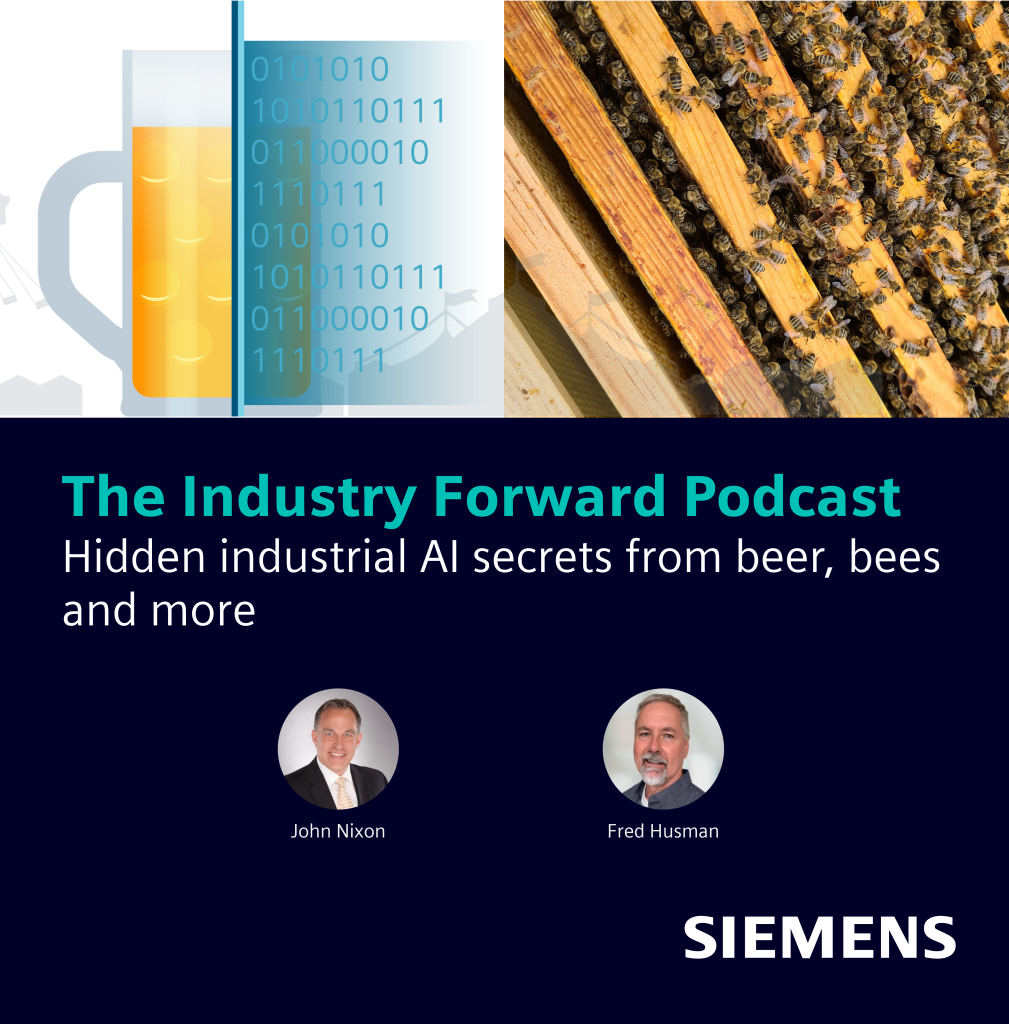
Our guest today is Fred Husman, the Senior Program Manager for SkyIO. One of Fred’s priorities is to help manufacturing outlets optimize and digitalize their processes for an [industrial AI] future.
Constellation Brands is one of SkyIO’s biggest clients. They produce various brands of beer including Modelo, Corona, Pacifica and Victoria. Yummy!
The pair are working with Siemens, to produce a digital twin of Constellation Brands’ entire operation. This will enable all the company’s data, new and old, to be accessible to [industrial AI] systems.
Fred, welcome back.
Given your experiences in brewing, what are lessons for other industries?
I myself, come from energy and chemicals. And I think about our customers like PepsiCo and others in beverages. But then I move over and I think about people in the specialty chemicals area, specialty paints, fertilizer, these other process industry segments that are akin to your experiences.
What are one or two things that they really should take as a lesson from what you’re seeing in brewing?
Fred Husman: Yeah, so I think first, they’ve got to start on the data capture. They’re already behind on that part. And they’ve got to capture the data and contextualize it right as they collect it.
That’s the key. A bunch of data in the database doesn’t do any good if it’s not contextualized. So that’s the most important part. Data lake, but it’s all contextualized.
Now what that enables you to do, like when you put an MES (manufacturing execution system) system on it:
- We’re tracking every order that comes down into the controller.
- We’re tracking all the consumptions, back.
- We’re tracking all the raw material additions.
- We’re tracking all the beer movements.
- We’re tracking all the operator manual additions.
And so, in the end, we can do full traceability or genealogy so that we know exactly, for a given bottle of beer, all the raw materials that went in there.
Because there’ll be times when there’s a quality problem at one of the raw materials that gets put in there. The vendor will come back and say, “Hey, lot number 100 had a problem. People shouldn’t drink the bottles of beer that have that lot in it.” Well, right now that’s hard for [Constellation Brands] to know exactly which bottles … that went into. But they’re getting to the point where that will be possible.
John Nixon: Oh my!
Fred Husman: So that when someone calls in and say, “hey, we had a problem with this batch of whatever,” they immediately, in seconds, instead of taking days of investigation, can say, “yeah, that’s on the shelf in case, you know, number such and such at Walmart.” And they can recall it.
John Nixon: Oh, my goodness.
Fred Husman: That’s where these consumer-packaged goods (CPG) companies got to get to. For things that people are eating and drinking, you need to be able to, for safety reasons, know how that was made and what’s in it.
John Nixon: Yeah.
That is exciting to be able to do something like that, because …when I was young, I remember we had things like the Tylenol scare that went on. And their only answer was just remove all the Tylenol on all the shelves across the country.
Fred Husman: Which people would be freaking out if you removed all the beer off the shelves. Both laugh.
John Nixon: I wasn’t going there, but you’re right. That’s exactly correct.
But no, that’s the kind of traceability, right? That well-orchestrated data. From what I would consider all the way from the lab to, let’s say, “where you’re doing tech transfer and you’re really kind of designing at scale.” Now you’re producing high volumes.
It sounds like that’s one of the big opportunities right there is, “can I look at lot, to use your example, lot 100, that input to my recipe, and now I know, it turns out it was off spec. It’s not, it doesn’t meet our requirements.”
Bottles have already, well, you would hope the digital twin would have captured [the issue] before the bottles actually went out of the warehouse. But let’s say it didn’t, right? “They’ve gone out the door, they’re on a truck. I know it’s on truck so-and-so, I know it’s on shelf such-and-such.”
Fred Husman: Yeah, I mean, but there’s nothing even the digital twin can’t predict that. I mean, you might already have the beer on the shelf at Walmart, and the vendor calls you and said, “Hey, we had a problem. We just figured out…”
So, you have to have tracked everything along the way. And that’s a lot of data you need to do that.
John Nixon: Right. Now, that’s exciting to see that.
So, when you talk about that, I can see how that then would lend itself to (say, specialty chemicals, paints, and so forth). Because they’re all dealing with the same thing, right? I mean, you get bad…
In fact, I had a chemical company in the Middle East that I went and visited. And the production manager was telling me, “you know, John, right now, one of the challenges we have when we’re producing this polymer product is 12% of our yield consistently is bad.”
“What happens is we get, our input that comes into the plant [and it] can vary in quality or vary … across the spectrum of what it might be by specification. And so, it may not be at the grade we’d need from the last run.”
“And so what ends up happening is it goes through our plant, And then when we get the product out, had we known what the input was, going in, and I could, let’s say, ‘dial up and dial down and manage the process as it was going through our plant,’ I could at least maybe grab another half a percent or a percent or 2% in better product.”
And so, I’m listening to you (Fred) and I’m asking myself, how do I capture data at the OT level? And as I’m starting to see off-spec output coming at the other end of the plant, what can I do to, in runtime, adjust operations, right?
I’m being a little obscure because I can’t tell you the customer or the process, but what’s interesting is, as I’m listening to you, it sounds like really the better part of the next decade has to be focused on OT level, data extraction, aggregation and traceability, so that AI can then come in and do what we’re talking about.
Fred Husman: Right, Yeah, you have to have the contextualized data.
And it’s all the historical data and the real-time data all contextualized, unleash [industrial AI] on that database, and they can do anything.
John Nixon: Okay.
So, as we’re talking about all this, one of the things that I come back to is sustainability, right? But with sustainability, I think oftentimes, when I talk to people, and I’ll admit this, as a young engineer, I would have thought sustainability always required an energy penalty.
But when I think about sustainability, I think that if you do it right, if you drive efficiency into operations, you’re gaining sustainability, right? Because some [company] like Constellation Brands, or anybody in [CPG], has to look at changing pallets. They have to look at supply chain disruptions [and] outages.
And so, there’s this vulnerability. There’s this risk profile that you have to drive a sense of sustainability through all of these challenges. And to me, greater efficiency inherently will drive a more sustainable posture.
What are your thoughts around that for CPG?
Fred Husman: I mean, definitely the digitalization effort and the use of AI, helps the plant use less raw materials, use less power.
I mean, that’s one of the low-hanging fruits. [Everyone’s] first step is, [to] use AI to be smart about exactly when certain equipment runs at the lower electrical rates … from the utility.
So that’s all happening.
John Nixon: That can create competitive advantage then if that’s the case, right? You’re using less raw material, less energy.
As you’re talking about this, to me, I don’t think sustainability represents a trade-off with profitability. In fact, I think one leads to the other.
I think you gain a more sustainable posture because you’re looking at your inputs and then the energy that you have to consume, the time and labor that has to go into this, and you need to drive better efficiency and productivity.
That leads to better profitability. To me, that drives a greater ability to manage the challenges that you see coming up in the CPG industry.
Fred Husman: Yeah, and I think the hesitancy with many of the customers, and Constellation Brands included, was they’re hesitant to take this first big step of extracting contextualized data from a running plant because they’re worried about affecting the plant operation.
So, you have to do that in a smart way where, for this Constellation Brands project, we’re adding this MES system on top of PCS7 (Siemens Simatic® suite PCS 7) and extracting these 20,000 tags all while they’re running.
So, and once they… realize that [it] was possible. Now they can’t go fast enough!
John Nixon: Wow.
I mean, all right.
So just I’d like to just tease out a little bit of, you know, when you say you put an MES system on top of PCS7. I mean, that must have been quite the challenge, right?
I mean, talk to me a little bit more about what that took to make that a reality.
Fred Husman: Yes, there was a lot of discussion … how to do that in a secure way, a way that was robust, right?
Because when you start putting in higher-level systems like an MES on top of your control system, the first thing you start doing is using it for more and more things for automated scheduling and automated decisions on which vessel to use, but instead of the operators doing all that.
But once you’ve taken that step, now if the communication between the MES and the control system goes down, you can’t make product.
So, you have to do that in a way where that communication stays up.
John Nixon: So, would you say putting the MES system on top of PC7 created a greater vulnerability or just, I mean?
Fred Husman: It could. I mean, that was a big concern.
It was, how do we do it in a way that we’re not adding points of failure to the system?
So, we wanted to use standard communication interfaces, all supported architectures by Siemens, and we think we did that. So, our MES interface to PCS7 is through a Siemens product called [the OpenPCS 7 interface], and it’s using OPC UA (Open Platform Communications Unified Architecture).
And we think, in hindsight, that was the best way to go. It’s the most secure way. It’s the [easiest] to handle way. So, the handling of their automation project and their HMI (human machine interface) project doesn’t change in any way. So, it’s almost like they don’t even know it’s there.
John Nixon: You know, you bring up…
I think you mentioned something that kind of created a creative spark in me, which is to ask a question about cybersecurity.
You know, as we start stacking all these systems, as we start making it easier to gather data and trace that data and orchestrate that data, are you feeling a sense of vulnerability is growing around cybersecurity?
And again… I’m not…
Obviously, Siemens, we talk about it all the time!
But you’re at SkyIO. Is there a concern or do you actually feel like, no, we’re actually doing a better job at dealing with security issues?
Not Siemens, I’m just saying as a species, what we’re seeing.
Fred Husman: I think that is a concern, and that there’s this digitalization effort at many of our customers, and at the same time, in parallel, they’ve got cybersecurity initiatives going on. Because, yeah, that they’re connecting more and more to the cloud.
For [industrial AI] to be leveraged, it’s going to have to access the data in organizations or plants that are spread out geographically across the internet. So, you’re forced to leverage AI all the way. You’ve got to have connectivity to the internet, so you have to do that in a cyber secure way.
John Nixon: Okay, Fred, we have really covered a wide gambit of information today.
And it’s been quite the dramatic journey for me. So, this has been just tremendous. I am loving this conversation. Because it really shows me there are so many aspects of when we say “digital twin,” … that’s not a Big Mac. That is a 10 layered sandwich. I mean, that is a lot to take in.
And we cannot afford to forget the OT level, which is where all this starts, right? And I think we all tend to focus on the headlines of the IT versus the OT. Because OT is just your everyday, right?
It’s a factory floor. It’s turning on the machine. It’s, making sure this flows to this and this mixes this. [And] at the end of the day, that’s like you said, it’s the OT level is where beer is made (referencing a comment Fred made in a previous podcast).
So, you know, given all that we’ve talked about today, is there something other than beekeeping that we haven’t talked about today that maybe you wanted to talk about?
Fred Husman: Yeah. So, I think we mentioned it a little bit earlier, but leveraging [industrial AI] is an absolute must, but it’s knowing what it’s going to help you with and what it’s not going to help you with (reverencing a discussion in a previous podcast).
For instance, I would never let an AI robot open up my hive and start trying to find my queen bee. [I] wouldn’t do it. It’s going to rough handle it. So, stuff like that is just like, you’ve got to know what it’s going to help you with and [when] it’s really just going to make your job longer.
John Nixon: Well, I love how, though, you found a way to find a way to reference beekeeping. That’s fantastic! And as we talked about prior to the podcast today, you know, I too had looked at that several months ago.
So, let’s just take a personal turn here for a moment for you and I. I do find it fascinating, the world of bees. And they’re highly complex organisms. They’re fundamental to the survival of our species.
Fred Husman: Yes.
John Nixon: They’re part of the very value chain that this ecosystem depends upon. And now this might be a crazy question. And maybe, you know, in our many, many discussions, I may not have asked you this before, but do you think in the world of beekeeping, of all the world.
Are there lessons from that for us in the digital world?
Fred Husman: Oh, I think so. I mean, there’s still things about the bees and their behavior that man has not figured out. And that’s even with AI, you know, they still can’t figure it out.
For instance, the superfood in the world is bee pollen. Not the honey, but the protein that the bees make. It’s like little [BB pellet] sized grape nuts tasting, protein packets, basically.
And that is the only food in the world that humans can live on for, say, four months with that in water. So that tells you right there.
And man has not been able to figure out, even with AI, how to reproduce bee pollen and feed it to the bees where the bees don’t die.
John Nixon: Interesting. So much more for us to discover as a species. But no, that’s pretty exciting.
I, we probably could have a whole podcast talking about how colonies work. I mean, for me, I always look at biomimicry, right? How [we and] our digital [systems] mimic other biologic systems.
And I find, interestingly enough, that as you look at the world of digital and as you look at things like beekeeping, you look at all these ecosystems and so forth, there are so many lessons held for us there that we are still struggling to bring over and to recreate.
But I mean, that is part of the whole journey, right? It’s learning to do that and understanding that whatever master craftsman was able to create this incredible thing that we call, like you said, pollen, leads to then, you know, this production of honey, and how do we, how would you actually find a way to recreate?
I mean, that journey of rediscovery and recreation of that, that’s exciting. And I can tell just looking at you that, you know, you’ve enjoyed this beekeeping and what it’s taught you. Do you find,
Okay, so you do beekeeping on one hand, right? You live in the world of OT in the other! I mean, is it somehow resonant with you that there’s just great commonality between the two?
Fred Husman: Well, there is, and those are probably my two favorite things.
Of all the industries I’ve worked in over my 35 years in automation, beer making is the best. And then, since I’ve become a beekeeper, that’s turned into my passion. And they are related a little bit.
People do make some alcoholic mead beverages out of honey. So, in a lot of the honeys, I had one last night, it was a blood orange honey, local, beer. So, honey and beer go together and yeah, I love them both.
John Nixon: Whatever way we can find to connect them on this podcast. All right, that’s fantastic.
So, Fred, I want to take a moment. I want to thank you for being my guest today. I’ve really enjoyed this conversation. Honestly, it was good to get back to our OT roots, which we need to focus on. You’ve had a wealth of experience over 35 years.
And then of course, I just love the fact that you’re an apiarist, right? That you do beekeeping. I think that it’s just, it really,
You’re such an incredible individual, and it’s been just a lot of fun to have a great conversation with you today.
Fred Husman: Yeah, well, I appreciate it.
And on that point, I have a shirt at home that says, “I hear what you’re saying, but I only want to talk about bees.” Both laugh.
John Nixon: I love that.
You know, maybe we’ll have to come back and do that. Maybe we just have to do that. We’ll have to come back and talk about bees. So, Fred, thank you so much for joining us.
Fred Husman: Yep, thank you.
John Nixon: Well today, we learned some key digitalization lessons from beer, bees and more.
The lessons first highlighted the critical importance of contextualized data at the IT and OT levels for the implementation of industrial AI systems.
We then delved into how digitalization and AI can drive both sustainability and profitability, challenging old assumptions about energy penalties.
And finally, we talked about biomimicry and how the lessons we must learn on the production floor can sometimes be taught by the nature outside.
Thank you so much for joining us on this episode of the Industry Forward Podcast. I hope this podcast helped you process your process industry questions. Thanks for listening, have a good one.
To learn more about industrial AI, click here.

John Nixon – Global Vice President of Process Industries at Siemens Digital Industries Software
As Global Vice President for Process Industries at Siemens, John leads a global team that helps process industries leverage digital solutions that enhance efficiency, accelerate innovation and achieve sustainability goals.
John has over three decades of experience in strategy, operations and technology deployment for energy, chemicals, life sciences and CPG. He is well versed in the operational and business pressures of industry, including regulatory demands, decarbonization, talent gaps and the push for innovation.

Fred Husman – Senior Program Manager at SkyIO
As Senior Program Manager at SkyIO, Fred manages process control projects using Siemens automation platforms. He has designed complete automation and network architectures for customers in the brewing, semiconductor, and chemical manufacturing industries.
Fred has over 35 years of experience automating projects in the Process Industries. He spent the first 15 years of that time as a Project Engineer working on commissioning and startups. For the last 20 years, he has focused more on Project Management.