A devastating surprise industries see with AI integration – Transcript
Listen to the podcast on industrial AI integration above. Or read the transcript below. For show notes, click here.
John Nixon: Well, hello and welcome to the Industry Forward Podcast, the premier show where we examine the key industry trends and transformative technologies that are reshaping how we make and move products. I’m John Nixon. I’m the Global Vice President of Process Industries at Siemens Digital Industries Software, and I’ll be your host today.
Right now, the Process Industries [are] in this tremendous transformation. We see it every day. We see headlines every day. Supply chain uncertainty and rising operational complexity, cost pressures, and a relentless need for greater agility are forcing companies to rethink … how and where they design, produce, and deliver their products.
The answer for many is to go digital. We hear that all the time. We got to go digital. They’re building comprehensive digital twins, in their operations. They’re tapping into industrial AI (artificial intelligence) for better, smarter decision-making and embracing really what I see as a shift towards data-driven, software-defined ways of working.
It’s really a profound change that we’re living. We’re living through this as a species right now in how manufacturers operate and compete. So today, we’re going to explore what this digital transformation looks like really in practice, right? On the factory floor, where it’s taking the industry next.
This is why I’m excited. I’m excited to be joined by Fred Husman. He is the Senior Program Manager for SkyIO. And while we may not get into it in detail today, he’s also an apiarist, right? Is that correct?
Fred Husman: Yes, that’s right. A beekeeper. Yeah.
John Nixon: That’s right. A beekeeper. That’s right. For those of you who don’t know that word.
And Fred and his team work with manufacturing leaders (including household names like Constellation Brands, for example, which we may focus on today) to modernize their operations and bring the (and I hear this oftentimes, what’s called the) factory of the future.
Right? We hear that a lot (factory of the future). But really, … you bring it really to life. And I’m excited to talk about that.
In that discussion, we’ll talk about digital twins, … industrial AI, modern software approaches and how that is supporting innovation and operational excellence for companies like [Constellation Brands].
I [also want to] look at the practical lessons you’ve learned along the way. And how these technologies [will] really, truly shape consumer packaged goods—you know, Food and [Beverage] (which you’ve been in for quite some time)—over the next three to five years. It’s going to be a fascinating discussion for you, our listeners, about the new digital playbook in manufacturing.
So, Fred, putting a lot of pressure on your shoulders to deliver, welcome to the show.
All right, so let’s set the stage here, Fred. The product we want to focus on today it’s something that has been with our species for centuries. It’s fundamental. It’s, I don’t know, sometimes I wonder if it’s not the most important product ever created, and that is beer.
So, behind this beloved beverage is a complex process where data is becoming more and more essential to stay competitive. Talk to us about that industry’s challenges.
Fred Husman: Yeah, so I’ve been working a lot with Constellation Brands for a decade or more. And for those that don’t know what products Constellation Brands makes, number one, they make Modelo, which has become the king of beers.
John Nixon: And I’m from Texas, and I love it.
Fred Husman: And then Corona, Pacifica, Victoria.
But, Constellation Brands and other brewers, the beer industry [has] been on a downtrend for about 3 years. So, people aren’t drinking as much beer. That looks like that’s about to change. There [were] some positive, encouraging results out of some of the biggest brewers in this last quarter.
But, when sales are down, you’ve got to get more efficient. And so that digitalization effort is being aggressively pursued now to … get through this little lull.
John Nixon: Yeah, you have to address changing palates, if you will, going forward.
So, for us, you mentioned Modelo, you mentioned Corona from Constellation Brands. It’s really a joint customer of ours here at Siemens and SkyIO. And as you’re [talking,] I’m thinking about them brewing beer with the factory of the future.
What does that entail? I mean, really, talk to me about how Siemens and SkyIO are enabling this transformation to this fully digital enterprise.
Fred Husman: Sure. Well, you know, Constellation Brands, more than any customer I’ve worked with, has standardized on Siemens architectures from the … plant floor, the IO, the controllers, the network, the drives, everything. And that’s for their entire … enterprise.
That’s in their process areas where they actually make the beer, that’s in their packaging areas where they … package the beer and the warehouse area. So, they’ve went all-in on Siemens.
And right now, we [at] SkyIO [have] a lot of Siemens experience. So, we’re able to help them with their digitalization effort. Probably the most important digitalization effort, … that’s the data extraction out of the control system. Getting that into … a data lake that they can leverage [for] [AI integration] and other things—to really be the brewery of the future.
John Nixon: As you’re talking about that, as I start to hear you discuss really the elements of a comprehensive digital twin—is what they’re really working towards.
Can you get a little more specific? Can you share an example of how a digital twin is being used at Constellation Brands?
Fred Husman: Yes.
So, we got a three-year effort that we’re working on [with] Constellation Brands right now, and that’s to put a MES system (manufacturing execution system) on top of their Siemens PCS 7 system (Siemens Simatic® suite PCS 7). It’s a batch system also.
So, we have to extract 20,000 or more tags from their control system and put it into a data lake. And to do that, you’ve got to test it. The only way to test the extraction of all that data is to be able to, run the batches of Modelo all the way through the process.
[That] means putting grain into the cooker, … running the batches all the way through the brew house, and the fermentation cellar, and the filtration until you got finished beer to packaging.
To be able to run batches on automatic, you need a digital twin. And so, we’ve actually assembled one of the largest, per Siemens, digital twins in the world right now, because it’s one of the biggest facilities in the world, or at least the biggest breweries in the world. Some say the biggest.
And so, we used … technology from Siemens called the SIMIT Virtual Controller. It allows us to very quickly simulate a system that has a ridiculous [number] of controllers, like 50 controllers, which would be very hard to actually have hardware to match production.
So, with the virtual controller, we’re able to set up a system economically for about 10 percent of what it would take to do with hardware. And we can get to the point where we can run the entire process, go through every step and transition all the way through to test the extraction of every data point up to 20,000. So, we feel good about going live with it.
John Nixon: So, let’s take a quick sidebar there. You talk about these virtual controllers and everything.
Fred Husman: Yes.
John Nixon: Sometimes things have the appearance of having great value and they don’t really stick. Are you seeing virtual controllers really are going to displace PLCs (programmable logic controllers), that world of hardware significantly going forward?
Fred Husman: I think so, yeah. It’s not quite there yet. You’re still going to need a physical IO interface.
John Nixon: Fair enough.
Fred Husman: But no, the virtual controller has advantages over the real controller too, especially on a digital twin. Because the virtual controller has a feature that lets you take [a], they call it a snapshot feature.
So, you’re testing brews [and] to get a brew all the way through the system takes weeks. So, if you run through a certain area and a data capture doesn’t happen, you’d like to be able to make some changes in the code and then jump right back in the recipe to just before that point, so you can retest it to see if it works this time, but you don’t want to have to start all the way at the beginning.
So, there’s some features like that the virtual controller lets you do. You can take snapshots along the way and say, “Hey, I can jump back to this intermediate point.” It makes iterative testing possible. When you have that much data to test, you need … a way to do iterative testing better.
John Nixon: Right, Well, okay, so we’re doing, you’re talking a lot about data, the high volume of data. It really is always impressive, right? Like we [live in] this world, but I always find it amazing just how much data is truly created.
So, as we’re drawing all this data out. How is Constellation Brands then actually using AI, in their operations, with all of this data? What kinds of decisions or innovations are really being supported by AI?
We talk about industrial AI, we hear about it every day. How is it practically being used at Constellation with [all] this data you’re talking about?
Fred Husman: Yeah, so I would say at this moment, it’s not being used. Laughs.
John Nixon: Okay.
Fred Husman: And that’s the thing with most of our customers, because really for AI to help an organization, you have to ask it questions and it has to be able to reference a database of information (historical and real-time even) so it can give you an answer based on what it knows.
Well, right now, these customers, including Constellation Brands, … don’t have that data lake that the [AI integration] can operate on. So, everyone’s scrambling to try to get that data lake set up. And that means data from all your plants in … the process areas, the packaging, the warehouse, even the distribution and across your organization, all the plants.
And so, once you—if a customer has a data lake of basically all the data in their enterprise that you can unleash AI on, that’s what separates you from the market.
Basically, then AI can answer any question that you can think of.
John Nixon: Right.
Well, okay, so you’re kind of getting into some of what I was going to ask you next.
Which is: I want you and I to sit down now around the fire. And I want you to share with me what have been some surprises or setbacks, maybe even cultural challenges that you’ve seen as you’re implementing [all] this data gathering, [all] these virtual controllers that are gathering all this data.
This, as you just talked about, this challenge around AI. I’m trying to parse out what’s been the setbacks and surprises that you’ve had to deal with in this.
Fred Husman: Yeah, I would say, so AI needs to be used in the organization at all levels, the management, the engineering.
John Nixon: Is it cultural, you think?That’s what it sounds like.
Fred Husman: Yeah, I think it is.
I mean, there’s … certain jobs are going to go away.
[So,] our project basically puts an MES system, which tracks all the orders all the way through the system, all the consumptions of the raw materials and product and then digitizes or makes electronic all the reports.
They have dozens and dozens of reports in … production [where] operators … capture [the] data [for when] they write them into Excel spreadsheets. They write them on paper forms. And this is their whole day. This is their eight-hour day.
Well, that task is going away. But those operators can instead embrace [AI integration] and be so much more valuable to the organization by making the plant run better. But there’s some hesitancy to embrace a system that’s taking away the main thing that you do right now.
John Nixon: So,
Fred Husman: I do have one more thing.
John Nixon: Go for it.
Fred Husman: The other thing that we’ve really learned is, we’ve had many customers when they first go down the digitalization effort. They’re thinking it’s about data and the data lake and how they’re going to use AI to leverage that data lake.
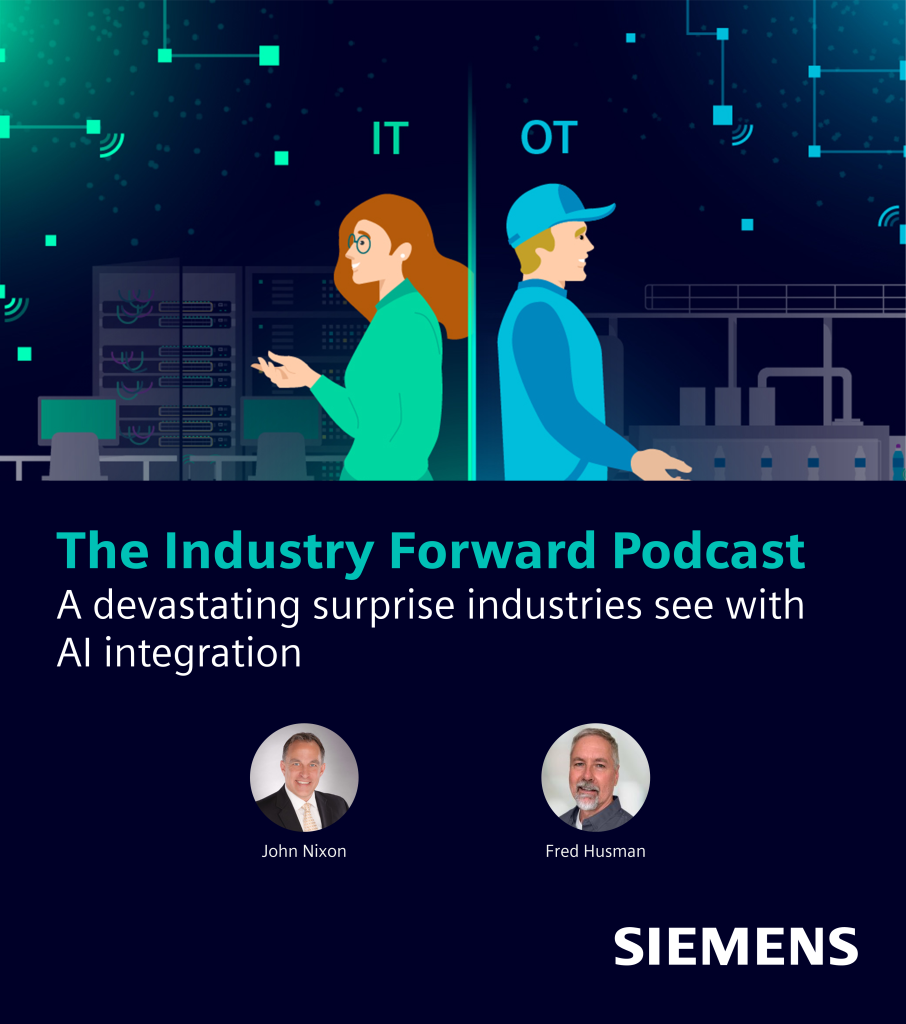
So, they’re thinking: IT, they’re thinking: cloud, they’re thinking: higher level. They’re not thinking about the OT layer, the [operational technology] layer.
So, they’ll start down that path by partnering with like an IT-centric vendor. And what I’ve seen is … those IT-centric vendors, I won’t name one, but they don’t know much about the OT layer. They don’t know how [to] get that data and contextualize it and put it in there.
And quite frankly, they’re not interested in learning about it. I wouldn’t say it’s like beneath them, but kind of. They don’t want to work down in the OT space. They want to take it from the data lake and take it from there, which they’re great at.
But you need a vendor that can do both sides: OT and IT. If you have a vendor that can help you with the OT-IT integration, that’s what you need. We’ve had several customers go down the [path] under contract with an IT vendor. And then they’re still floundering a year later to get the data out.
And then they come back to us and say, “hey, that other company didn’t have the OT chops. Can you help us?” And now we’re working with them.
John Nixon: Okay, so that is a very good point. I think in the headlines, what we hear about is industrial AI, and AI this, and [AI integration] that. It’s always on the IT side of the shop that really a lot of the focus is [on] out in the world.
And you’re sitting here going, “Ladies and gentlemen, let’s not forget about the actual data coming off the machines on the factory floor that power all of that.”
Fred Husman: And the beer is made on the OT layer.
John Nixon: There we go.
Fred Husman: Without the OT layer, nothing gets made.
John Nixon: Well, then the OT layer is the most important to me now. Fantastic. All right.
Well Fred, you just answered the question I was about to ask! So, we can skip that as we’re also at time. John laughs.
Fred, thank you for being on the podcast today. It was a pleasure having you.
Today, we dove into the world of digital transformation within the process industries.
We explored how companies like Constellation Brands, with the help of Siemens and SkyIO, leverage the comprehensive digital twin and prepare for the industrial AI revolution.
We learned about the practical applications of virtual controllers in testing and the critical need for an integrated OT-IT approach to truly unlock the power of production data.
So, that brings us to the end of another episode of the Industry Forward Podcast. Thank you, our listeners, for joining us today. I hope this podcast helped you process your process industry questions. Have a great day!
To learn more about industrial AI integration, click here.

John Nixon – Global Vice President of Process Industries at Siemens Digital Industry Software
As Global Vice President for Process Industries at Siemens, John leads a global team that helps process industries leverage digital solutions that enhance efficiency, accelerate innovation and achieve sustainability goals.
John has over three decades of experience in strategy, operations and technology deployment for energy, chemicals, life sciences and CPG. He is well versed in the operational and business pressures of industry, including regulatory demands, decarbonization, talent gaps and the push for innovation.

Fred Husman – Senior Program Manager at SkyIO
As Senior Program Manager at SkyIO, Fred manages process control projects using Siemens automation platforms. He has designed complete automation and network architectures for customers in the brewing, semiconductor, and chemical manufacturing industries.
Fred has over 35 years of experience automating projects in the Process Industries. He spent the first 15 years of that time as a Project Engineer working on commissioning and startups. For the last 20 years, he has focused more on Project Management.
All trademarks are property of their respective owners.