How AI connects manufacturing data
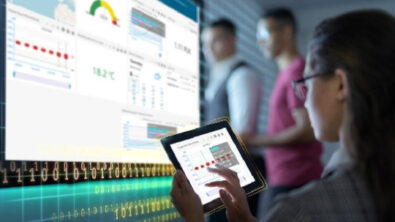
Data driven manufacturing represents the future of the manufacturing industry, allowing companies to connect intelligent insights with shop floor data and production processes. While the digitalization of industry continues to progress the next step – bringing intelligence to the collected data, offers a fresh, new set of challenges to overcome. AI will play a key role in this transformation, however, bringing sweeping insights to the tip of every users finger.
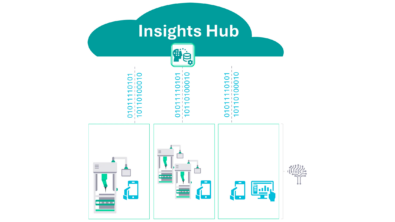
In a recent podcast, Ralf Wagner, Senior Vice President of Data Driven Manufacturing for Siemens, explored the four key areas Siemens Insights Hub applies AI to extract meaningful optimization from existing data. By building a platform that supports data intelligence it’s possible for end users, not just data scientists, to realize tangible benefits from all types of factory data.
Check out the full episode here or keep reading for the highlights from that conversation.
Applying AI to the shop floor
Ralf starts the conversation by going over the four main approaches to AI he and his team are taking with Insights Hub. Since many manufacturing companies don’t have a large number of data scientists on staff, a major focus for AI in Insights Hub was to produce tools that could be used by non-AI experts. To achieve this, their first major AI application is offering out-of-the-box AI solutions.
With many tools on offer, Ralf highlights Quality Prediction as a powerful out-of-the-box AI tool that helps minimize waste and production errors by using AI to help predict, before the part is even finished, whether it will pass quality inspection or not. Beyond the obvious benefits of a tool like this, the fact that it can be deployed quickly and easily even by non-AI experts makes it highly valuable, allowing for immediate benefit and building trust in AI-powered tools as a whole.
AI is also ideally suited to handling large datasets, such as time series data, which is where the second key application comes in. Connecting data with pre-trained AI models makes it easy for users to identify problems at a glance. AI can filter through sensor and production data to find anomalies and raise alerts before they become major problems, including making connections between different datasets that might have otherwise gone unnoticed.
For companies that want to put more of a focus on developing AI models in house, Insights Hub also offers comprehensive AI model management solutions since, as Ralf says, data has gravity. Moving data, especially large-scale IIoT and production data, around costs money and has unique challenges associated with it. By contrast, AI models are much smaller than the data they work on and are far easier to move around. Building a framework to make sure data, models and compute resources can be securely connected to each other as needed is also a key part of enabling a robust, data driven manufacturing solution.
As with all AI applications within Insights Hub, their final focus area is also centered around making tools more accessible. The Production Copilot provides a simple, natural language interface for accessing tools and data, connecting people and information seamlessly, especially in manufacturing and maintenance areas where getting critical information has traditionally been a more difficult task. Thanks to the power of generative AI, thousands of pages of references material and years of historical data can be summarized and searched in an instant, making important information available to anyone.
The move to data driven manufacturing
For all the different AI applications Ralf and his team are developing, the core goal remains the same: to make decisions and reach the root cause of problems faster. Manufacturing companies have long relied on continuous improvement processes to get the most out of their resources and now, by leveraging AI as well, those improvements can be taken to the next level.
Connecting data across everything from maintenance logs to MES systems makes that data all the more valuable for the added context these connections provide. While the sheer volume of data would make it difficult for a human or traditional algorithms to analyze efficiently, applying AI to the problem will only increase the value of that data further, as it’s capable of making sense of the sea of connected information tools like Insights Hub can provide.
The move to data driven manufacturing will unlock a wealth of optimization to support a more rapid pace of innovation within the manufacturing field. To reach those goals, however, intelligently applying AI will be a key aspect of this move as well, since it will take on the role of making connections and increasing tool accessibility for users in every step of the manufacturing process.
To find out more, click here.
Siemens Digital Industries Software helps organizations of all sizes digitally transform using software, hardware and services from the Siemens Xcelerator business platform. Siemens’ software and the comprehensive digital twin enable companies to optimize their design, engineering and manufacturing processes to turn today’s ideas into the sustainable products of the future. From chips to entire systems, from product to process, across all industries. Siemens Digital Industries Software – Accelerating transformation.