Building Industrial AI for the shop floor – Podcast Transcript
Robotics have been a staple in manufacturing for decades, allowing certain repetitive tasks to be automated yet, for as powerful as automation is, replicating full human-like abilities is difficult to achieve. By incorporating AI with advanced robotics, a new level of flexible, adaptable, robotic systems can not only take on tasks previously limited to humans, but also support rapid product iteration and development in a way never before possible.
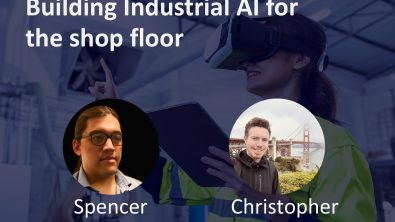
In this episode, host Spencer Acain is joined by Christopher Schuette, Senior Product Portfolio Manager for Robotics AI at Siemens Digital Industries to examine what it takes to build production ready Industrial AI solutions capable of operating complex machines under a variety of conditions.
Check out the full episode here or keep reading for a transcript of that conversation.
Spencer Acain: Hello, and welcome to the AI Spectrum Podcast. I’m your host, Spencer Acain. In this series, we explore a wide range of AI topics from all across Siemens and how they are applied to different technologies. Today, I’m joined by Christopher Schuette, Senior Product Portfolio Manager for Robotics AI at Siemens Digital Industries. Welcome, Christopher.
Christopher Schuette: Thanks, Spencer. Great to be here, and hello to all listeners.
Spencer Acain: To start things off, Christopher, could you tell me a bit more about yourself and your work at Siemens?
Christopher Schuette: Yeah, for sure. So I’m working for Siemens quite a while, starting directly after my study of mechatronics. I started in customer services. I wanted to explore the fields out there to how users, what they’re doing with our products, with Siemens products. And after that, also some time in system testing, product testing, and also training our customers in new products, I turned to business development to just follow the question, how’s the future of automation look like? And can I shape it or be part of it? And one of these parts in business development was great to be at the birth of a new vertical that is called vertical into logistics. What is an amazing feel of new technologies, shuttle systems, AGVs, robotics, all these great things that happen there and that brought me to an own initiated project that turned now to a complete product line where we started in to exploring the field of ai enabled robotics and as you said I’m now the Product Portfolio Manager in this field of robotics AI products that focus on AI-powered applications that you can upgrade off-the-shelf robots with.
Spencer Acain: Great. So it sounds like you’ve really been in this from the start. Can you tell us a bit more about those AI-powered robotics? How are you upgrading robotics? What does that look like? And why is this technology important?
Christopher Schuette: Oh, yeah. why it’s important so we identified that uh I take some studies so mechanical also the words tell us that around 50 to 60 percent of work in manufacturing are still performed by manual labor forces and they’re not fully roboticized or automated and around 50 to 40 are just in dynamic changing environments and where traditional automation cannot catch up its widget. So it struggles in performance. And for that reason, humans still need to perform repetitive robot like work in a time where the labor pool of workers are shrinking, especially in industrial countries and the payment of that workers are rising. So the economic pressure is high that are the foundation of what we’re doing and what we’re doing is um so our first product is probably the one of the first in the area of physical AI that terms try to explain or differentiate the digital AI that is behind your screen that helps you to navigate that helps you to search in search algorithm and also the chat gpt is for sure something like in this area but the physical ai touches our real world so it’s intact with real world um and it sees reason and act in dynamic changing environments that is complete new paradigm if this realize as we think it will be and the first product that we bring up was in the portfolio pick ai that enables any robot to pick items that it has never seen before without training by the user, very easy to use, very easy to integrate in existing machines, new machines. And that was just our start point.
Spencer Acain: Yeah. So it sounds really like you’re kind of addressing that core issue, like you’re saying, of robots are very static in the past in the way they can pick stuff. So you have this… you know just ability to handle whatever at any time and then um but how is that from your ability to leverage like more advanced ai now like our how are you seeing the technologies that type of technology improving with you know with more powerful ai accelerators available because really this is something that’s um that requires that kind of extra power to be able to just do that human-like tasks without much training without any training For example, I know Siemens is starting to integrate like NVIDIA accelerators in their PLCs. Is this something you’re able to take advantage of?
Christopher Schuette: Oh, yeah, definitely, Spencer. First of all, we learned very early that we in industry want, yeah, we have to think in industry and system values, not in isolated technologies. To your question, so combined PLC and it’s fact that the most of the industrial process out there are today PLC based. um needs to somehow merge or integrate with what is possible for ai today that is powered by gpus also for an NVIDIA and for that it’s very good to see that siemens NVIDIA joining forces building waiting systems and that it merging closer and closer together. So we make the experience to have GPU power technology very close to the PLC. And then we learned also to have it separate in a PC is also worth it, and then have a better interfaces that is at the moment a pro progress and I’m very happy that we’re also driving the way toward a software defined automation concept and the idea behind that is to bring automation to a level where it comes from a one off specialized machine for one customer to a modelized product that you can scale out on the market with less engineering effort and you can achieve that by having the IT-OT convocation. You take the engineering methods from IT that was built over decades and convert it to the industrial level. That is what we’re doing with products like the automation expansion product that is giving you an IT-like engineering. On the other hand, to answer your question, on the GPU accelerator level, we have more and more products here that are taking that type of hardware, combining better to the PLC world, and also to the level where the PLC get even virtualized. And you can put that on one device, but also great. And also, you can deploy that with a concept like Industrial Edge. So all these things are perfect, and it’s really system value. But I want to tell you what we learned to use bigger AI models. So our R&D teams come from AI-based computer vision for post-estimation at the very beginning. And we released just last year a second product tier that use also an industrial grade foundation model for segmentation of random items as is one part of our product and it helps to provide our users with more information about the unknown item so at least length the with the orientation. It’s also part of an intelligent suction group activation feature that adapts to the multi suction gripper used to adapt to the item size position in the room. And at the end, it’s for the user less tool change and picking in a very wide range of items just by advancing the architecture of neural networks. And we have another core metric that is the end-to-end compute time. And we learned with the huge foundation model that I just named. It took us from some milliseconds. So the first tier of our PKI was able to run on a tablet PC like CPU without a GPU. That was OK. The new version edition needs a GPU because it takes with all GPU over two seconds to compute. That is not good when you have a very high performance machine. So you need this GPU integration to reduce the performance and to compute time heavily. That is obvious and very great to have it so integrated with NVIDIA together and It’s so great that we are getting more and more friends here with the NVIDIA colleagues. We are in regular exchange and bringing this infrastructure in a more tangible system value way on the market. Very curious about what will happen also in the future here.
Spencer Acain: Yeah, no, I can imagine. But kind of to pivot from that, like, you know, you have all this extra power available now in the PLCs on the factory floor with these accelerators. But to reach the kind of goal that you’re talking about of just being able to have a robot that’s picking anything and everything without any training at the end or very little training at the end, is that how much back-end training has to go into these AI models? Is it all… Like, do you pre-train it completely and then just ship it out and then the customers don’t need to do anything else? Or do they have to train as well? Or how are you managing that kind of training of these models to be able to handle these diverse situations?
Christopher Schuette: Unfortunately, I can’t give a very clear answer to that, but let me try it. One of the fundamental product decisions we did is if we want to give these retraining capability in the hands of our users, which are integrators and OEMs of these creators of advanced robotics solutions with all its complexity. So they need to get the data, they need to label it, retrain it, test it, or if we make their lives easier, as easy as possible, and keep the retraining in our product team. And we decided to take it in our product team and give the OEMs integrators an out-of-the-box performance model. And in the case the model not reaches the performance that we expect or they expect, we are able to retrain these models. And how big is this effort to do so? Just to give you a thought, we have a product that the value proposition is that it can grasp the most of the items in the warehouse, nearly to every item in the warehouse we are on the way to, to get there. It’s different to these approaches where you specifically train one item in manufacturing, probably in a neural network. And it, it works in reliable for that one out for another one. So isn’t especially why we take these training in our capability in a product team, because we cover item classes, not a specific product that is fed by CAD data, for example and how big is such an effort. It took us up to three years to come from a little baby network for five degree of reasons, peak pulse detection and computation with really good industrial grade performance to what we have today, a multi-sectional group already deployed the field neural network, the foundational model backed, that really makes a job in operations. So three years of collecting data, firstly from synthetic data, from simulation, because it’s cheap to generate and easy to generate, but it turns out that you need to find other ways to make really a reliable industrial grid.
Spencer Acain: So beyond that synthetic data you were just talking about, how were you able to get all the training data then? Obviously, like you said, you can’t just use CAD data or synthetic data for this. So you needed a lot of real data to pre-train and develop your models. So where were you able to get all of that?
Christopher Schuette: Yeah, good question. The underlying challenge most companies working on physical AI face is the limited availability of large-scale real-world robotics data. Models like GPT were trained on internet-scale datasets, and we don’t yet have an equivalent data foundation for robot learning – so the data gap remains very large and is probably one of the biggest challenges for model performance and market success. This is well recognized across the technology field. For applied robotics AI systems in industrial settings, continuous improvement depends heavily on operational real-world data, particularly edge cases. This includes vision data along with contextual signals such as system states, also from the PLC, and outcomes. For example perception foundation models like segmentation models are training on large curated, labeled datasets – often still involving significant manual annotation effort. Looking ahead, visual action models promise to generalize manipulation skills across tasks and environments.
To achieve this, richer training datasets are required. Today a combination of visual observations with trajectory-level motion context. This allows models to understand the scene and adapt directly the robot motion to it. The technology field is evolving quickly. Within a year, entire foundation model architectures can change several times – driven by new research insights. And this significantly advance the maturity of the technology. One constant will probably stay – a infrastructure to feed the need for large-scale data collection and continuous model improvement – its this vision behind mostly automated data flywheel. In the foreseeable future, real-world data stay a must, not optional, to achieve industrial-grade performance. That is why we are actively building these capabilities within our product team.
Spencer Acain: Yeah, I mean, obviously, building that kind of infrastructure and designing that isn’t something you want to have everybody doing on their own all the time. But that is all the time we have for this episode. So once again, I have been your host, Spencer Acain, joined by Christopher Schuette on the AI Spectrum podcast. Tune in again next time as we continue diving into what it takes to bring AI automation into the factory.
Siemens Digital Industries Software helps organizations of all sizes digitally transform using software, hardware and services from the Siemens Xcelerator business platform. Siemens’ software and the comprehensive digital twin enable companies to optimize their design, engineering and manufacturing processes to turn today’s ideas into the sustainable products of the future. From chips to entire systems, from product to process, across all industries. Siemens Digital Industries Software – Accelerating transformation.