Building a framework for AI assisted engineering

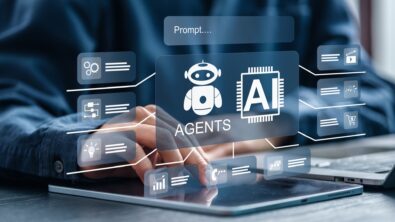
Artificial intelligence is here to stay, with agentic AI being the latest addition to the roster of AI technologies that have materialized in recent years but realizing the potential gains of these advancements requires careful planning and forethought. For all its potential benefits, adopting AI into industry isn’t a simple task with many, very real, concerns that must be addressed before widespread adoption can happen. As those hurdles are gradually cleared though, AI will begin to offer increasing benefits across the breadth of the engineering lifecycle.
In a recent podcast, Shirish More, AI Program Product Manager at Siemens and Michael Taesch, Senior Director of Product Management for NX Manufacturing, explored these questions of what it will take for AI to reach adoption across industry, and what the industry will look like once it does.
Check out the full episode here or keep reading for some of the highlights of that conversation.
The framework of agentic AI in industry
Trust has been an ongoing challenge for AI adoption since its inception. To fully reap the benefits of AI, it must be allowed to function in a largely autonomous way yet, especially with generative AI systems, errors and hallucinations are still possible or even likely depending on a particular task. This requirement of trust only increases with agentic systems since, by design, they function with a higher level of autonomy than a simple chatbot would. If the dream of complex, multi-agent systems is ever to be realized, then answering the question of user trust is vital.
Trust can mean many things in many different contexts, but Shirish highlights two important examples when it comes to AI in industry. First, results generated by AI systems or agentic frameworks must be trustworthy, after all, if engineers must second guess every AI generated result, they have no value. This is a key challenge that both his and Michael’s teams are working to address, ensuring that every result created by AI is grounded in fact and validated for the level of quality expected in industry.
Secondly, AI must be trustworthy enough to handle sensitive data, such as a company’s proprietary IP. AI models aren’t always the best at following guidelines, so ensuring sensitive information is only available to those who should have access to it is a must for any large-scale AI deployment as well. Today, attempting to address these problems is usually done through a less than perfect combination of many different tools and platforms but, going forward, an ideal solution would be to have a single, integrated, out-of-the-box framework that handles trust at every level for industrial grade AI solutions, allowing for easy and safe deployment of advanced AI tools, a goal being worked toward by Shirish and Michael as well.
How AI will assist engineering
The role of AI is not, and should not, be to fully replace humans but rather, as Michael says, to empower them. Combining AI with expert users allows repetitive and menial tasks to be offloaded which in turn supports experts who have years or even decades of experience to work with greater freedom and creativity. This kind of expertise is not easily taught to AI, and in fact it may not be possible at all, yet AI remains a powerful tool to increase both creativity and productivity.
The key, as Shirish says, it to apply AI intelligently to domain-specific problems, keeping it practical, responsible and ethical while also deeply embedding it in workflows where people already work – keeping the human in the loop. Rather than completely reimagining the design process with new steps or methods, seamlessly integrating AI allows these processes to become faster and more convenient. In some cases, users may not even know AI is helping them. Instead, they’ll know a task that once took an hour now takes only a few minutes and they can get back to the important work only humans can do.
Artificial intelligence isn’t going anywhere and is already moving from a lab project or hypothetical to a real product that can offer real results, yet these are only the first steps it will take. The path ahead for AI isn’t an easy one with many hurdles still to overcome but for all those challenges, the potential for improvement is too great to ignore and, as they are overcome one by one, AI will become an increasingly powerful tool across every step of the engineering cycle.
Siemens Digital Industries Software helps organizations of all sizes digitally transform using software, hardware and services from the Siemens Xcelerator business platform. Siemens’ software and the comprehensive digital twin enable companies to optimize their design, engineering and manufacturing processes to turn today’s ideas into the sustainable products of the future. From chips to entire systems, from product to process, across all industries. Siemens Digital Industries Software – Accelerating transformation.