Building a digital first future for semiconductors
Bringing chips from concept to reality is a monumental task that requires vast expertise across many specialized disciplines, with the challenges mounting in every successive generation. To meet the demands of next generation chips, companies must be ready to leverage digital first technologies from design to manufacturing, especially when producing some of the most complex devices on Earth.
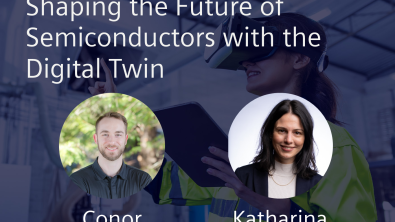
In a recent podcast, host Conor Peick was joined by Katharina Westrich, Global VP of Electronics and Semiconductors at Siemens, to discuss the importance of digital twin technology in chip design and manufacturing, how that can enable AI, and what it takes to go from design to functional fab
Check out the full episode here or keep reading for some of the highlights of that conversation.
Leveraging the digital twin
The digital twin is a powerful piece of technology and, as Katharina notes, the semiconductor industry was probably one of the first to use it. With as complex and expensive as chips are to design and build, the ability to simulate designs, examine performance and close the loop between the physical and virtual worlds is critical in efficiently tackling complexities and boosting innovation.
The first phase of a design project is often the most critical and having a strong digital twin foundation can help designers better make decisive decisions during crucial early design stages. Especially when designing chips, decisions made during the early stages of development can have an outsize impact on the final result with little ability to go back and make changes once a critical point has been passed. By leveraging digital twin technology, it becomes easier to run the countless simulations required to understand the way a chip will behave once it has been manufactured.
The digital twin also lays a strong foundation for AI. As Katharina says, the semiconductor industry is rapidly growing and expected to face a significant talent shortage over the coming years. AI is one way to help alleviate this by offering the ability for engineers to do 5 to 10 times more than they’re already doing with its ability to multiply the engineering effort put into various stages of the design to manufacturing process.
Realizing chip to factory
Chip manufacturing, especially memory, is a cyclical business. To help companies manage this risk while also supporting the costly and complex nature of semiconductor fabrication, factories are increasingly being built digital first, Katharina explains. This means integrating technologies like digital twin and AI right from the outset to help optimize not only a chips design but the fab it will be produced in. Material flow, operations, staffing, logistics; bottlenecks can be identified digitally in all these areas and more and quickly optimized through the use of a digital first approach.
Before companies can start applying technologies like digital twin and AI, they must have a strong data backbone to support it. This single source of truth is required to ensure everything from digital twins accurately reflecting the exact state of a fab at any given moment to AI producing grounded results. After all, in the age of AI the problem of “garbage in, garbage out” has never been more relevant.
This means the first step on a digital journey is often to build out this robust data backbone through integration layers, PLM systems and more to ensure this technology can be applied the right way. In the semiconductor industry especially, 60% of companies use more than six systems to store or access their product lifecycle data. Bringing all that data together in a way that can be used seamlessly by other digital technologies is a key challenge but also an opportunity for companies to see real benefits as well.
In an age of rapid change, digital evolution and AI, embracing a digital first approach for the future is a must. In an industry as complex and cutting edge as semiconductors, this is truer than anywhere else. In order to create a new generation of chips to meet the challenges of tomorrow, the semiconductor industry must start by laying the groundwork for future digitalization today.
Siemens Digital Industries Software helps organizations of all sizes digitally transform using software, hardware and services from the Siemens Xcelerator business platform. Siemens’ software and the comprehensive digital twin enable companies to optimize their design, engineering and manufacturing processes to turn today’s ideas into the sustainable products of the future. From chips to entire systems, from product to process, across all industries. Siemens Digital Industries Software – Accelerating transformation.