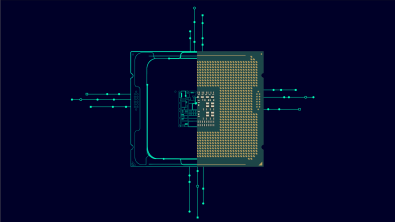
AI accelerates efficient chip design

AI is finding a place in all sorts of new products and industries but as adoption continues to accelerate, key concerns around efficiency and power consumption represent very real challenges to overcome in areas where power consumption and space represent invariable constraints. To overcome these challenges, a smarter, more flexible approach to designing AI accelerators is key – something that AI itself may be able to help with.
In a recent podcast, host Spencer Acain was joined by guest Russell Klein, program director for Siemens EDA’s High-Level Synthesis (HLS) team to explore the applications of HLS for AI chip design as well as the potential applications of AI in that process. AI and machine learning offer great potential in the EDA space to address complexities that have traditionally been too difficult to automate or approach problems in ways that weren’t practical before.
To learn more, listen to the full podcast here or keep reading for some of the highlights of that conversation.
Combining AI with HLS
High-level synthesis is a method for turning algorithms into chips, effectively designing specialized chips to efficiently execute specific algorithms. AI, at its core, is nothing more than a series of sophisticated algorithms so by applying HLS to them instead of using general purpose AI accelerators, its possible to produce chips that can execute specific algorithms with far greater efficiency than any general purpose chip could manage.
This, in turn, helps support the adoption of AI into applications where power is a major limiting factor such as smartphones, factory robotics or even embedding smart functionality directly into sensors. These types of applications have very strict requirements when it comes to power consumption and heat dissipation but could also benefit greatly from on-device AI that can quickly complete tasks like speech recognition, image classification or presence detection.
Augmenting chip design with AI
While HLS is a powerful tool, it is only a single part of the highly complex chip design process which, as chips grow more complex themselves, is only becoming more difficult to learn and efficiently manage. AI offers the potential to help assist in that process, making tools smarter and easier to use while providing greater clarity and efficiency into the chip design process itself.
One area that AI is poised to make a big impact is in heuristics. Currently, the process of going from algorithm to chip design is involves making numerous assumptions, decisions and tradeoffs when it comes to deciding how data is stored, retrieved and processed on chip. HLS tools, like Catapult, use heuristics to make these decisions based on data gathered over numerous projects which can then be further fine-tuned by an expert user. However, this process is still very rigid, with selections made by cutoff values and hard-coded conditions.
Replacing these rigid heuristics with machine learning has the potential to further improve efficiency since decisions can be automatically informed by the context of the specific algorithm being implemented; a heuristic that might make sense in general might not for a specific algorithm or vice versa. While this was already possible through manual expert adjustments, there is a steep learning curve to reach that level of expertise and, with hundreds of possible parameters to tune in millions of permutations, it is not always feasible to employ such a level of manual adjustment.
AI and machine learning have many potential benefits to offer complex tools, like those found in the chip design process, with their ability to inject human-like intelligence in areas too complex and nuanced for traditional automation or manual adjustment. This in turn will help drive AI adoption through the design of specialized more efficient chips that can bring AI into devices where it is difficult or impossible to today, making it an important step in the AI revolution that is reshaping industry.
Siemens Digital Industries Software helps organizations of all sizes digitally transform using software, hardware and services from the Siemens Xcelerator business platform. Siemens’ software and the comprehensive digital twin enable companies to optimize their design, engineering and manufacturing processes to turn today’s ideas into the sustainable products of the future. From chips to entire systems, from product to process, across all industries. Siemens Digital Industries Software – Accelerating transformation.