How to make healthcare systems that rival science fiction – Transcript
For the show notes of this healthcare systems design podcast, click here.
John Nixon: Hello listeners! Well, welcome to the Industry Forward Podcast! The program where we explore the key trends, transformative technologies and real-world innovations reshaping fields from aerospace to energy and beyond.
I’m your host, John Nixon, Global Vice President of Process Industries at Siemens Digital Industries Software. And today I’ll be talking with Patrick Ansems, the Global Head of Life Sciences at Siemens Digital Industries Software.
Today, we are going to talk about the future of the Life Sciences industry and how we are now starting to develop treatments that are right out of Science Fiction (sci-fi). But to get to that sci-fi future, we need to dig deeper into how bodies work and how we monitor them.
We’re just scratching the surface of what data can be discovered about human bodies. I mean, I’m excited about what we’re going to be able to provide this industry.
I mean, Life Sciences organizations, they work with the most complex systems (healthcare systems) we know. And of course, the most complex system, of course, is the human body. And many of the relationships and dependencies in the body are still being discovered.
We’re therefore having to collect just an incredible volume, variety, and veracity. There’s this volume of data on the human body, as never before that we’re uncovering, and we will continue to uncover.
I’m going to ask you about the product development perspective on Life Sciences. And I think this is where the conversation is going to get really interesting because in Life Sciences, we’re collecting all this data for a reason. It’s fundamentally about reducing uncertainty in the most complex system we know, right? As I said, the human body.
And from a product development perspective, what that means is we’re going to shift away from this kind of trial-and-error model right, toward a much more data-driven, evidence-based approach.
So, why collect more data? Well, and it’s continuing to grow and what’s the context here, right? So first, variety or we have to understand the variability, right? How different patients respond, how biology behaves under different conditions.
Second, we’ve got to de-risk the development because the cost of failure is enormous, both financially and in terms of, and the most importantly, the patient, the impact to the patient, to that person.
The irony is more data actually then adds more complexity. It slows development. It’s not connected, right? It’s not, it’s not contextualized. So, the opportunity becomes as I see this, “how do we turn that explosion of data into something usable?” That’s what we keep coming back to.
So that’s where digital technologies, what you and I wake up to every day. If you can connect that data through a digital thread, right, as we say, a digital twin, a true one, right, with the provenance of the life cycle behind it, then we get to predict outcomes earlier, right?
We simulate the therapies or processes before you run them physically: dry lab, wet lab. Ultimately, we move towards a more personalized and adaptive treatment. So, I think the goal isn’t just collecting data, right? It’s making sense of it! And using it fundamentally to change how products are developed, tested and brought to market and, ultimately, are personalized for a patient.
Patrick Ansems: Agreed, right?
There’s already a lot of examples where [there are] personalized [medicines]. Think about CAR [T cells] therapies, right? Which are fundamentally [your] own isolated T-cells that are modified to treat cancer.[1] So, there’s already a lot of areas where that personalized medicine approach is not, let’s say, just a holy grail. It’s real.
But the question that we have, or the remark that I would like to make is, “how can we scale that?” Because innovation, those type of innovations need to move from “impressive for a very small group of individuals” to “impactful at scale.”
To me, in order to do that, those technologies that we have are … colliding with linear systems (healthcare systems). So, thinking R&D about an ELN (electronic lab notebooks) or just a LIMS (laboratory information management system) system or just an MES (manufacturing execution software) systems. Those systems (healthcare systems) don’t necessarily scale with the dynamics that we now have as an industry.
So, this is really where those digital twins, or digital threads as we like to call them, are going to be key. Because as organizations, we need to move across 3 essential pillars. First, accept that it’s going to be digital first. We talked about that at length. AI is here. It’s not going to go away. So, we just need to embrace that as a technology. So, utilize that at its fullest extent. But in order to utilize that, organizations need to have their data strategy in order. Because there’s no AI strategy without a data strategy.
The secondary pillar is simulation. Is that when we start to have these really complex processes and we would like to do some level of verification whether our hypothesis is correct, simulation is going to be very essential. Because we’re going to run into the world where the number of variables that we’re going to test are extreme. And if you’re going to do that in a manual sense, you have a lot of experimentations and a lot of risk associated to that. So, simulation is going to be a key forcing function to be able to test in silico that wide variety of options that you have.
John Nixon: Yes!
Patrick Ansems: But that model can only be good if you can optimize that continuously with information that is actually coming from the physical world. So, if you don’t find a way to connect the physical to the virtual world, your model can’t be verified. And if your model can’t be verified, the outcome of AI is still useless.
So, these three pillars are important. So, if I would like to give, let’s say, the listeners a piece of advice, right? Think about these three pillars. Think about:
- How are we going to transform my organization [into] a digital first organization?
- How I’m going to utilize simulation to be able to do an end-to-end digital twin of my product as well as processes?
- How can I optimize my model continuously utilizing information from the real world?
Whether that’s real world from the lab. Or whether that’s real data coming out of your manufacturing facility. Or whether that’s real data coming from the real-world evidence around your specific patients.
So again, to summarize, it’s all about product, processes and patients. If you can do them digital first, simulate it end to end and optimize it continuously, we are off into a very good state to really kind of go towards a more personalized set of medicines for our patients and also giving the ability to treat also patients that are now non-treatable because there’s not enough of them, right? Or because there are no drugs currently available.
So all of those things will hopefully, and as I said, I think a little while in the past is, “if I go with retirement, which is about 20 odd years away from now, and then we have [healthcare systems] in place where we can treat people based upon their genetic makeup, based upon the environmental conditions that they’re living in, and providing a cure that has an efficacy of over 90%, I would leave this world and Siemens also as an extremely proud person.” But until then, focus around digital first, simulation and optimize so we can work on the product, the process as the patient.
John Nixion: Absolutely. And we’re at time.
But I’m going to ask you, because as you’re talking about digitalization and simulation, you talk about product process and patients and how that’s driving volume, variety, and veracity, right? So, all of these challenges in front of us.
But if we have a little bit of fun here towards the end and we look at the world of science fiction, right, which often has been predictive of what has become actual reality. You know, from a life sciences perspective, what sci-fi, what science fiction will we look like in the future? I mean what inspired you from science fiction?
I mean, I’ll tell you what’s in my mind. I think about Dr. McCoy in Star Trek. And how every time there was some kind of affliction, there was this ability to:
- Immediately passively read off what the challenge was,
- Understand how to treat it, or
- Be innovative in the moment, again, around a very specific exotic challenge.
And it was always exciting to me as part of the entire narrative of the exploration of space to see how important that Life Science aspect was to our journey as an interstellar species and the innovations we had around it.
You know to be able to lay on a “biobed” and it [can] immediately can pull all of the information about you as an individual right there and create that digital twin for treatment.[2]
But what’s inspired you from science fiction?
Patrick Ansems: Well, I’m not a big sci-fi fanatic. Just to be fair.
John Nixion: Oh, wait a minute! Why are you on this podcast and you’re not a science fiction fan?! Laughing.
Patrick Ansems: I know, I know, I know, I’m living in the world of, let’s say, “reality.”
But if you ask about inspiration, I think inspiration for me has not necessarily come out of sci-fi, but it’s much more grounded, right?
And, like we all have people that we have loved throughout our lives, whether it’s family, or friends, or kids, or parents. And we’ve all seen, we all have examples where somebody has been, let’s say, leaving this world because of a disease, right?
For me, the reason why I get up every day is not to make sure that doesn’t happen, because that’s a little bit of a utopia. You always get older, so there will be some reason why we will leave this beautiful planet of Earth. But if that could happen in a very healthy state and not based upon disease and people have a high quality of life, right? So, it’s not only about duration, but it’s also about the quality of their life. I think that is my reason why I’ve been doing what I’ve been doing for the last say 25 years of my professional career.
When I started in the lab, it was all about building molecules that would make people better. And as I transitioned into those lab informatics world, that has always been around, okay, how can I now optimize that process that when there’s a lot of very smart people in this world, right? There’s a lot of fantastic Nobel Prize winners, but this is a daunting statistic that I heard in another podcast, right?
If you think about the digital chemists, which are usually people that actually make the molecules, right? So small molecules, so drugs like paracetamol as an example. So, if you take 20 of them, there’s only one that will actually have the luxury to actually ever bring a product to market.
So, think about that for a little bit, right? So, there’s in certain of these organizations, these large form organizations, there are hundreds of those individuals and only a handful of them will actually ever make … a molecule to market.
That is not because of lack of diseases, but it’s because of the amount of diseases that we have and how we need to treat them. For lots of them it’s unknown or it’s very large and the entire chemical and biological space, so where we can design molecules, is 10 to the order of 60. So that is an astronomical high number. So, the probability of finding something that is successful is as random as trying to take a random key and trying to unlock a door that is locked down.
So, improving those alts where we can utilize data and a digital twin approach to actually increase those alts of bringing molecules to market at a good cost in good healthcare systems with patients that will have a high probability of getting good for what they’re having. That’s the thing for me.
And I don’t think that that’s sci-fi, right? I think we’re actually mentioned not too far away. And that’s what’s keeping me up. So, I’ve not necessarily been looking at it from a sci-fi perspective, but I’ve mostly been looking at it. Wouldn’t it be great if we would be able to give every human being on this living planet the most healthiest and the highest quality of life that they could endeavor to do? Whatever it is that they would like to do, love the people that they love, be the person that they want to be, and not be affected by a disease or any type of effect that we would have been able to fix.
So that’s my Holy Grail, I’m just giving everybody the quality of life and the duration of that life that they all deserve as a human race.
John Nixion: 100%. I mean, in all seriousness, I mean, you’re right. I would almost say we’re living through what was dreamed of in science fiction literature. It is a reality today.
And we are there, I can, I don’t, like you, I feel like the inflection point, it’s almost within our grasp. It’s like we’re moving through it now and it’s really exciting.
And I’ll say that I’m going to try not to be offended by the fact that when I brought up Star Trek and science fiction, you said, well, some of us live in reality.
I’m going to work really hard not to be offended.
But that’s okay. That’s all right.
Patrick Ansems: I mean, remember, Joe, the first conversation that you and I had. I know, between Star Trek and Star Wars.
John Nixion: I know.
Patrick Ansems: Go back into that point is like, I’m extremely bad at it. I know. Every person has flaws, that’s smart.
John Nixion: And now the whole world knows that there is a part of our relationship that we still have to work through. But that’s okay. That’s all right.
So, thanks for that. I really do, as always, we’re kindred souls in what our focus is here. So, thank you for that.
Patrick Ansems: Yeah, I’m really happy to be working with such a great team here at this company and stay with a great person like yourself. So, I’m pretty pleased with that.
John Nixion: Well, thank you. I think that’s a great place to leave this conversation.
When you step back, what we’re talking about here is really pretty remarkable. We started with the human body, arguably the most complex system we know, and this incredible volume, variety and veracity of data that we’re uncovering. But collecting that data, that’s really not the finish line. We have to connect it, we’ve got to contextualize it and actually put it to work.
And that brings us back to Patrick’s three pillars: become digital first, use simulation to understand products and processes before we move into the physical world, and then continuously optimize these models with real-world information.
If we can do that across the product, the process and, most importantly, the patient, suddenly some of those things we used to call science fiction don’t feel quite so fictional.
Personalized treatments, better outcomes, and a more human touch, and a healthier quality of life are increasingly within our grasp.
Patrick, thanks again for joining me. And to everyone listening, thanks for joining us on the Industry Forward Podcast. Until next time, keep listening, keep learning and, of course, keep processing your process industry knowledge.
All right, take care.
For on how Siemens helps to design healthcare systems, click here.
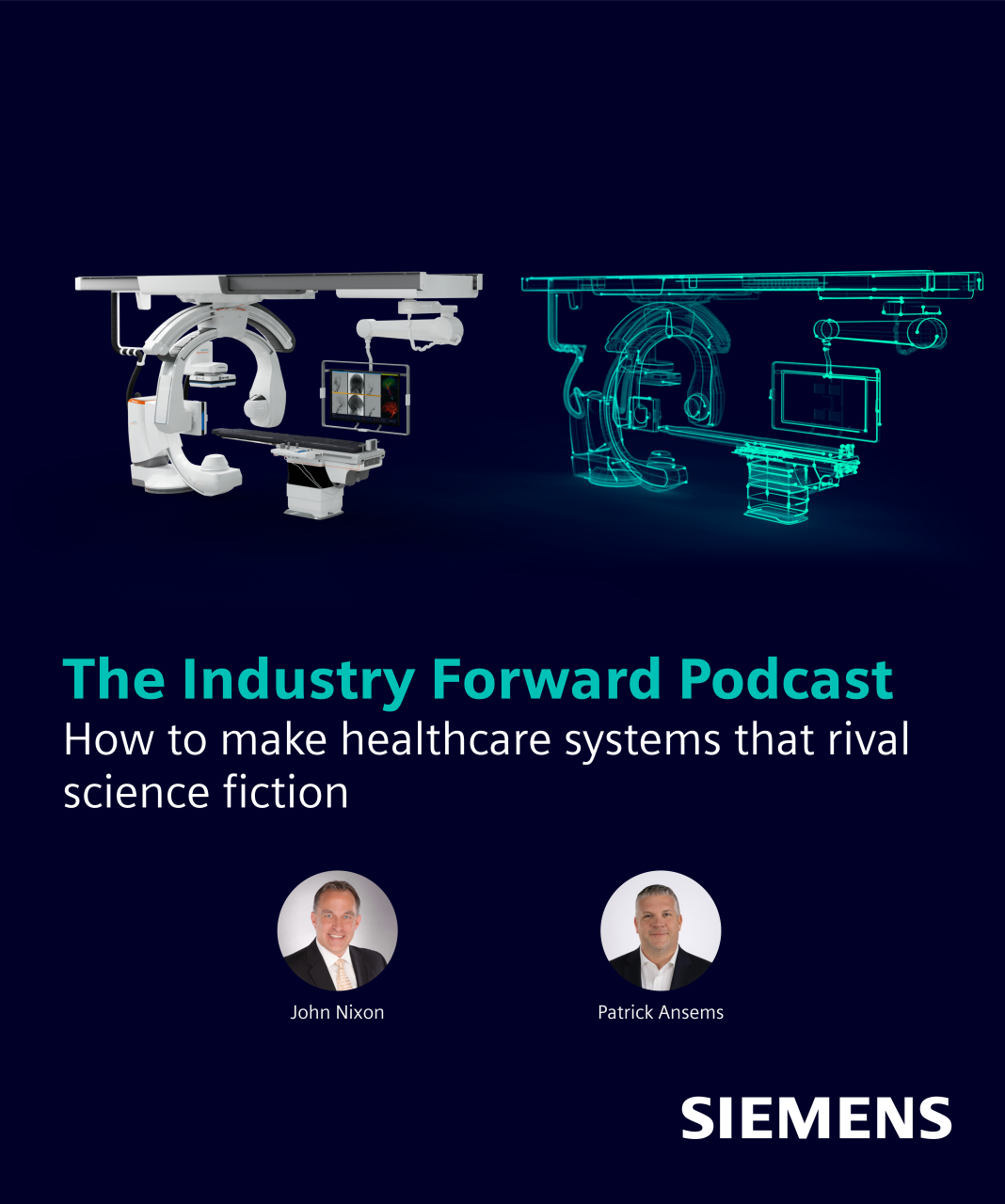

John Nixon – Global Vice President of Process Industries at Siemens Digital Industries Software
As Group Vice President for Process Industries at Siemens, John leads a global team that helps process industries leverage digital solutions that enhance efficiency, accelerate innovation and achieve sustainability goals.
John has over three decades of experience in strategy, operations and technology deployment for energy, chemicals, life sciences and CPG. He is well versed in the operational and business pressures of industry, including regulatory demands, decarbonization, talent gaps and the push for innovation.

Patrick Ansems – Global Head of Life sciences at Siemens Digital Industries Software
As Global Head of Life Sciences at Siemens, Patrick helps pharmaceutical and medical device organizations build comprehensive Digital Twin technology that spans development to manufacturing, and beyond. These tools accelerate innovation and deliver better therapies to patients.
Patrick has 25 years of experience ranging from wet labs to digital transformation. He understands the complexity of scientific workflows and how to translate them into strategies that deliver business outcomes.
Connect with Patrick on LinkedIn
[1] Cleveland Clinic, “CAR T-Cell Therapy: What It Is & How It Works,” last updated February 14, 2024, https://my.clevelandclinic.org/health/treatments/17726-car-t-cell-therapy, accessed October 2, 2026.
[2] Memory Alpha, “Biobed,” Memory Alpha | Fandom, https://memory-alpha.fandom.com/wiki/Biobed, accessed October 2, 2026.