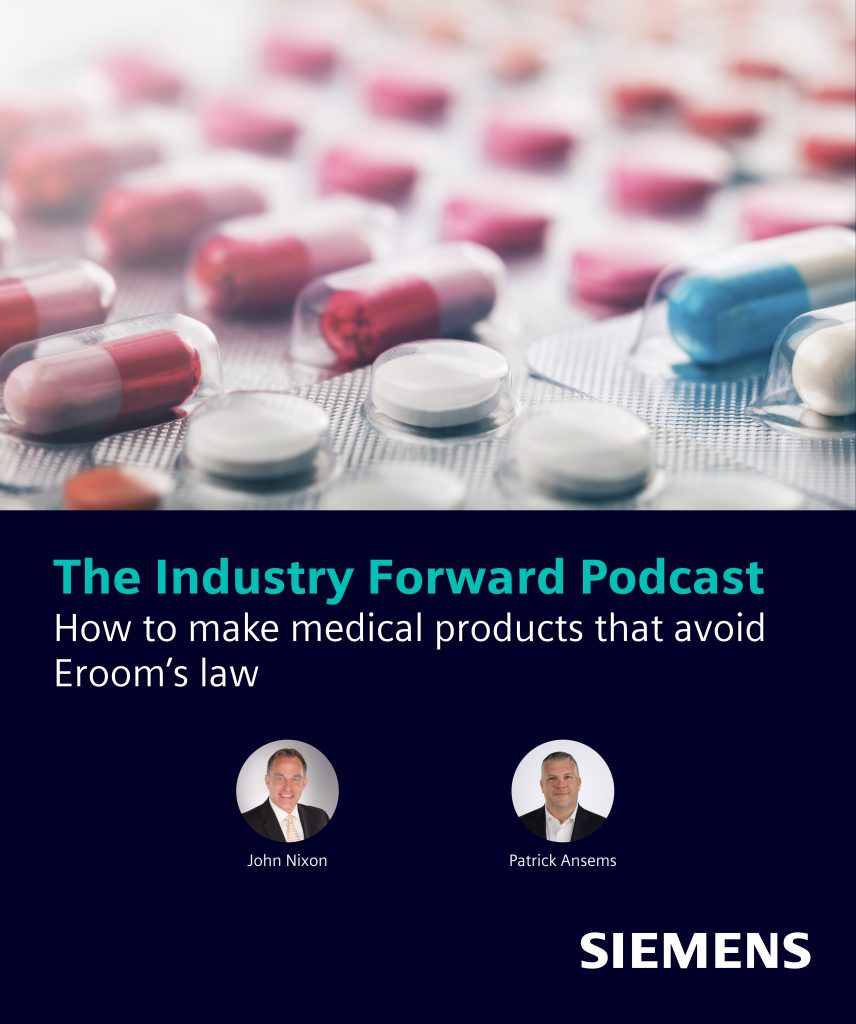
How to make medical products that avoid Eroom’s law – Transcript

To listen to the podcast on Eroom’s law, click above. To review the show notes, click here.
John Nixon: Hello and welcome to today’s episode of the Industry Forward Podcast. Where we explore the key trends, transformative technologies and real-world innovations that are reshaping fields from aerospace to energy and beyond.
I’m your host, John Nixon, Global Vice President of Process Industries at Siemens Digital Industries Software. And today we are continuing our discussion of digitalization challenges in the process industries. Today, though, we’re going to take a focus on the world of life sciences. And when we say life sciences, we’re discussing both medical devices and pharmaceuticals.
And I am happy to have our guest today, Patrick Ansems, the Global Head of Life Sciences at Siemens Digital Industries Software. Pat, welcome to the podcast. And can you tell our listeners a little about yourself?
Patrick Ansems: Yeah, hey, John. Thanks very much for having me. And I’m looking … forward to our conversation.
So, you asked me to introduce myself. So, I’m a molecular biologist by education, and I spent more than 10 years working in the life sciences industry. And before I moved into the world of software and digitalization, I’ve had so many of these challenges that we’re going to talk about today. And because I’ve [experienced] them firsthand, by working in complex and very regulated environments, I’ve seen how difficult [it is to connect] science, data and technology … in a very meaningful way.
So, for the last 15 years, I’ve worked exactly on that intersection of science, data, and technology. That’s the space I enjoy the most, because life sciences are full of brilliant science and brilliant people. But turning that science into safe, scalable and affordable products for patients is incredibly hard.
So, [in] my current role, I lead the Global Life Sciences business for Siemens Digital Industries Software, as you mentioned. And my focus is really on helping pharmaceutical, biotech, and med devices, as well as healthcare innovation companies reduce complexity, improve decision making and ultimately bring better treatment [approaches] to patients faster.
So as mentioned, I’m really looking forward to our conversation because I think this industry has a lot of potential, but also a lot of real pressures around cost, speed and regulation. And digitalization can help. But only if we make it practical, connected and grounded into the real-world challenges that our industry faces.
John Nixon: Yeah, and Pat, when I first met you, I did as everybody does, I checked out your LinkedIn profile. And I saw this arc of pharmaceutical and bioinformatics and this journey of digitalization that you’ve been on. It’s like you were on a vector for us to work together. And to me, it’s exciting every day when we get to do that.
So Pat, one of the things that you really brought into the conversation for us at Siemens is this concept of Eroom’s law. Like you’ve really [zeroed] in on that. And the concept of Eroom’s law is frequently discussed in the life sciences industry.
Can you please define the term for our audience and how does it relate to the time it takes to research, approve, regulate, manufacture and bring the new treatments that our species needs to market.
Patrick Ansems: Yeah, I’m more than happy to, because I think that terminology is really important for our listeners to understand.
So, Eroom’s law is very important because it captures one of the biggest challenges in life sciences that we have today. Which is all about bringing new treatments to patients. And that has generally become much slower, and much more complex and much more expensive over time.
[Most] people know the inverse of that, which is Moore’s law from technology. Where computing power improved dramatically while costs are coming down. And we’ve seen [similar progress] with part of life sciences as well. Take into example, let’s say genome sequencing. In the past, that was extremely expensive and therefore another capability that was supplied broadly. But costs have fallen dramatically and that has opened a lot of opportunities [for] research, and diagnostics [and] in personalized medicine.
But in drug development, it has fundamentally moved into a different direction. So, Eroom is of course [Moore] spelled backwards and that is intentional. Despite us doing better science, and building better instruments, and generating more data and having more compute power; the cost of developing a new drug has been estimated to roughly double every nine years.
And this is where many of the people now look at AI (artificial intelligence) and say, “well, that’s going to be our silver bullet. That’s the fix that will kind of untangle all that madness.” And I can really understand why that comment has been kind of generalized in public.
But AI can help us do and explore more biology and design better molecules and generate better hypothesis and make better and faster decisions. But AI only changes the equation if it scales across the entire life cycle. So, if AI helps us discover a molecule faster, but development is still fragmented, or tech transfer is still manual, manufacturing scale will depend on trial and error and regulatory evidence is still reconstructed through documents and handovers, [then] that bottleneck simply cannot move downstream.
So, for me, that’s the key point. Discovery alone is not enough if you can discover a promising therapy but cannot produce it reliably, and can’t scale it safely, and get it to patients through the required regulatory process, then that patient impact is still limited. So, AI is definitely part of the answer when we start thinking about … making Eroom’s Law turn more into Moore’s Law. But if you can’t connect data, … reserve context and avoid manual handovers between research and development. If we don’t bring in that foundational knowledge and do that, AI can only get us [so] far.
John Nixon: [Well,] Pat, you mentioned AI and I often hear that used over and over again. Obviously, right? We wake up to it every day. It’s on our smartphones. It permeates everything we do now as a species.
But my fear is that people see it (AI) as a magic wand. And so, I appreciate how you and I and the collective team of Siemens have really understood, “if you don’t have a data strategy, if you don’t take all these federated sources of information,” in the case of life science, you’ve got patient information, you’ve got a whole clinical trial management system and journey you have to go on, and the human body itself. I don’t know if you would reflect [on] this, but it seems to be truly the most complicated engine of life.
And for us to create this digital twin around it, and a personalized digital twin, it is this big final challenge that we see in front of us. And the more and deeper we go into research around the human condition, the more complex it appears. And so, for me, as we’re creating all this data around the human engine, right, the body of a human from brains to feet, in my view, it’s as if we’re uncovering ever greater complexity. And the only way we’re going to truly be able to apply AI to that is if we have a very profound data strategy.
Would you agree with that? Do you find that in front of you as well?
Patrick Ansems: Yeah, if I talk to customers, a lot of the conversation is structured around the following concept, “there is no AI strategy without a data strategy.”
And especially if you look at something as complex as a human being. I mean, think about that, right? I mean, Siemens is quite a big … engineering company, right? And that’s how most people will know Siemens. But one of the most sophisticated pieces of engineering is actually “the person,” right? That’s you, and me and the people that we love, right?
What type of system can you think of that is [as] comprehensive as a human body? [Where] positive and negative feedback loops [are] happening? Where there was also a capability to do self-healing, right? We all broke a bone, or we had, say, some type of wound that was self-healing in a way.
So, think about that level of complexity and then try to figure out how you’re going to model that to that extreme. It’s probably super complicated to do.
And if you don’t think about how you’re going to model such a comprehensive system, it’s very hard to start putting AI … on top of that, right? Because if you don’t have the data structured … as a foundational data fabric for you to build knowledge and intelligence on top of, then any of these AI investments are relatively useless.
And if you look at what most … industry experts are saying is that “there’s a lot of AI examples happening across research and development and manufacturing. But really to scale that, the consensus currently is that only one of the one percent out of [all] these AI initiatives that we do are [scaled] successfully.
So, there’s still a lot that we can gain. So, I would say, yes, AI is extremely helpful. There’s a lot of pockets where it’s providing already as we speak, a lot of value. But applying AI end to end on such a comprehensive system as a human being [is] something that we haven’t completely untangled yet.
John Nixon: Well, and when you have billions of people on the planet, and so that is billions of unique models to the human condition, it really demands a personalized approach.
So, let’s talk about that for a moment. Personalized healthcare has become a major focus of the life science industry in recent years. Explain, what does that mean? How will the pharmaceutical industry be able to, again, research, approve, regulate, manufacture and bring to market these bespoke treatments?
Wouldn’t Eroom’s law apply here for literally every individual treatment?
Patrick Ansems: It’s a very good question. And [the way] how I look at it, well, let’s first look at personal health care as such. It’s that it is moving us away from the fact that a treatment is going to be reproducible for every patient. If you look at the general efficacy of any type of treatment across different types of disease areas, think of asthma, or [diabetes,] or cancers. The studies are showing that there is a range between … 40 and 60 percent of the individuals that are just non-responsive to treatments.
So, there is no such thing as one treatment being applicable for the entire human race or the entire population because we are all different, right? We’re all part of the same species, but you and I are even different, right? We look different, we act different, but we’ve also been growing up in different environments. I’m based in the Netherlands; you’re based in the US. We have different environmental conditions that we live in. We might have different social economic conditions that we’re all living in.
[All of] those factors affect why treatment is working for one patient and not necessary for the other. So, if we look at that from a, let’s say, a treatment perspective. We need more of an upper platform approach, right? We need a more common and validated way of doing research and clinical development as well as manufacturing and provide regulatory approval where the foundation is controlled and repeatable.
Because if we don’t, we end up, like you’ve been mentioning, in a situation where every drug will need to be verified and validated in a similar way. So therefore, the economics of scale don’t necessarily apply to that anymore.
So, if we can’t do that and come up with a more platform approach, personalized healthcare cannot bend Eroom’s law curve, right? Only if we start combining connecting data, automation and digital twins and a very strong quality system, the goal can [be] to make healthcare much more personable and much more effective and also therefore much more cost effective because we’re going to substantially reduce the amount of money that needs to float around in our healthcare system because we are losing a lot of benefits.
John Nixon: So, it really does sound like a daunting challenge.
And by the way, to your earlier comment about [how] we grew up in different environments. I mean, I was raised in Texas. So, I live off BBQ and fajitas. So, I know my biome is going to [be] very different than yours there in the Netherlands.
Both laugh.
Patrick Ansems: It will, it will for sure, right? We have [many] more potatoes and vegetables. Zei gezunt (Translation: be well/healthy).[EW1]
So yeah, [and] of course, let’s mention that the climate is different.
So, [all] these things, [all] these factors contribute to us as an individual – next to our genetic makeup. So, if you don’t take [all] these factors into consideration, healthcare cannot become personal and therefore we will still have these large numbers of non-efficacy treatments [for] patients.
John Nixon: So, as you’re talking and I think about the true magnitude, and scale, and challenge about the variety of the human condition we see at scale with billions of people on the planet. The concept of a comprehensive digital twin, one that is truly personalized, is [one of the big challenges] in front of us.
I mean, the comprehensive digital twin, it often comes up in conversation with respect to scaling up processes from bench to pilot, right? And then we get to scale. But in the life sciences industries, it ties back in, right? It has another role with respect to what we’re talking about here, this individualized healthcare and personalized medications.
Could you take a moment and explain the role of digital twins for the life sciences industry across that life cycle of research, product development, manufacturing and personalized healthcare?
Patrick Ansems: Yeah, I’m glad you’re asking that question then.
The role of the digital twin in life sciences is all about helping us understand, predict and improve … complex systems before decisions become expensive or very risky.
And you already mentioned a classical example of scale up. You start with a process that works at the bench, then move that to pilot scale and eventually to a full manufacturing scale. And every [one] of those steps introduces risks, and the process may behave differently. Equipment may introduce variability. The quality profile might change.
So, a digital twin helps us model those changes much earlier. So, we can reduce trial and error and actually make better decisions before we start committing to physical production.
But in life sciences, to me, the opportunity is much [broader] than manufacturing. You can think about digital twins of molecules. You can think of digital twins of the product, of the process, the plant and even the production line. That is extremely important because the real challenge is not only the discovery part, or say like if you can’t discover it, but you can’t really deliver it safely, what is then the impact for a patient? That’s still extremely limited.
And this is also where life science is becoming so unique. We [have already] talked about how the human body is such an amazing piece of engineering. There’s not that many systems that work in such a complex way, but with thousands of [feedback] loops.
So, for personalized healthcare, the digital twin is not only about pretending that we can create a perfect digital twin copy of the human being. We’re not there yet, there’s a lot of things that we don’t know yet. But it’s about creating incremental better models to study specific relationships between the patient and the design of the therapy, the manufacturing process.
And one key point that we hear a lot when we speak towards our customers is all about context. The digital twin is only useful if we understand not just the data, but more importantly, the context in which that data was generated. So, was it lab data, was it pilot information, was it manufacturing data? Those are all created under different conditions. And if we lose that context, as the data moves from research to development to manufacturing, and to the end to the patient, we lose meaning in every step of that process.
So, for me, that [comprehensive digital twin] becomes much more than a model. It [becomes] the decision engine. So, it connects the real to the digital world, and it creates a closed loop mechanism where real-world performance can improve that virtual model over time.
So, this is why it’s also [so] important to have that as a foundation for AI, because AI needs trusted data. If it doesn’t have access to trusted data, it starts to hallucinate. And what is worse than an AI model that starts to hallucinate? We start to put trust in a system, but if that system doesn’t have access to the right amount of information, the outcome of that is as useless as it can be.
So, it needs to be built on reliable information to be able to make reliable decisions. So, in the end, if we’ve been able to execute that [to] the fullest extent, to [build] out the digital twin of the product, of the process, and the patient. So, the three P’s (product, patient, and process). That’s where we become much more productive, much more connected, and able to bring much better and safer drugs and treatments to patients in a much faster way.
John Nixon: Well, Pat, we’re going to have to discuss this further. We’re running out of time today on the … Industry Forward Podcast. So, we’re going to come back to this, but I want to thank you for joining me today.
Let me just [look] back at what we’ve just talked about. The main part of our discussion today was Eroom’s law. We realized that unlike Moore’s Law, it’s becoming more complicated. It’s becoming more complex. It’s taking longer to get the necessary developments in life sciences to the myriads of individuals that make up the population on our planet.
Driving personalized healthcare, which is a tremendous development for our species, right? It’s just not one solution for all. We realize that everybody, as you said earlier, nature and nurture coming together to create this unique individual with their unique needs. It’s going to be a daunting challenge for us because each one of those individuals will need their comprehensive digital twin. And the contextualization, the context necessary to then bring AI into this requires us to really bring in an incredible array of data that comes in service to that individual.
So, this is going to be a very profound discussion you and I need to continue. So, we’re going to be bringing you back for future episodes.
Well, I want to say I hope this helped our listeners process their process industry knowledge. Yes, always a pun at the end. And I want to thank you for listening. Come back, join us next time, and I look forward to seeing you.
To learn more about the healthcare offerings from Siemens, click here.

John Nixon – Global Vice President of Process Industries at Siemens Digital Industries Software
As Group Vice President for Process Industries at Siemens, John leads a global team that helps process industries leverage digital solutions that enhance efficiency, accelerate innovation and achieve sustainability goals.
John has over three decades of experience in strategy, operations and technology deployment for energy, chemicals, life sciences and CPG. He is well versed in the operational and business pressures of industry, including regulatory demands, decarbonization, talent gaps and the push for innovation.
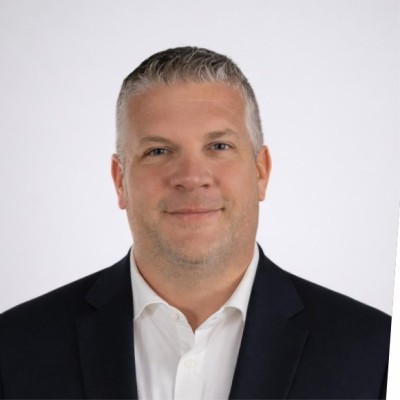
Patrick Ansems – Global Head of Life sciences at Siemens Digital Industries Software
As Global Head of Life Sciences at Siemens, Patrick helps pharmaceutical and medical device organizations build comprehensive Digital Twin technology that spans development to manufacturing, and beyond. These tools accelerate innovation and deliver better therapies to patients.
Patrick has 25 years of experience ranging from wet labs to digital transformation. He understands the complexity of scientific workflows and how to translate them into strategies that deliver business outcomes.