Thanks for the reactor. Now where is the digital twin? Transcript

Listen to the podcast on the digital twin or read the show notes, here.
Thiago Ribeiro: Welcome all. My name is Tiago Ribeiro, and I’m the Global Head of Energy, Chemicals, and Infrastructure here at Siemens Digital Industry Software, introducing the Boltzmann Reactor System. Digital transformation in chemical production.
And I’m here today with Ben Turner, who is the CEO of Latticept, but most importantly, the principal engineer. Welcome, Ben.
Benjamin Turner: Thanks so much for having me.
Thiago Ribeiro: You’re welcome.
So, I think this is a very interesting topic. We are seeing a fundamental shift in how complex industrial equipment is designed, validated and delivered. And moving from empirical, experience-driven engineering to physics first, digital first, right?
Benjamin Turner: That’s right, yep.
So now, computing technology has come so far so quickly. Now we can do chemical simulations that people really thought were impossible just five or six years ago, and they really were.
So now we can do actual simulations of physical assets that we deliver, and we deliver the digital twin at the same time. That’s the whole goal behind the Boltzmann reactor system. Provide the physical asset and the digital twin that comes with it.
Thiago Ribeiro: Right, this is very interesting.
And I’m a chemical engineer, and I have been working with [the design of] chemical equipment for quite a while. I’ve been working with computational fluid dynamics (CFD) for over 20 years. And honestly, speaking from my heart, CFD generally has two problems, right?
One is the learning curve. Sometimes it’s really difficult to start using it.
And the second part is, … it takes a lot to simulate real complex phenomena.
But what you’re saying right now is that technology caught up and we are able to design [equipment] much faster.
But before we get into that topic, can you explain to me what [a] Boltzmann reactor is?
Benjamin Turner: Sure, yeah.
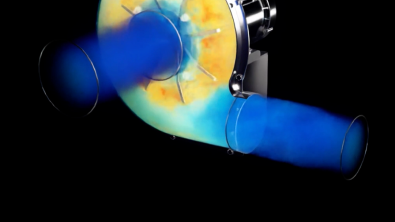
The Boltzmann reactor is a novel replacement for the half-pipe jacket. So, it actually started with just the jacket technology. I invented a new jacket known as the Omega jacket, which is a replacement for half-pipe jackets that we use on chemical reactors for heating or cooling the process.
So, it started with the jacket and then I thought, “well, actually, we should just sell the whole reactor.” So, I named it the Boltzmann reactor because it’s named actually after the process [that] we use to simulate [it], the lattice Boltzmann method.
So, you’ve got the reactor, the Boltzmann reactor. And it comes with its own digital twin, solved in M-Star (Siemens M-Star CFD), which uses the lattice Boltzmann method. So, that’s where the name Boltzmann reactor comes from. I borrowed his name because I was so impressed with M-Star and the lattice Boltzmann method.
Thiago Ribeiro: Right.
This is interesting because back in the days, when I was like dimensioning chemical reactors, I used to open those really old books and see all those correlations and all of those graphs. And I was wondering, where does it come from, right? Somebody did an experiment.
But, right now we have different materials that we’re producing. We have pharma industry, chemical industry. And what used to work not necessarily works anymore. We need to do simulation, right?
So, what you’re saying is that we—instead of trusting faithfully in old diagrams, we can simulate the complex phenomena that’s going on in those reactors. Is that what you’re saying?
Benjamin Turner: That’s exactly right. Yeah.
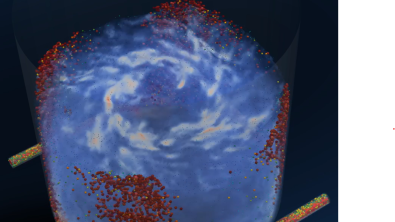
The actual mechanics inside of it. And that’s what I don’t think a lot of people understand how far and how fast this has happened. You know, literally in the last 10 years, you know, it used to be very impressive just to do a mixing simulation. You know, in M-Star, we do a mixing simulation in five, ten minutes—literally on a laptop.
But now we can also include reactions. We can include discrete elements, bubbles, mass transport. I mean, the actual chemical process is now completely simulatable on relatively inexpensive hardware. You know, we’re talking about gaming GPUs and stuff like that.
Thiago Ribeiro: Awesome.
Correct me if I’m wrong. So, you’re not just delivering the simulation, you’re delivering the real equipment with the digital twin.
Benjamin Turner: That’s exactly right. Yeah.
So, in your experience, you may have had to simulate a piece of equipment, right? So, what’s the first thing you have to do? You have to find the drawings and put [them] in the software, right? Yeah?
So, we’re kind of skipping that whole step. We simulate what you get in M-Star CFD. We provide you [with a] digital twin and we provide [you with] the actual physical asset. So, we kind of, we’re skipping a step here. You don’t have to go back, in the future, after you have problems and simulate what happened.
You know, hopefully in advance, if you’re going to have problems and how to mitigate those in advance. Really the ultimate goal here is to make M-Star, and Siemens really, the de facto standard for digital twin simulations.
You’re going to ask in the future, where is the M-Star digital twin file with this physical asset? I mean, that’s the ultimate goal, right?
Thiago Ribeiro: That is very impressive.
Because again, back in the days when I started using CFD, people were doing all of those cool simulations for designing equipment.
But again, when we manufactured the equipment, we would not use the file anymore. We would put it on a shelf. And only if the equipment had problems, [would we] go back to those files and we would revisit the simulations.
But you’re telling me right now, we’re not just using it to simulate and design those [equipment], but this technology is useful for the real operations. So, we’re moving all the information from the early design to operations.
And what are the benefits of that, Ben?
Benjamin Turner: The benefits really allow the flexibility of the operator, the user owner to make changes to their process and know what the effects are going to be before they just have an accident or just waste a bunch of money doing experiments.
Another additional benefit, we actually laser scan the entire reactor when we deliver. So, not only do you get a computer model of what the reactor is. We literally laser scan what the welds look like. We ultrasonically scan it. So, this is literally the physical asset [we] deliver.
So, in the future, you’ll be able to determine when you’re going to have a downtime, or when you have reliability problems. Because you’re going to be able to do fatigue analysis on the actual asset that you purchased for me. right?
And so, you can do all this process optimization, all of this reliability studies, all that in a computer, right? Before you spend any money in real life, you can do all of these simulations at a computer and you know they’re accurate because it’s literally what you purchased from us, right? The whole package.
Thiago Ribeiro: This is amazing. This is amazing.
Because again, I’m finding simulation to be useful in real operations. I can change the conditions [from what] the reactor [was] designed for. And we can see [how] those changes, [impacted] my production, right?
Benjamin Turner: That’s right.
Thiago Ribeiro: And it has impact in throughput and safety, reliability, and everything that people care about in their operations.
Benjamin Turner: Yeah, exactly.
So, a perfect example is like a mixing tank impeller. You know, if you open a book, a textbook, there’s a bunch of different shapes, but that’s not really what you order, right?
You order some unique impeller, we can simulate that actual impeller that’s put in the tank with the actual coil geometry, the actual spacing of the coil, all the different non-Newtonian rheology of the fluid itself.
All of those physics that would be very difficult to, without performing an experiment, to do in CFD. We do that in advance before we give you the reactor. So, you know it’s going to work. At least in a computer before you actually run it.
Thiago Ribeiro: Nice.
And from what I understand, [you are] providing us [with not only] the reactor and the simulation, but [also] the know-how, right?
Because as I mentioned in the beginning, CFD has traditionally been considered a very tough and difficult technology to start [to] use. But what you’re saying is that you also provide the support and make it easy and accessible for people that not necessarily have a CFD background.
Benjamin Turner: That’s right. Yeah, exactly.
I don’t really like these words, but they call it “democratizing simulation.” I think it’s got too many syllables.
But … we want to extend the knowledge of a PhD to layman chemical engineers. [So, they] can use these tools to do very complicated simulations without having to go to school for 12 years to understand what all these turbulence models mean and all this specific information.
So, we bake-in all those physics into our models so that your average operator, or maintenance engineer, can use these tools to get important information out of the software without having to become an expert in that specific field.
Thiago Ribeiro: Right, and those results come fast, right?
Benjamin Turner: It’s very fast, yeah.
Thiago Ribeiro: Because it uses [the] lattice Boltzmann algorithm that is very different from traditional finite element analysis (FEA) or finite volume analysis (FVA), right?
Benjamin Turner: That’s right, yeah.
So, Lattice Boltzmann is unique and, you know, people ask, “you know, why now? What is the intersection of time and technology? Why is it so important right now?”
And it’s really that the lattice Boltzmann method is inherently parallel, which is perfect for the rise of the GPU, right?
Thiago Ribeiro: Oh, right.
Benjamin Turner: So now we have 10s of thousands of cores literally in a gaming GPU.
So, the lattice Boltzmann method allows us to fully access all of those cores and solve them without having to go back and rewrite all these old finite volume algorithms. They’ve made full use of the GPU. But lattice Boltzmann, really from the beginning, … was born on NVIDIA® GPU.
So, we call it GPU native, and it really, that’s not just a marketing slogan. Like we don’t even—you can’t even run it on a CPU. It’s designed for NVIDIA GPUs.
Yeah, we can leverage that massive memory bandwidth, those massive cores to solve these very, very hard problems that just weren’t possible before.
Thiago Ribeiro: Super nice.
And that’s why. from my point of view, this technology is catching up right now. Because back in the days, again, I feel like an old man speaking. Both Laugh.
But back in the days, GPUs were a thing that we’re only using to play video games, right? But now we have adapted [it] to the industrial operation, and we can run those simulations much faster.
Benjamin Turner: That’s right. Yeah.
And you know, a lot of times people say, “well, it’s our hardware, excuse me, our software is GPU accelerated.” In reality, if you dig into the actual speed ups, 30 to 40 percent is what some competitors claim.
We get orders of magnitude. So, we can do a mixing simulation literally in 10 to 15 minutes on a laptop that would take days or weeks to do in competing software. I mean, it’s really that fast.
And that’s, [where] we’re leveraging all of that computing power in advance, so that when we provide [our clients with a reactor], we already know what the major risks are going to be. We’ve already done all the simulations and seen, oh, well, there’s a stagnant spot over here that doesn’t mix right. Or, you know, this bottom corner over here has some sort of hot spot.
So, we can take all that into account before your asset gets into the field and doesn’t work. We do all that in advance.
Thiago Ribeiro: This is outstanding.
And you [showed] me earlier today that you have developed this mobile application as well. Can you tell us a little bit more about that?
Benjamin Turner: Sure, yeah.
We call it the Boltzmann Reactor Lab. We’re trying to make this as easy as possible.
So, my background was an EPC (engineering, procurement and construction) firm. So, where you had to sit down in front of a computer in a spreadsheet and literally type in all of the specs for the reactor. So actually, it started with chemical engineers.
Chemical engineer would tell me, “hey, this is what the duty needs to be. This is how many coils it needs to be.” And then me as a mechanical engineer, okay, “well, it needs to be this thick and we use this material.”
And then, you know, we go to the impeller [manufacturer], get the impeller. And this whole process is very long, right? And there’s no CFD involved in any of this process, right? We’re just trying to order a reactor.
But now with the Boltzmann Reactor Lab, you can go online. If you’re the chemical engineer, you can type in exactly what parameters you’re looking for. It’ll calculate the correlations like, you’re (Thiago) talking about, “from a textbook.” And then you can download an M-Star CFD file to check those correlations at the same time.
So, you’re getting a digital twin basically on command from the web app. And then once you’re satisfied with all the technology, you push a button and quote that literal reactor. So, that reactor now is basically tied to this digital twin.
So, when you quote it, you’re [going to] receive that reactor with that digital twin that you typed in yourself on the web app. So, like you’re saying, “we’re trying to make this as easy as possible.” We don’t want you to have to be a PhD to order a reactor, or do a CFD simulation, right?
We want every chemical engineer to be able to basically “spec” their own equipment and use this extraordinarily powerful CFD software to get accurate and value-added insights from these computational tools.
Thiago Ribeiro: This is amazing.
So, we’re running out of time. And I like to end my podcasts asking this question. So, if someone remembers one thing from today, what would it be?
Benjamin Turner: One thing?
Thiago Ribeiro: One thing!
Benjamin Turner: The one thing to remember is that physical assets in the future will be delivered with digital twins.
[Imagine] if you received a chemical package that didn’t come with a CAD (computer-aided design) [file]. You would think that was insane, right? “Where is the drawing?”
In the future, your physical asset will be delivered with digital twins so that you can integrate that into your entire operations. And that is what Latticept is going to deliver. We’re delivering the first chemical production system that comes with its physical reactor and the actual digital twin that goes with it.
Thiago Ribeiro: Amazing.
So, thank you so much, Ben, for this rich discussion. And if you’re watching this at home, I invite you to visit Latticept’s website or to visit Siemens’ website to learn more about what we are doing [with the comprehensive digital twin], [and] how we are collaborating. Because this is the future of engineering, design, manufacturing, and operations.
Thank you so much.
Benjamin Turner: Thank you so much.

Thiago Ribeiro – Global Head of Energy, Chemicals and Infrastructure at Siemens Digital Industry Software
As Global Head of Energy, Chemicals and Infrastructure at Siemens, Thiago defines strategy, investment priorities and go-to-market guidance that drive profitable growth and long-term customer value.
Thiago has almost two decades of experience in chemical engineering and the energy industry. He has led large-scale digital transformation for companies worldwide, such as in the United States, Canada, Europe, the Middle East, South America and Asia.
Connect with Thiago on LinkedIn

Benjamin Turner – CEO and Principal Consultant at Latticept
As CEO and Principal Consultant at Latticept, Ben runs the Siemens M-Star CFD reseller. The company also acts as an equipment supplier that pairs its physical products with out-of-the-box, complete digital twins.
Ben has almost two decades of experience in mechanical and chemical engineering. He has worked in all tiers of industry including the development of pharmaceutical therapies, reactors and more.
All trademarks are property of their respective owners.