Topics in AI Systems: Part I — GNN and LLM Fusion

In a meeting with my Siemens colleagues late last year, I made the comment that Graph Neural Networks (GNNs) are different from the typical deep-learning AI like Large Language Models (LLMs), and this came as a surprise to some of the attendees. Here, I would like to explain the differences and point out that the best approach for solving complex problems in Digital Industries is the fusion of these “different” deep learning models. Part II of this series will offer various types of GNNs and LLMs with application areas, and Part III will offer guidelines on architecture and fusion implementation patterns. The final part, Part IV, is perhaps the most useful in this series because it discusses challenges and practical applications of GNN+LLM fusion.
GNNs and LLMs are two of the most powerful, yet fundamentally different, forms of AI emerging in digital engineering. At their most base level:
- GNNs are built to understand complex systems of connected components such as product structures, manufacturing lines, and supply chains.
- LLMs are built to understand the vast body of human engineering knowledge captured in requirements, documentation, CAD models, standards, and service records.
Modern industrial problems require both in order to create effective “AI Systems” (see Figure 1).
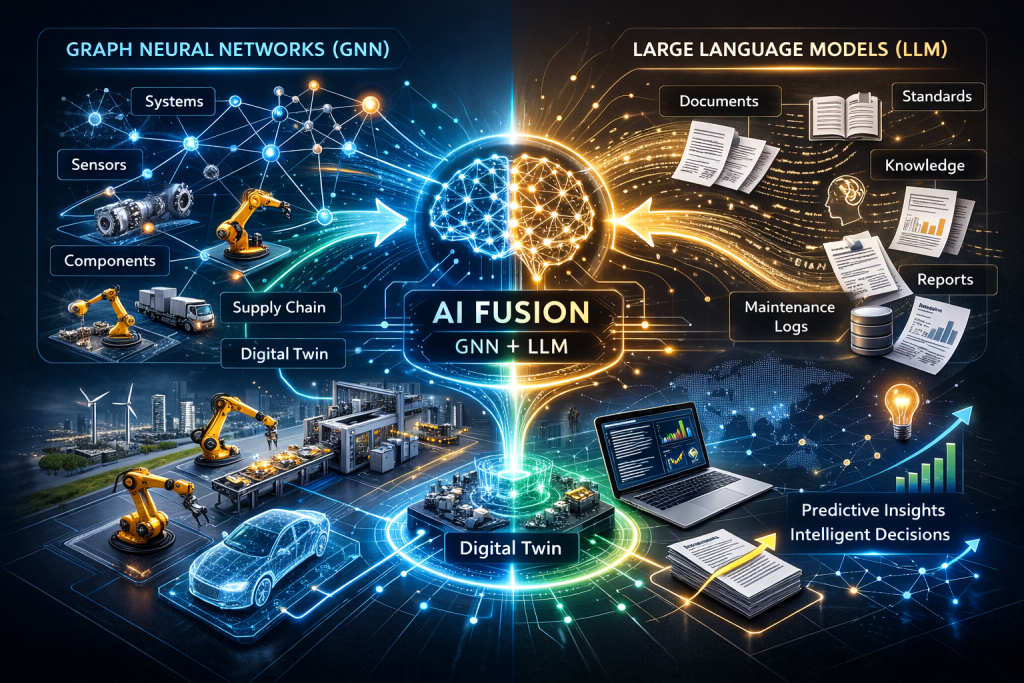
Figure 1: Illustrating why GNN+LLM fusion can create an AI System capable of solving complex problems.
I. Euclidean vs. Non-Euclidean Structure
To understand the differences between GNNs and LLMs, it is necessary to first understand the differences between Euclidean and Non-Euclidean data.
Euclidean data refers to information that is represented in a multi-dimensional, flat (linear) space where relationships between data points can be directly measured using straight-line distances (Euclidean distance). This type of data is regular, structured, and typically lies on a Euclidean grid, meaning each node in the data structure has a fixed number of neighbors. Key characteristics of Euclidean data include grid-like structure, translation invariance (i.e., the structure holds true even if the spatial location shifts), and fixed neighborhood (i.e., each data point has a set number of neighbors). Examples include:
- Digital Images (2D Grid): An image represented as a grid of pixels (matrices), where each pixel has a consistent, uniform relationship to its neighbors.
- Tabular Data / Spreadsheets: Data organized in rows and columns is Euclidean because relationships between features can be calculated in a flat, Cartesian coordinate system.
- Time-Series Data (1D/2D): Data that changes over time can be treated as Euclidean data because it is sampled at regular intervals.
- 3D Meshes (Voxel Representation): While 3D shapes can be non-Euclidean, if a 3D object is represented using voxels (3D pixels) on a regular grid, it functions as Euclidean data.
In contrast, non-Euclidean data includes complex structures like social networks or chemical molecular structures, where the number of neighbors per node varies. In other words, non-Euclidean data is information that cannot be described on a flat 2D plane. It is often hierarchical or network based. Examples include:
- Social Networks: Represented as nodes (users) and edges (connections), social networks are non-Euclidean because they have an arbitrary, non-fixed number of neighbors.
- Molecular Structures: Chemical molecules consist of atoms (nodes) connected by chemical bonds (edges) in complex 3D graph structures, essential for drug discovery.
- 3D Mesh Surfaces: In computer graphics, 3D models (e.g., a human face or car engine) are represented by mesh surfaces, which are locally Euclidean but globally curved.
- Product Lifecycle Management: A modern product exists as a network of requirements, CAD models, simulation results, manufacturing processes, suppliers, and service records. This “digital thread” is inherently graph-structured and ideal for GNN analysis.
Armed with this basic understanding, it will be easier to wrap our minds around the unique strengths of GGNs and LLMs, and why fusion of the two best positions Digital Industries for success as we utilize AI systems in the real world.
II. What are GNNs?
Imagine trying to understand a social network, a chemistry molecule, or a product structure. We don’t just care about the individual components; we care about who is connected to whom. Here is some important information about GNNs:
- Data Type: Non-Euclidean structures. As discussed above, this means the data is not a flat, orderly grid (like pixels in an image or rows in a spreadsheet). It is a graph of “nodes” (entities) and “edges” (relationships).
- Strengths: GNNs excel at analyzing how information spreads across a network, finding hidden communities, relationships, or predicting if two chemical compounds will react.
- Analogy: A GNN is like an engineer studying the full electrical and mechanical architecture of an automobile or aircraft. It understands how sensors, wiring harnesses, hydraulic systems, and control software are connected, and how a change in one subsystem propagates across the entire vehicle.
- Industrial Example: In a digital twin of an aircraft or electric vehicle, every component, subsystem, and interface forms a massive graph. For instance, a GNN can predict how a design change in an electronic subsystem might impact reliability, maintenance schedules, or downstream manufacturing constraints.
III. What are LLMs?
LLMs are designed to handle human language, which is sequential and packed with semantic meaning. Here is some important information about LLMs:
- Data Type: Euclidean Linear/Sequential structures. Again, in this type of structure, text or image follows a specific order (word 1, word 2, word 3…or pixels surrounded by a regular grid of other pixels).
- Strengths: LLMs excel at understanding nuance, answering questions, and generalizing from massive amounts of text and/or image data.
- Analogy: An LLM is like a senior systems engineer who has read decades of design standards, certification rules, maintenance logs, and engineering documentation, and can instantly explain how they relate to the problem at hand.
- Industrial Example: LLMs can analyze requirements documents, service bulletins, simulation reports, and supplier documentation to extract knowledge that would otherwise remain buried in millions of pages of text.
IV. Why Fusing GNNs with LLMs is the “Best Approach”
Using only a GNN means missing out on rich textual information (like a product description). Using only an LLM means missing the structural relationships (like the fact that two parts in a system are often used together). Fusing the two methods allows more contextual, informed analysis. In other words, combining graph reasoning with natural language interfaces provides both the accuracy of structured reasoning and the accessibility of conversational interactions and semantics.
Fusion has the following explicit advantages:
- Better Contextual Understanding — An LLM can read a node’s description (e.g., “This drug treats headaches”), while the GNN knows that drug is connected to 50 others. Together, they understand what it is and where it sits in a larger system.
- Improved Accuracy — Current research and industry experiments consistently show meaningful accuracy improvements compared to using either approach alone.
- Reduced Hallucinations — In engineering and manufacturing, incorrect information is costly and potentially unsafe. By grounding LLM reasoning in the verified structure of a GNN, fusion significantly reduces the risk of confident but incorrect recommendations.
- Solving Complex Problems — In drug discovery, the GNN understands the molecular shape (structure), while the LLM understands the scientific literature (context).
Table 1: Summary of Features of GNNs, LLMs, and their Fusion
| Feature | GNN (Graph Neural Network) | LLM (Large Language Model) | Fused (GNN + LLM) |
| Data Focus | Structure/Relationships | Semantic/Language | Structure + Content |
| Best For | Social networks, Chemicals, Product Structures | Text, Reasoning, Dialogue | Complex, Real-world Networks |
| Analogy | Looking at a Map | Reading a Dictionary | Using a guide map + manual of semantics |
V. Industrial Use Cases for such an AI System
Example 1: Intelligent Engineering Assistants
A GNN models the full system architecture of a product (for example, an aircraft environmental control system); an LLM reads requirements, design rationale, and certification rules. Fusion enables asking: “If we change this compressor, what downstream systems are impacted?” and receiving answers that are grounded in real system structure and real documentation. This moves AI from chatbots to engineering copilots.
Example 2: Manufacturing Planning and Optimization
A factory production line forms a complex graph of machines, workflows, materials, and dependencies understood by GNN; an LLM understands process documentation, work instructions, and historical reports. Fusion enables predicting bottlenecks before they happen, explaining why they happen in natural language, and recommending corrective actions grounded in plant knowledge.
Example 3: Service and Maintenance Intelligence
Service records, sensor data, and parts relationships form a massive service graph are all understood by a GNN model; an LLM model understands technician notes and maintenance manuals. Fusion enables predictive maintenance grounded in real system relationships, conversational troubleshooting assistants for field engineers, and faster root-cause analysis across fleets.
Example 4: Supply Chain Resilience
Supplier networks are graphs, whereas contracts, risk reports, and communications are text. Fusion of appropriate GNN and LLM models enables early detection of supply chain risk, impact analysis of supplier disruption, and natural-language explanation of mitigation strategies.
VI. Final Remarks and What is Next
By fusing LLM with GNN, we get an AI system that not only understands the “what” (requirements) but also the “where, why, and how” (structure, relationship, implementation). For electro-mechanical systems such as aircraft, vehicles, or industrial machinery, a fused GNN+LLM model can understand what each component does, where and how it connects to other subsystems, which requirements it satisfies, how it is manufactured, and how it should be serviced. This moves AI from answering questions to understanding engineered systems end-to-end; thus, the name “AI System.”
In Part II of this series, we will review the different types of GNNs and LLMs and review where and how they should be applied. For example, Graph Transformers can be considered a specific type of GNN where the classical message-passing mechanism is replaced by global multi-head self-attention. Key differences between the two are information aggregation (locality vs. globality), computational complexity (linear complexity of classical GNNs vs. quadratic complexity of transformers), and over-smoothing of classical GNNs. The implementation choice must balance global context against cost and be mindful of both transformer overkill (on cost) and GNN over-smoothing traps.
Part III will offer guidelines on architecture and fusion implementation patterns. The fusion of GNNs and LLMs enables a new class of AI systems that can understand both the structure of engineered systems and the knowledge surrounding them. Such a fusion brings AI closer to the daily workflows of engineers, planners, and service teams, supporting better decisions across the entire product lifecycle.
Part IV discusses when developers should use GNN+LLM fusion, and when a simpler approach might be more appropriate. It also reviews challenges and opportunities, as well as economic justification, in the context of product-design change. When used appropriately, fusion can help create AI systems that are more grounded, more explainable, and more useful to the engineers responsible for designing, building, and maintaining complex products. However, Fusion may not be economically justified when products are simple, changes are localized, impact analysis already follows deterministic workflows, or historical change records are sparse.
Note: This blog was created with the help of AI.