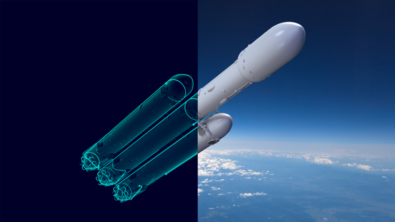
The digital democratization of space

The face of the space has been changing rapidly in recent years. Historically, the space sector has been dominated by government-run organizations with immense resources at their disposal. Now, however, smaller companies from the private sector have been gaining the edge. The last decade alone has seen multiple small companies and startups get spacecraft up to orbit and even land on the moon.
There are many reasons behind this tremendous shift, but a key one in particular has been the spread of digital transformation throughout the space sector. Thanks to the advancement of digital tools and technologies in simulation, systems engineering, and more, companies have been able to reduce spacecraft complexity and costs that have typically kept smaller players from entering the field. In short, digital transformation is increasingly democratizing access to space.
Bridging systems and data
One of the biggest challenges to any organization working in space is the sheer complexity of the spacecraft they build. From rockets to satellites, spacecraft integrate some of the most advanced technologies and systems known to humankind. These systems are also tightly integrated with each other. A simple change to one system would very likely require many more changes to be made across other systems.
The complexity of these systems has also increased tremendously in recent years. Not only are today’s spacecraft still dealing with complex mechanical, electrical, and thermodynamic systems, but they are also becoming more and more software-defined, integrating new electronics and software into their functions. As discussed in a recent episode of Talking Aerospace Today, a single semiconductor can have tens, even hundreds of thousands of interactions across multiple systems, exceedingly more than typical spacecraft technologies.
Trying to account for all those interactions with traditional, siloed approaches to systems engineering would be incredibly difficult, but digital transformation is changing how it can be done. At the center of this shift is the comprehensive digital twin, the virtual representation of a product and its processes across its lifecycle, all the way through design, production, and operation. The comprehensive digital twin enables end-to-end, real-time data connectivity to all stakeholders in a program, bridging together isolated data silos and fast-tracking collaboration.
With tools like the comprehensive digital twin, new space companies can gain a better grasp on the complexity of their products, accelerating innovation and getting new spacecraft out to market faster.
Reducing costs of testing
The amount of time, money, and resources it takes to test and certify spacecraft before launch has also significantly decreased thanks to digital technology.
Testing is especially critical for any space organization launching products to orbit and beyond. After all, if something goes catastrophically wrong on a satellite or space station, there is no way to send a repair team to fix it on time. Not yet at least. Therefore, making sure everything goes right on Earth before launch is not only necessary, but also potentially lifesaving.
Historically, this could only have been done in large testing facilities, such as wind tunnels, run by government agencies with all the resources necessary to test their craft physically. Now, however, all those tests can be done on computers. Simulation tools have steadily grown more advanced over the years, capable of simulating complex scenarios to higher degrees of accuracy. Furthermore, the real-time data sharing provided by the comprehensive digital twin also offers increased accuracy and fidelity to simulations of a product.
Spacecraft testing and certification can be very expensive in terms of time, money, and resources for any space organization. By delegating those phases to simulation and digital tools, however, those expenses are reduced, giving new companies a better opportunity to gain a foothold in the space sector
Expanding the playing field
The examples discussed above are just a few aspects of digital transformation, but they encapsulate how digital technology is transforming the space sector and opening it for more entrants. As tools such as the comprehensive digital twin and simulation make managing spacecraft complexity easier while reducing costs, the barrier for entry into space exploration is lowered, giving more room for new players to not only enter, but also stay and thrive.
This is a boon for space exploration. The more players there are in the race, the rate of innovation becomes greater, raising the potential to expand humanity’s reach beyond Earth by multitudes.
Siemens Digital Industries Software helps organizations of all sizes digitally transform using software, hardware and services from the Siemens Xcelerator business platform. Siemens’ software and the comprehensive digital twin enable companies to optimize their design, engineering and manufacturing processes to turn today’s ideas into the sustainable products of the future. From chips to entire systems, from product to process, across all industries. Siemens Digital Industries Software – Accelerating transformation.