The journey of AI in manufacturing
Artificial intelligence is improving by leaps and bounds, with new breakthroughs seemingly happening overnight, the technology is the very definition of the cutting edge. When it comes to the manufacturing industry however, being cutting edge isn’t enough, rather, new technology must be both useful and reliable – offering clear benefits without compromising on core values.
In a recent podcast, Ralf Wagner, Senior Vice President of Data Driven Manufacturing at Siemens, discussed what it means to bring new, innovative technology like AI into the OT world and, going forward, how AI will continue to evolve in the industrial world and beyond.
Check out the full podcast here or keep reading for some of the highlights of that conversation.
Bringing AI to manufacturing
A key concept for artificial intelligence is time. A well thought out and robust AI solution can vastly reduce the amount of time required for common and repetitive tasks, speeding up everything from deployment to maintenance to testing. At the same time, achieving a robust, industry ready, AI deployment has traditionally required a great deal of up-front time as well, usually from AI and data science experts working in conjunction with domain experts.
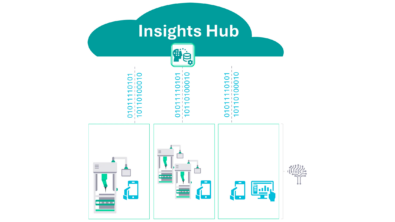
Ralf explains how overcoming this up-front cost in both time and expertise is vital to widespread AI adoption. Rather than requiring users to build, train, test and maintain AI models from scratch, offering out-of-the-box AI solutions that dramatically reduce time to value for customers is Insights Hub’s secret ingredient to driving adoption across the manufacturing industry.
While offering easy to use, pre-trained solutions helps make adopting new AI technologies quick and easy, it can also lead to privacy concerns. Ensuring the security of proprietary data is just as important as ease of use when it comes to bringing AI into the factory. Running models in a way that ensures complete data privacy, whether by keeping them on premises or in a secure, private cloud is critically important. In order to assuage any concerns and make sure whatever path customers choose, this process too must be easy and seamless since it also plays an important role in bringing AI to the OT world.
Finally, a strong deployment doesn’t just mean setting and forgetting an AI solution, but instead developing a continuous testing pipeline to test model consistency is also a key element Ralf says. This means making sure that, every hour of every day, the model is always returning the expected answer to a given question. Something else of surprising importance for an industrial-grade AI model is the ability to tell the user “I don’t know” when asked a question with no clear answer, preventing hallucinations and false positives that might arise from forcing the model to answer a question it lacks information for.
What the future of AI holds
AI is advancing at a speed which Ralf calls previously unseen in technology, making the future hard to predict but right at the forefront is, of course, agentic AI. AI agents offer a far more autonomous and proactive approach to artificial intelligence, allowing them to work individually or together to reason through and solve everything from simple tasks to complex problems with minimal human interaction.
While AI agents are still in their infancy, in the future they offer the potential for a truly revolutionary level of automation, allowing complex systems to respond automatically to sudden changes, feedback and user requests. AI agents will likely be a key element in achieving the next evolution of closed loop optimization that already takes place in factories and production systems, allowing even minute variations to be accounted for through rigorous virtual testing and validation, before finally deploying optimized solutions to the shop floor.
Humans aren’t leaving the shop floor or the design process anytime soon but with AI, the effectiveness of their efforts can be multiplied many times over. By developing AI technology with the goal of bringing tangible benefits, not cutting-edge theories, into reality those goals can be achieved quicker than ever. Reaching the dream of true digital enterprise is a long process and AI will pave just a single, important, step on that journey but for the companies willing to embark on this journey, each step taken promises a competitive difference and clear improvements.
To learn more listen to the full podcast here
Siemens Digital Industries Software helps organizations of all sizes digitally transform using software, hardware and services from the Siemens Xcelerator business platform. Siemens’ software and the comprehensive digital twin enable companies to optimize their design, engineering and manufacturing processes to turn today’s ideas into the sustainable products of the future. From chips to entire systems, from product to process, across all industries. Siemens Digital Industries Software – Accelerating transformation.