Igniting the industrial AI future: Roland Busch at CES 2026 introducing Digital Twin Composer
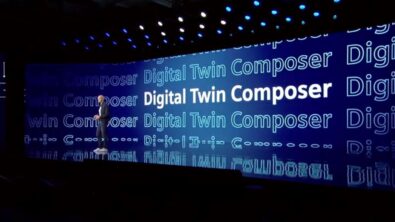
In an era defined by transformational technology, Roland Busch, Siemens CEO, took the stage at CES 2026 not just to discuss products or figures, but to narrate a powerful story, one that connects the dawn of electricity to the burgeoning revolution of artificial intelligence. Just as electricity reshaped society over a century ago, AI is poised to redefine our world today. With AI, we are shifting from isolated applications to a future where intelligence is integrated into every facet of industry, encompassing factories, buildings, grids, and transportation systems.
Siemens stands firmly at the center of this shift. Drawing on decades of industrial data, deep engineering expertise and trusted global partnerships, we are focused on bringing AI into the real world, safely, reliably and at scale. CES was not simply about sharing strategy. It was our opportunity to show how this once-in-a-century technological transition is already delivering measurable outcomes for customers and society.
And that momentum led to one of the most anticipated moments of the keynote: the unveiling of a breakthrough solution that allows industries to design, test and optimize, digitally first.
When two tech worlds share one stage
On the CES stage, Roland welcomed NVIDIA CEO Jensen Huang to discuss the evolution of our long-standing partnership. Together, we announced the next phase of our journey: building what we call the Industrial AI Operating System, a unified foundation designed to transform how the physical world is conceived, built and operated.
By combining NVIDIA’s accelerated computing and AI technology with Siemens industrial software, automation platforms and domain expertise, we are empowering customers to design products faster, validate decisions virtually and adapt production in real time.
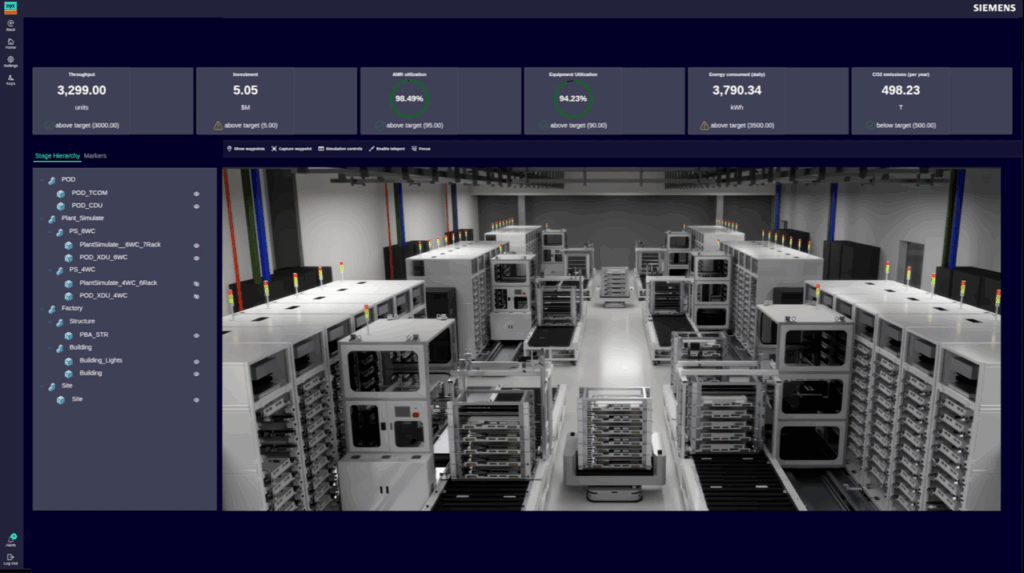
In the discussion, Roland explains how Siemens customers are already using the Digital Twin Composer to solve design problems early by optimizing sizing and layout and then carry the same digital model forward into virtual commissioning. Once the real facility is built, those same virtual assets can connect to real-world sensors, turning the digital twin into a live operational dashboard for day-to-day factory management.
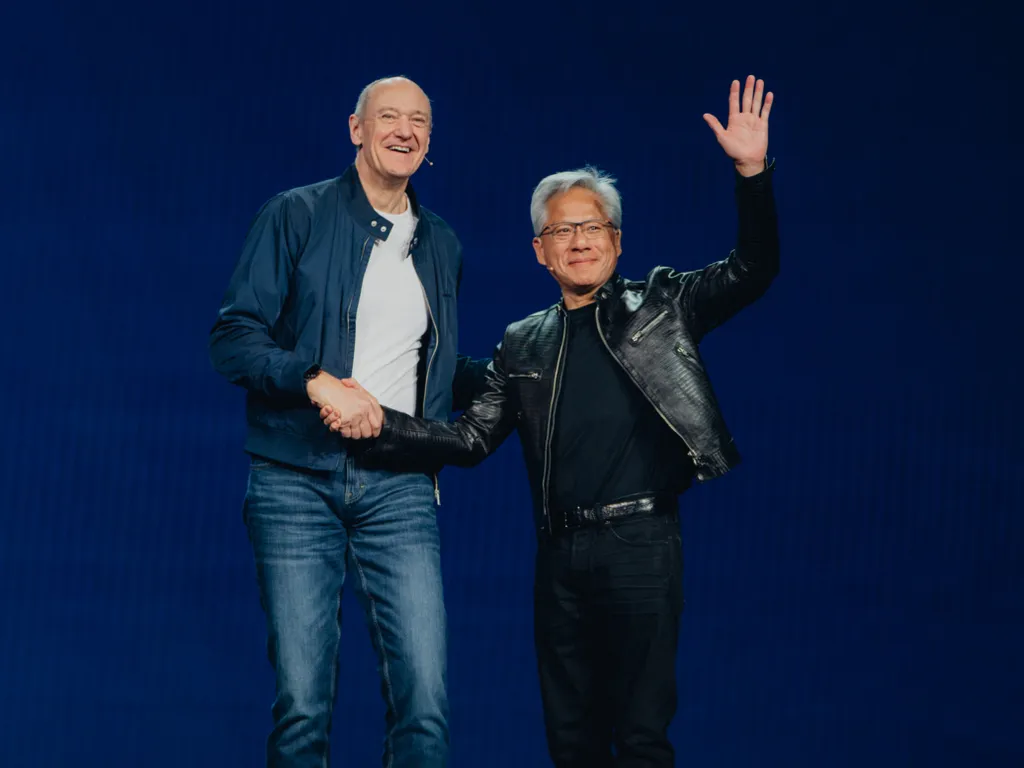
During the keynote, NVIDIA CEO Jensen Huang reiterated how high the stakes are when building modern industrial systems. He described projects like a one-gigawatt AI data factory, a $50-billion investment, where delays, redesigns or downtime simply cannot be tolerated. Before construction even begins, the entire facility must already exist digitally. Every power system, cooling circuit, workflow and compute resource must be simulated, tested and optimized in advance, and then continuously managed once operations begin.
Whether it’s an AI factory, a chip plant or a car factory, operating without a digital twin is no longer imaginable. This set the perfect stage for Roland Busch to introduce the Digital Twin Composer, enabling companies to create photorealistic virtual models of plants, processes and products to connect them to real-time data and confidently simulate decisions before they happen in the real world.
Introducing Siemens Digital Twin Composer: connecting design, simulation and real-time data with AI
This vision took full shape when Roland introduced the Digital Twin Composer, where the conversation around industrial AI shifted from future concept to practical capability. The newly released solution connects design, simulation, real-time data and AI into one environment, creating a continuous digital thread that enables companies to build twice: first in the virtual world, then in reality with greater speed, certainty and insight.
Today, too many engineering and production teams still work in silos. The Digital Twin Composer removes those barriers, allowing teams to test products, validate automation, simulate entire plants and manage operations from a unified digital twin. Powered by Siemens Xcelerator Portfolio, NVIDIA Omniverse libraries and computer vision, organizations can recreate entire facilities with physics-level accuracy, identifying up to 90% of issues virtually before they reach the production floor.
As Joe Bohman, executive vice president, PLM Products, Siemens Digital Industries Software shared:
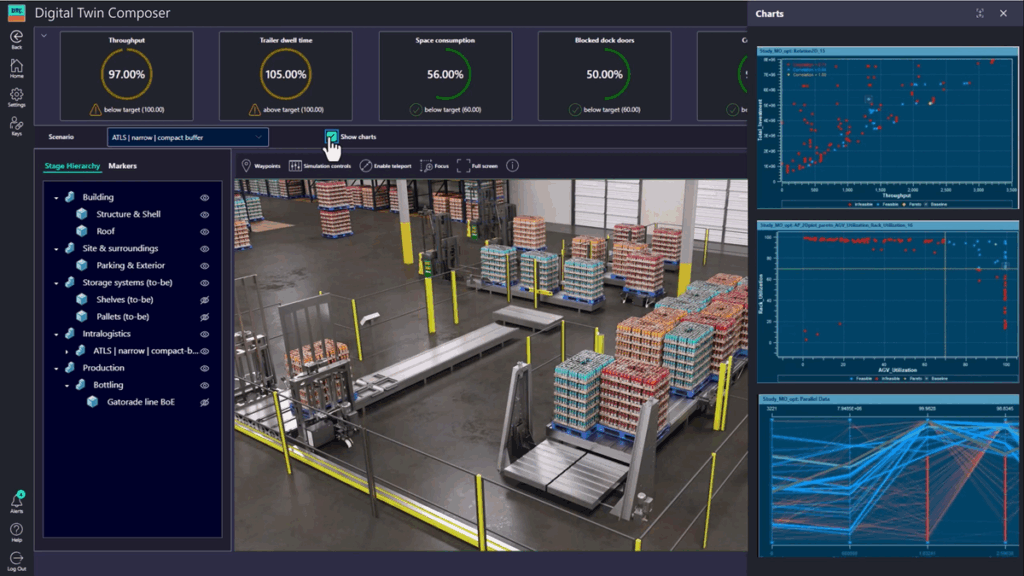
Digital Twin Composer helps manufacturers master complexity, accelerate production, reduce costs and boost profitability.”
At the core of the Digital Twin Composer technology stack are products from the Siemens Xcelerator portfolio. Tecnomatix digital manufacturing software is used to optimize material flow, production throughput and equipment utilization, and to validate automation behavior and control logic before physical commissioning. Line Designer, Teamcenter, and Simcenter software also play a role to support early layout exploration, maintain trusted lifecycle data and enable AI-driven design optimization across the digital twin lifecycle.
Leading CPG company, PepsiCo, steps into the future using the Digital Twin Composer
One of the most compelling moments came when Roland invited Athina Kanioura, CEO, Latin America and Global Chief Strategy & Transformation Officer at PepsiCo, to join him on stage.
Athina described the realities of modern manufacturing: rising demand, constant disruption and facilities designed for a very different time. Instead of managing challenges one by one, PepsiCo chose a digital-first, AI-driven transformation strategy, with Digital Twin Composer at the center.
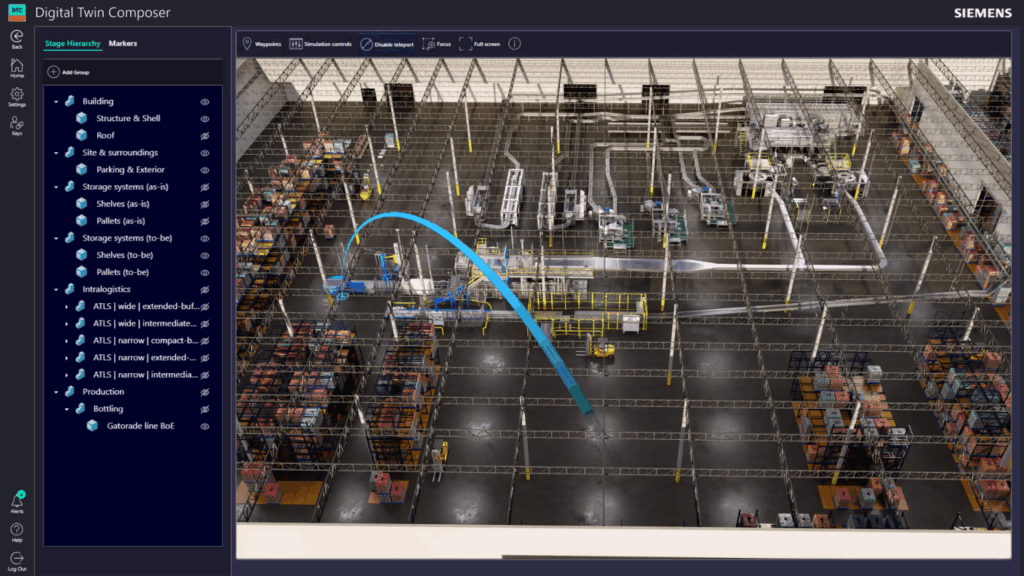
PepsiCo now builds immersive, high-fidelity digital replicas of its manufacturing and warehousing environments. Using Digital Twin Composer alongside NVIDIA Omniverse and computer vision, they model every machine, conveyor, pallet flow and operator path with precision.
This collaboration marks a first-of-its-kind effort for a global CPG company, reshaping how plants and warehouses are simulated, tested and optimized before any physical change occurs. Inside these virtual environments, AI agents run thousands of simulations, uncovering bottlenecks, improving throughput and evaluating automation decisions.


PepsiCo has already achieved incredible results with Digital Twin Composer, including:
- 20% increase in throughput on initial deployments
- Near 100% design validation
- 10–15% CapEx reduction by uncovering hidden capacity
- Faster design cycles and accelerated commissioning
PepsiCo is no longer reacting to operational challenges. It is anticipating them, using the digital world as a proving ground for the physical one.

“The Digital Twin Composer allows us to do everything in the virtual world, to simulate everything so we don’t have to spend a dollar on the physical plant before we know the final design.
We can pull massive amounts of data into an immersive, photorealistic environment, and with AI-powered simulation, we can explore thousands of potential layouts to find the most efficient options. With the Digital Twin, this type of tasks that would have normally taken months, now takes days.”
Athina Kanioura, CEO, Latin America and Global Chief Strategy & Transformation Officer at PepsiCo
Scaling the industrial AI revolution
As Roland closed his keynote, one message became clear: Siemens is building the infrastructure for a world powered by AI and digital twins. Our foundation is strong from AI-native platforms, trusted automation systems, deep domain experience, and a powerfully expanding partner ecosystem. We are scaling these advancements with trust, reliability and safety at the core, because when AI meets the physical world, precision matters most.

AI is no longer peripheral; it is becoming the driving force behind how the world designs, builds, moves, powers and produces.
📣 Learn more about Digital Twin Composer and our CES announcements
Discover how Siemens is shaping the future of Industrial AI, and explore the launch of Digital Twin Composer in our press release👉 Read the full press release


![Orchestrating the AI Factory of tomorrow: a workflow for speed and future-readiness [VIDEO]](https://blogs.sw.siemens.com/wp-content/uploads/sites/7/2026/04/digital-thread-ai-factories-395x201.png)
