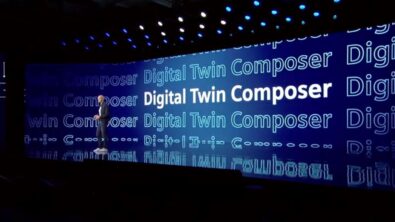
The Factory That Thinks: Inside Siemens Digital Twin Composer at Hannover Messe 2026 [VIDEO]

Explore how Siemens, NVIDIA and AWS are turning siloed factory data into a living, self-optimizing system and what it already delivered for major CPG leader, PepsiCo. At Hannover Messe, Siemens used the world’s premier industrial stage to demonstrate something extraordinary: a fully connected, AI-powered digital enterprise and Siemens Digital Twin Composer was at the heart of it.
If you weren’t able to attend, watch the video on demand where leaders from Siemens, NVIDIA and AWS share how to move from data silos to a living factory, helping manufacturers scale the industrial metaverse with Siemens Digital Twin Composer.
Meet the experts and watch the discussion from Hannover Messe:


Too much data, not enough answers
Manufacturers aren’t short on data. Most already have 3D factory layouts, point cloud scans, fluid dynamics simulations, and live IoT sensor streams. The problem is that all of it lives in separate silos, logistics, production and facilities each working from their own version. When a plant manager asks “what happens if I change this line?”, no one can give a real-time answer.
Guillaume Cordonatto, Siemens Director of Digital Manufacturing Innovation, explains: “You’re spending more time making sure you have the right context instead of working the actual problem. And this is precisely what Digital Twin Composer was set out to solve.”
What Digital Twin Composer actually is
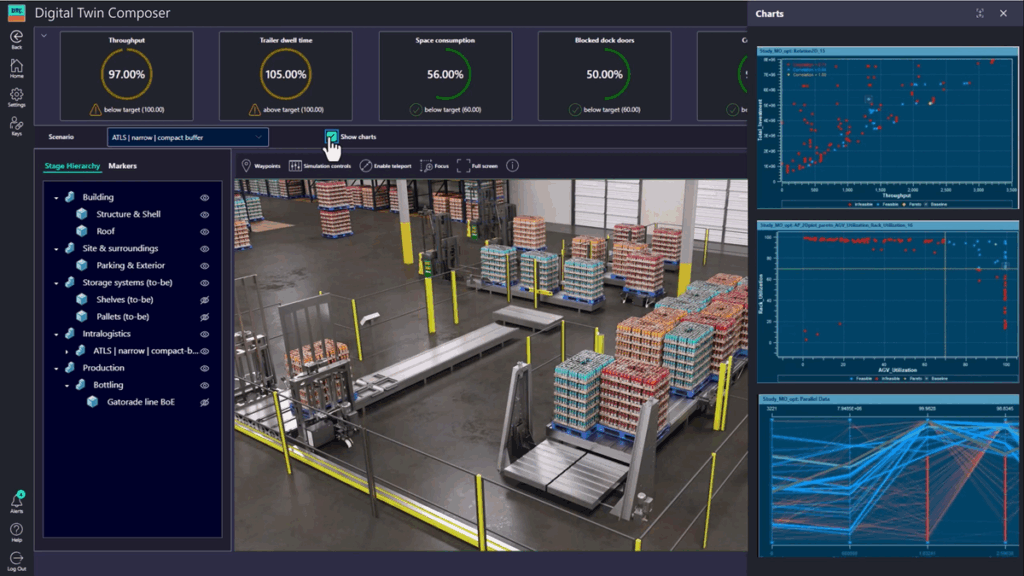
Digital Twin Composer is a SaaS, cloud-based application where it pulls together point clouds, simulation models, facility layouts and IoT streams into a single governed scene in real time, running on top of existing tools without forcing a costly migration. The configuration management backbone (powered by Siemens Teamcenter) means the digital twin evolves in lockstep with the real factory.
Under the hood, NVIDIA Omniverse handles the high-fidelity rendering and physics at scale. Mike Geyer, NVIDIA Omniverse Manufacturing Lead, described the significance: “It’s never been possible to simulate an entire factory, much less do it in the cloud and connect it to all these amazing systems. This is something that’s never been done before.”
The PepsiCo proof point
The live demo shown on stage pulled directly from Siemens’ collaboration with PepsiCo at Hannover Messe, a company constantly reinventing its production lines to stay closer to consumers and build a more resilient supply chain. The numbers speak for themselves:
- 20% throughput improvement on repurposed lines
- 90% of issues caught before touching the physical floor
- $1M+per hour in avoided downtime costs
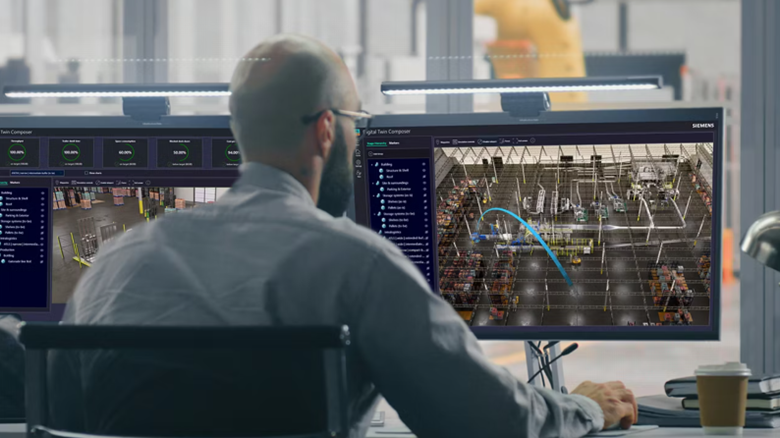
The 90% figure was the one that resonated most. Traditional problem-solving happens at installation time, when equipment is on the floor and a facility can be down for over a million dollars an hour. Digital Twin Composer moves that work into the virtual world, letting teams test dozens of scenarios and find the optimum configuration before a single bolt is moved. As Geyer put it, it’s not just about catching problems, it’s about looking ahead: “We can not only go back in time and see what’s happened, but look ahead, see what changes might be coming from global supply disruption and reconfigure our facilities on the fly.”
What’s coming next
All three panellists pointed to three near-term developments that will push the platform further: AI agent teams that proactively optimize the twin, deeper real-time sensor integration with the physical factory, and high-fidelity environments for safely training humanoid robots before they ever set foot on a real floor.