Orchestrating the AI Factory of tomorrow: a workflow for speed and future-readiness [VIDEO]

The world’s data centers are undergoing a fundamental transformation. What were once facilities for storing and serving data are rapidly becoming “AI Factories,” purpose-built powerhouses designed to generate intelligence at unprecedented scale. This shift introduces enormous complexity: how can we build faster, operate under tighter power constraints, and engineer for hardware that often doesn’t exist yet?

In our first blog exploring the AI Factory landscape, we discuss the core challenges shaping AI factory development and why traditional approaches are no longer sufficient. Here, we go deeper, discussing the tools and the tangible outcomes that Siemens’ Digital Twin Composer makes possible to help accelerate the design and operations of AI Factories to drive long-term efficiencies.
The concept is straightforward: build twice. First in the virtual world, through simulation and multi-discipline validation. Then in reality, with the speed and certainty that comes from digitally stress-testing every major decision before concrete is poured or infrastructure is purchased.
The hidden cost of AI infrastructure and how the Digital Twin is fixing It
Behind every AI breakthrough is a physical reality we rarely discuss: the compute centers making it possible, and the staggering cost of designing, building, and operating them. As Siemens’ Zvi Feuer, Senior Vice President of Digital Manufacturing Software and CEO of Siemens Digital Industries Software in Israel shares: in the first year of operation alone, up to 70% of CPUs in poorly designed facilities are physically destroyed by heat. The culprit is often counterintuitive. Packing racks tightly together to save space is precisely what triggers catastrophic failure. When density outpaces thermal dissipation, heat can’t escape fast enough, and CPUs don’t degrade gradually. They fail suddenly, and completely. This is the hidden cost of inadequate thermal planning in the facilities the entire AI economy depends on
Then there’s the operational challenge. Once a production system is running, as Feuer notes, a new set of questions emerges: How do you maintain a complex facility over a 15-year lifespan? Which spare parts belong in your warehouse? How do you catch a failing machine before it takes down your entire line? Predictive maintenance done right means scheduling interventions during off-hour, with the right tools and parts already staged, before a bottleneck machine stops your throughput entirely.
Digital Twin Composer is the connective tissue behind solving these complex industry problems. Rather than visualizing in isolation, it unifies product, production, facility, and operations into a single executable model, one that can catch a rack proximity flaw before it burns out millions in hardware, and keep production systems running predictively across their entire operational life.
The integrated workflow: from concept to continuous optimization
Now that we discussed the core challenges and use cases of how Digital Twin Composer can help address the complexity of designing and operating the future AI Factory, let’s dive into what the workflow could look like for an engineer using Digital Twin Composer on an AI factory project. We will detail what simulation tools are involved, how do they connect, and what tangible business outcomes can customers realistically expect. The journey of designing, building, and operating an AI factory requires seamless collaboration across diverse disciplines, from power systems engineers to thermal cooling specialists and real estate developers. Digital Twin Composer acts as the unifying environment, bringing together building infrastructure, production systems, and operational intelligence into a single, connected digital thread.
This is how Digital Twin Composer addresses the AI factory challenge. Once the production system is designed, the same technology stack extends seamlessly into service and operations. Think of it as a complex machine that outlives the product lifecycle by years, one that has to be maintained with the same rigor we apply to any industrial system. We talk endlessly about AI, but rarely about what’s actually powering it: massive, heat-generating compute infrastructure that demands exactly this kind of end-to-end software discipline.”
Zvi Feuer, Siemens Senior Vice President of Digital Manufacturing Software and CEO of Siemens Digital Industries Software, Israel
Phase 1: Design – engineering the AI Factory in the virtual world
So what does this actually look like in practice? Here’s how an engineer uses Digital Twin Composer across the full lifecycle of an AI factory project, beginning with the first phase which is about building a comprehensive digital replica of the AI factory and validating every aspect of it before any physical construction begins.
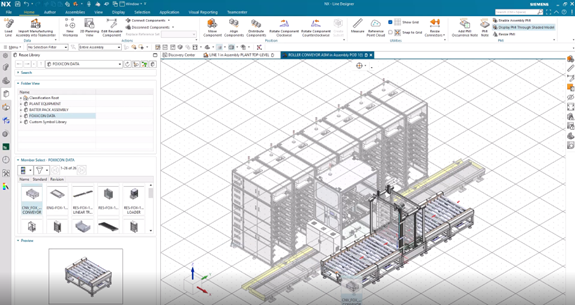
Using Siemens NX Line Designer, engineers can create detailed 2D and 3D layout, drawing in AI racks, cooling distribution units (CDUs), and other infrastructure elements from reusable libraries. The tool allows teams to evaluate equipment clearance, ensure precise alignment, and generate a full Bill of Equipment as the design evolves, keeping layout planning and resource management in sync from the start. With the layout established, the focus shifts to performance validation, particularly around power and cooling. The 3D model from NX feeds directly into Simcenter STAR-CCM+ for airflow and thermal simulation, revealing exactly how heat will distribute across the facility under real operating conditions. For liquid cooling systems, Simcenter Amesim handles 1D network simulations, modeling how coolant moves through the infrastructure.
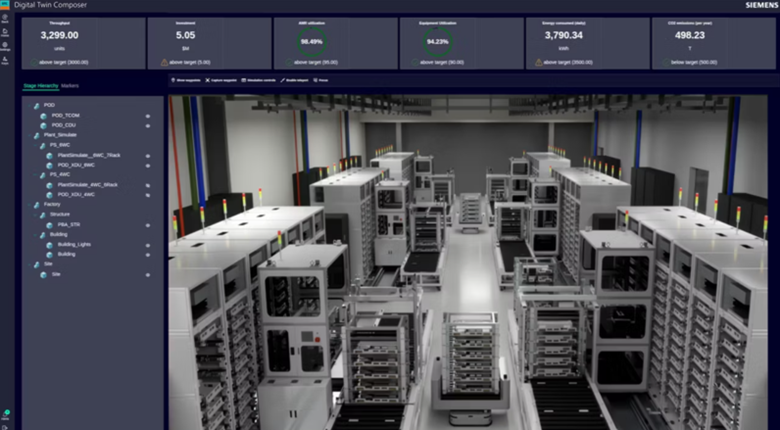
These tools become most powerful when their outputs converge. Digital Twin Composer acts as the central hub, ingesting results from NX, STAR-CCM+, and Amesim to give stakeholders a unified view across every domain: product, production, facility, infrastructure, and operations. Teams can evaluate layouts, thermal performance, power scenarios, and logistics before a single dollar is spent on physical build-out. This directly addresses one of AI factory development’s hardest problems: planning for hardware that doesn’t exist yet.
Phase 2: Build – optimized construction and virtual commissioning
With a validated design in hand, the focus shifts to construction, and ensuring the transition from virtual to physical goes smoothly. While most AI factories may not involve robots, AGVs, and material flow in the traditional sense that Siemens Plant Simulation and Process Simulate software typically simulate for manufacturing plants, these tools offer broader capabilities that can contribute to the overall efficiency and robustness of an AI factory. AI factories may be a new category of infrastructure, but the underlying construction and logistics challenges they present, sequencing heavy equipment, managing material flow, preventing bottlenecks before ground is broken, are industry challenges Siemens has been solving for years across some of the world’s most demanding infrastructure projects.
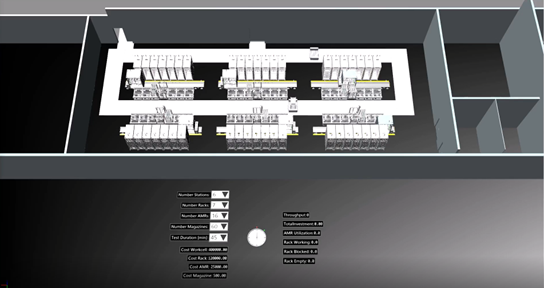
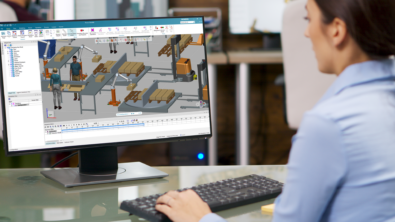
For example, Plant Simulation software could empower AI Factory engineers to perform system-level simulations to validate process robustness and experiment with various system configurations to optimize performance and equipment utilization. In an AI factory context, this could involve optimizing the overall resource utilization, logistics within the facility (e.g., for heavy equipment movement, waste management, or even personnel flow), and identifying potential bottlenecks that could impact the “tokens per watt” metric, as discussed in our previous blog.

Success stories with Siemens customers like Max Bogl, German multinational construction company that works on transport, civil engineering and infrastructure, uses Siemens Plant Simulation to plan material flow, vehicles and transport processes more precisely. Specifically, Max Bögl operates energy corridor construction, where lines are routed over many kilometers. Expanding renewable energy is changing the requirements for Germany’s power grid because large and sometimes rapidly fluctuating volumes of energy must be transported over long distances. Companies are building transmission routes, modernizing existing grids and adopting infrastructure to future load flows. This use case demonstrates how Plant Simulation can be used beyond traditional discrete event manufacturing and used in an AI Factory setting.
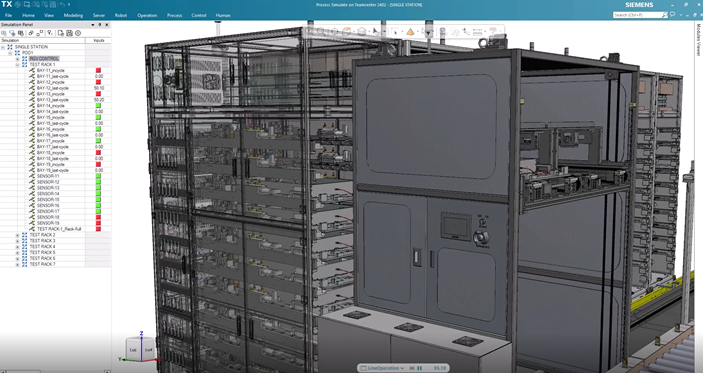
Another example from the Tecnomatix portfolio is with Process Simulate, which enables dynamic simulations to validate equipment performance and control logic functionality. For an AI factory, this is essential for verifying processes related to maintenance, equipment assembly, human interaction, or any automated systems within the facility. The human simulation capabilities available in Process Simulate can verify workstation designs and optimize ergonomics, ensuring a safe process according to industry standards. Process Simulate also supports virtual commissioning, validating the build, installation, and commissioning (mechanical and electrical) of zones containing robots and other automation devices, and simulating real PLC code. The layout data from Line Designer can also be imported into Process Simulate for feasibility analysis and ergonomic validation. The digital model used to design the AI factory is not archived after construction begins; it carries forward into virtual commissioning. This allows teams to validate the facility’s behavior before a single system goes live, ensuring operations will function as intended.

Phase 3: Operate- continuous optimization and future-proofing
The value of the Digital Twin doesn’t end at commissioning. It becomes a living model for ongoing optimization, predictive maintenance, and adaptive management throughout the facility’s operational lifespan. Digital Twin Composer and Teamcenter work together here, providing predictive analytics, scenario planning, and lifecycle data management for the complete factory digital twin.
This is what makes it possible to manage an AI factory as the complex, long-lived machine it is: intelligently planning spare parts inventory, guiding employee training, and preventing costly breakdowns before they happen. When a bottleneck machine determines your entire facility’s output, preventing its failure isn’t just good maintenance, it’s a business-critical capability.
The future of AI Factory development
AI factories are among the most complex infrastructure projects ever attempted, multidisciplinary, high-stakes, and evolving faster than traditional development cycles can accommodate. The integrated workflow enabled by Digital Twin Composer directly addresses the metrics that matter most: time to token and tokens per watt. By simulating and validating in the virtual world first, teams compress deployment timelines and ensure every watt of power translates to maximum AI output. More importantly, this approach builds in adaptability. By stress-testing scenarios digitally, AI factories can be designed to accommodate future compute technologies, even ones that don’t exist today. It’s a continuous digital thread that treats the AI factory as a living, evolving machine, one that must be safe, efficient, and adaptable from the first design decision to the last maintenance call, years down the line.


Comments
Leave a Reply
You must be logged in to post a comment.
This article gives a powerful insight into how AI factories are evolving, especially with the “build twice” concept using digital twins to reduce risks and improve efficiency. I like how it explains the full workflow—from design to continuous optimization—in a practical way. [ https://laexias.com/inter-ipmat/ ]