Why a model-based enterprise requires more than a model

Many manufacturers pursuing a model-based enterprise start with the same goal: replace disconnected documents and drawings with a digital 3D product model that can be used throughout the lifecycle.
It’s the right goal.
But creating a model is only the first step.
The real challenge is ensuring that engineering intent remains connected as products move beyond engineering into manufacturing, quality, supplier collaboration, compliance, service, and other lifecycle processes. Without that connectivity, organizations often find themselves recreating product information in multiple systems, maintaining separate definitions, and losing visibility as products and processes change.
The model exists, but the enterprise is not truly model-based.
A model-based enterprise requires more than a model.
Model-based enterprise definition: A model-based enterprise (MBE) is a product lifecycle management (PLM) approach that uses a digital product model as the authoritative product definition across engineering, manufacturing, quality, supplier collaboration, service, and other lifecycle activities.
It requires an authoritative product definition and a digital thread capable of connecting that definition across the lifecycle.
Teamcenter connects product information, product structures, processes, and decisions in a managed digital thread, transforming digital models into a foundation for business execution. We believe this is why Siemens scored the highest in the Model-Based Enterprise Use Case in the Gartner 2026 Critical Capabilities for PLM Software in Discrete Manufacturing Industries report. Learn more and access complimentary reports.
A model-based enterprise is more than engineering
Many organizations associate a model-based enterprise with engineering.
In reality, a successful model-based enterprise extends far beyond design. Teamcenter approaches the model-based enterprise as a business-wide discipline rather than an engineering initiative.

A model-based enterprise extends that authoritative product definition across the product lifecycle so stakeholders can make decisions from connected product information. Engineering, manufacturing, quality, suppliers, program teams, service organizations, and other stakeholders can leverage that shared product context to support their decisions and processes.
The goal is not simply to replace drawings with models. The goal is to ensure that everyone who depends on product information can work from the same product definition and maintain alignment as products evolve.
Achieving that alignment is often the hardest part of a model-based enterprise initiative. As products move through manufacturing, quality, supplier collaboration, and service processes, disconnected systems can create multiple versions of product truth.
Teamcenter addresses this challenge by establishing an authoritative product definition and connecting it through a digital thread. The result is a model-based enterprise where engineering intent remains connected throughout the lifecycle.
Start with an authoritative product definition
Every model-based enterprise begins with a single source of product truth.
Teamcenter helps organizations establish an authoritative 3D model-based product definition that serves as the foundation for lifecycle activities across the business. Instead of treating the product model as a deliverable that is handed from one team to another, Teamcenter enables that definition to remain connected as products move through engineering, manufacturing, quality, supplier collaboration, service, and other lifecycle processes.
The result is that engineering intent does not stop at design. It remains connected to the decisions and processes that follow.
With Teamcenter, the product definition becomes accessible to more than engineers. Through visualization capabilities and the JT data format, stakeholders can view and interact with accurate 3D product information without requiring access to the authoring CAD system. As an openly published ISO-standard format, JT helps organizations share product information across teams, suppliers, and lifecycle processes while maintaining a connection to the authoritative product definition.
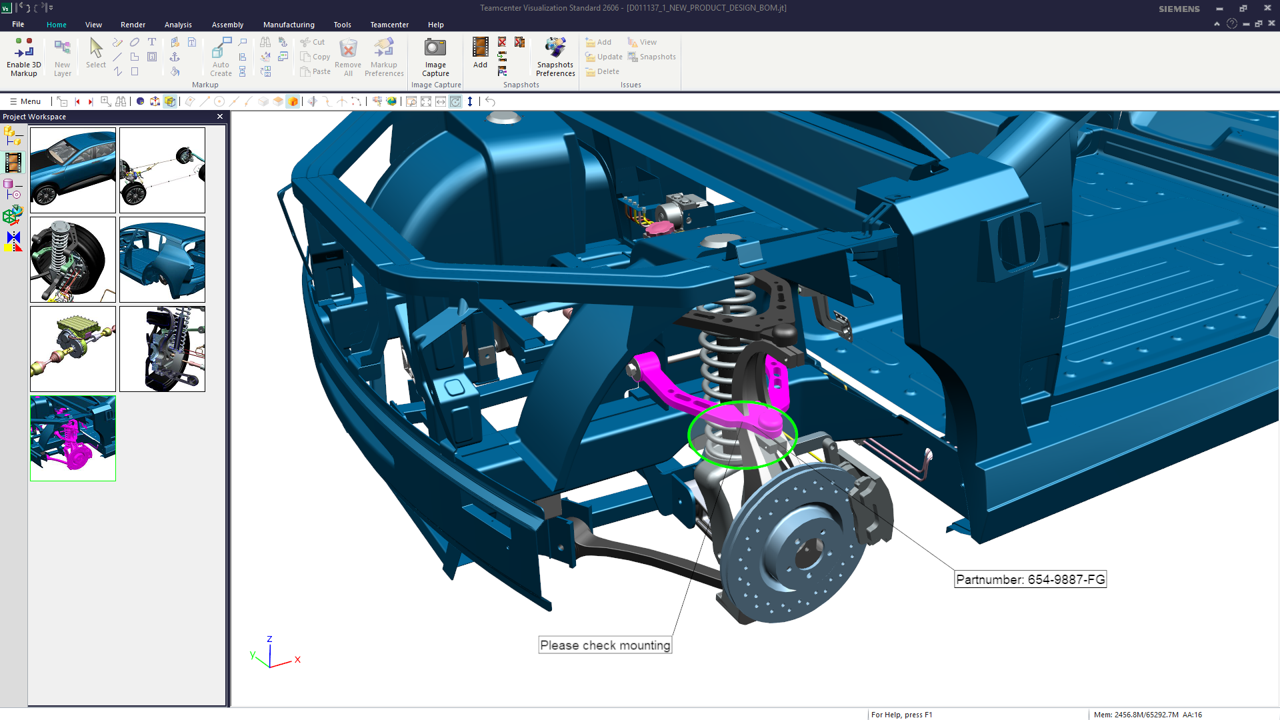
Because that authoritative definition is connected through the digital thread, teams can understand not only what a product is, but also how it is configured, planned, validated, supplied, manufactured, and supported. Rather than creating separate interpretations of product information, stakeholders across the lifecycle can work from a common product definition while maintaining the context they need for their specific roles.
Teamcenter helps preserve engineering intent as products move from design into manufacturing planning, quality execution, supplier collaboration, service activities, and ongoing lifecycle management. The value is not simply access to a 3D model. The value is maintaining a connected product definition that supports decision-making across the lifecycle.
The digital thread turns product models into business assets
A digital model becomes significantly more valuable when it is connected to the processes and decisions that depend on it.
Teamcenter connects product models to engineering BOMs (EBOMs), manufacturing BOMs (MBOMs), bills of process (BOPs), manufacturing planning activities, visualization environments, model-based work instructions, and other lifecycle definitions.
Rather than forcing teams to recreate information at every stage of the lifecycle, Teamcenter maintains relationships between these connected definitions.
As a result, product information can flow more naturally between teams and across the product lifecycle. Teams throughout the enterprise can access lightweight, CAD-neutral 3D representations of the product and work from the same product definition without requiring specialized CAD expertise.
This continuity is what transforms a digital model into a business asset. The importance of lifecycle connectivity is reflected in real-world initiatives as well. For example, Navantia is using the digital thread in Teamcenter to manage the development of complex naval vessels, resulting in a 50% reduction in process times. This demonstrates how connecting product information, processes, and stakeholders can help organizations operate more efficiently across the lifecycle.
And it is what distinguishes a true model-based enterprise from a collection of disconnected digital tools.
Managing change across the model-based enterprise
Product development is never static.
Requirements evolve. Designs change. Manufacturing plans adapt. Suppliers update components. Service teams identify issues in the field. The challenge is not making changes. The challenge is understanding how those changes affect the broader enterprise.

Without connected lifecycle definitions, organizations often spend significant effort identifying impacted structures, updating multiple systems, and validating consistency across teams.
When changes occur, Teamcenter enables teams to evaluate impacts in context rather than discovering them downstream. Engineering intent remains connected to manufacturing planning, quality processes, supplier activities, and lifecycle execution.
This ability to propagate and manage change across connected lifecycle definitions is one of the key enablers of a successful model-based enterprise.
Because the value of a model-based enterprise is not measured by how effectively information is created. It is measured by how effectively information remains connected as change occurs.
Frequently asked questions about model-based enterprise
What is a model-based enterprise?
Model-based enterprise definition: A model-based enterprise (MBE) is a product lifecycle management (PLM) approach that uses a digital product model as the authoritative product definition across engineering, manufacturing, quality, supplier collaboration, service, and other lifecycle activities.
What is the difference between model-based definition and model-based enterprise?
Model-based definition (MBD) focuses on creating and managing digital product definitions, including 3D models and product manufacturing information (PMI).
A model-based enterprise extends those definitions across the organization so connected product information can drive execution, collaboration, and decision-making throughout the product lifecycle.
Why is a digital thread important for a model-based enterprise?
A digital thread connects product information, processes, and decisions across the lifecycle. It helps maintain continuity between engineering, manufacturing, quality, suppliers, service organizations, and other stakeholders while improving visibility into product changes and their impacts.
How does Teamcenter support a model-based enterprise?
Teamcenter helps manufacturers establish an authoritative 3D model-based product definition and connect it through a digital thread that spans engineering, manufacturing, quality, supplier collaboration, service, and other lifecycle activities.
What are the benefits of a model-based enterprise?
Organizations pursuing a model-based enterprise often seek to improve product traceability, change management, lifecycle continuity, collaboration, decision-making, and alignment between engineering intent and business execution.
The model-based enterprise advantage
A model-based enterprise only works when the authoritative product definition is not limited to engineers but can be understood and leveraged by everyone responsible for building, validating, supporting, and improving the product.
Teamcenter helps manufacturers establish an authoritative product definition, connect it through a digital thread, and manage change across the lifecycle. This gives teams the ability to understand change, act with confidence, and stay aligned across engineering, manufacturing, quality, suppliers, service, and other lifecycle stakeholders.
In other words, the model-based enterprise definition is not simply a 3D model. It is the ability to connect product information, processes, and decisions across the lifecycle through a digital thread so teams can work more efficiently, respond to change with confidence, and deliver better products.
🧠 Make smarter decisions with AI-powered PLM
🚀 Start fast and grow with Teamcenter X
🚗 Take the Teamcenter X 30-day test drive
🌟 Learn more about Teamcenter solutions
Gartner Disclaimer:
Gartner is trademark of Gartner, Inc. and/or its affiliates.
Gartner does not endorse any company, vendor, product or service depicted in its publications, and does not advise technology users to select only those vendors with the highest ratings or other designation. Gartner publications consist of the opinions of Gartner’s business and technology insights organization and should not be construed as statements of fact. Gartner disclaims all warranties, expressed or implied, with respect to this publication, including any warranties of merchantability or fitness for a particular purpose.
Gartner, Critical Capabilities for PLM Software in Discrete Manufacturing Industries, Marc Halpern, Sudip Pattanayak, Rajan Saini, Brady Barnes, 10 June 2026.
Table of Contents