SPLIM Bike: When chasing kids leads to a game-changing invention

Every parent knows the moment: your toddler discovers gravity on a balance bike and barrels downhill—while you suddenly realize you’re not nearly as fast as you thought. For Jin Calta, that moment wasn’t just a parenting challenge. It was the start of an engineering solution.
Calta, a design engineer by trade, first observed the problem while watching his sister. Later, experiencing it himself as a parent, he approached it the way engineers do—by asking whether a technical solution could exist. That question became the foundation of SPLIM, a Czech Republic-based hardware startup developing a balance bike with an integrated speed limiter.
“Many parents know this problem well,” Calta explains. “I saw parents running after their children, then I had my own child, and I had the same problem. I thought, ‘there must be a technical solution.’”

Rethinking the balance bike
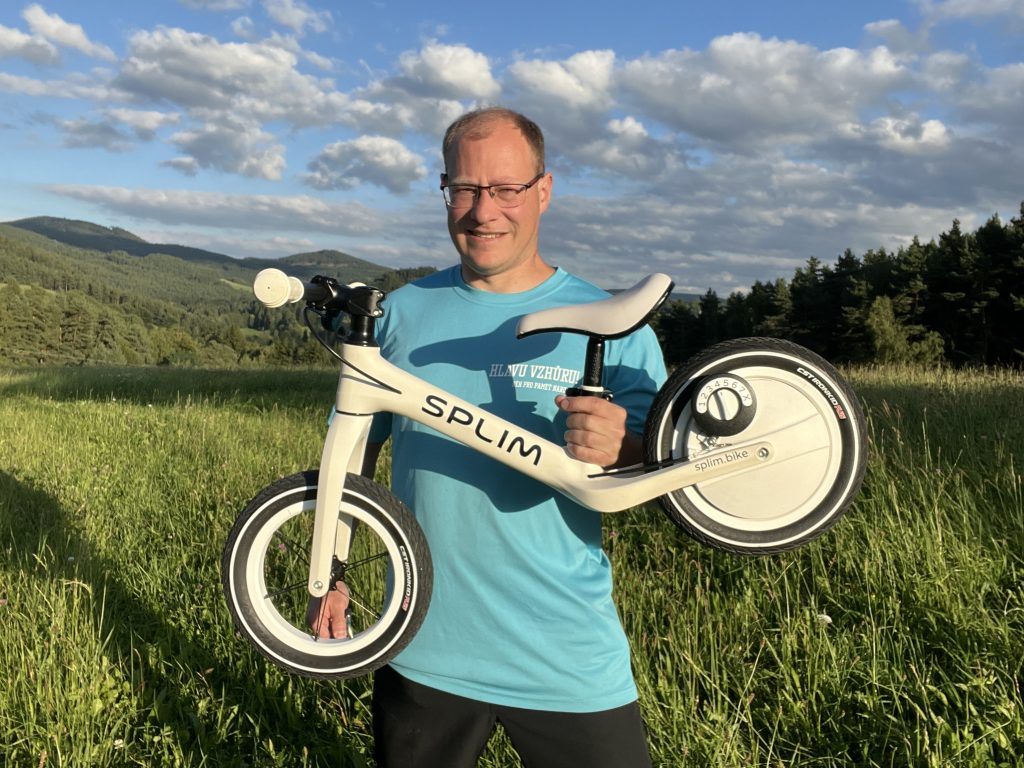
At first glance, the SPLIM bike looks like any modern balance bike: lightweight, minimal, and designed for young riders. But inside the rear wheel sits a mechanical innovation—a speed-limiting system that allows parents to set a maximum pace.
Once that speed is reached, an integrated braking mechanism automatically engages, preventing further acceleration. The limiter can also be switched off entirely, allowing the bike to function like a conventional model.
The concept is simple but transformative. Children maintain their independence, while parents regain peace of mind. Instead of sprinting downhill, families can walk comfortably side by side.
Weighing just 3.3 kilograms, the bike remains competitive with the lightest models on the market. Its frame uses glass fiber–reinforced plastic produced through gas-assisted injection molding (GAIM), combining durability with flexibility. But the real innovation lies in the engineering behind the speed control mechanism.


Engineering first, everything else second
Before founding SPLIM, Calta worked on products ranging from chainsaws to industrial induction heating systems. That background shaped his development philosophy.
Rather than relying on rapid prototyping and trial-and-error iteration, he began with theory.
“I made a mathematical model,” he says. “I optimized parameters like spring stiffness and brake forces in an Excel sheet. So, when I built the first prototype, I already knew it would work.”
This physics-driven approach reduced uncertainty early and accelerated development once prototyping began. Early versions were tested and refined under real-world conditions—often with his own children as riders.
Like many engineering journeys, however, it wasn’t without improvisation. “I even used duct tape for the first prototype,” Calta admits.
Designing with Designcenter X Solid Edge
To bring the concept to life, Calta turned to Designcenter X Solid Edge, part of the Siemens Xcelerator portfolio. Already familiar with the software from his professional career, he used it not just for CAD modeling, but as a core engineering tool.
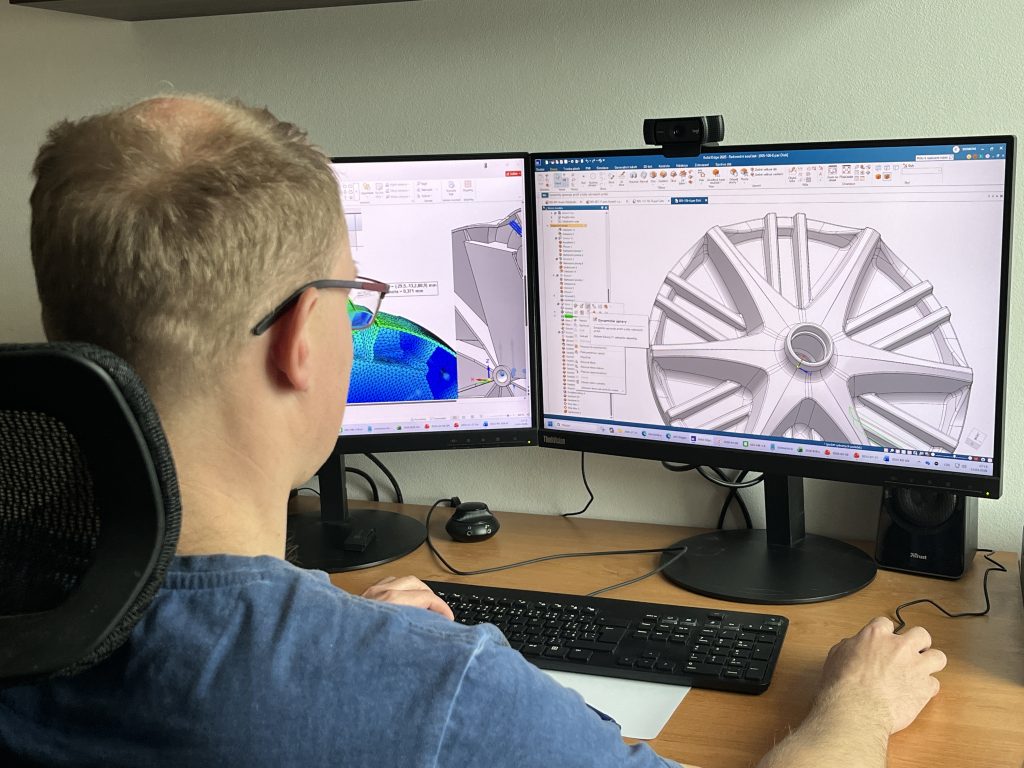
Designcenter X Solid Edge to develop a way to control the speed of a child’s bike. (Image: SPLIM.)
One of the biggest challenges was ensuring structural integrity under real-world stress. Inside the speed limiter, plastic gears transfer braking forces. Under heavy loads—such as downhill riding—these components risk deformation, which can lead to gear skipping.
Using integrated finite element method (FEM) analysis within Solid Edge, Calta identified and resolved the issue.
“I used FEM to optimize the geometry and increase stiffness,” he explains. “The deformation was too high, so I adjusted the design to make it more rigid.”
This was not abstract simulation—it directly addressed a failure mode observed during testing. The result: a robust mechanism capable of handling dynamic loads without compromising performance.
Beyond engineering, Solid Edge also supported SPLIM’s early go-to-market efforts. Integrated rendering tools enabled the creation of high-quality visuals for the website and promotional materials—long before mass production or professional photography were feasible.
From prototype to production
Today, SPLIM is transitioning from development to scaling. Around 20 working prototypes have been produced, combining off-the-shelf components with custom-designed parts—many manufactured via 3D printing.
Approximately 10 components are printed using ASA material, selected for its durability and UV resistance. While the design is largely finalized, scaling production presents the next major challenge.
Injection molding requires significant upfront investment in tooling. Without it, production remains limited to small batches.
“Scaling production requires significant investment in tooling, which is why I’m currently looking for an investor or a strategic partner,” Calta says.
In the meantime, SPLIM is following a phased strategy: producing smaller quantities, validating demand, and reinvesting revenue to support growth.
The reality of building a hardware startup
SPLIM’s journey underscores a fundamental truth: building physical products is very different from building software. Development cycles are longer, costs are higher, and every design decision carries lasting implications.
Despite these challenges, early signals are promising. Initial prototype runs sold out through pre-sales, demonstrating strong interest from parents.
“It’s a new product,” Calta notes. “But parents understand it immediately—they know the situation where their child rides away too quickly.”
As Calta transitions from engineer to entrepreneur, he gains direct access to customer feedback—insights that continue to refine the product. This blend of technical rigor and market awareness is a defining strength at this stage.
Engineering precision applied to real life
SPLIM’s ambition is not rapid disruption, but focused excellence. The goal is clear: build one product that works exceptionally well.
“Everything looks pretty promising at the moment,” Calta says. “SPLIM could become a company selling tens of thousands of bikes per year.”
This is not innovation for its own sake. It is engineering applied to a real-world problem—a child’s bike, a parent’s concern, and a better way to balance both.
By combining disciplined engineering, practical tools like Designcenter X Solid Edge, and a deep understanding of user needs, SPLIM demonstrates how thoughtful design can transform even the simplest everyday experiences.
To learn more, visit Siemens.