The thrilling world of water slides: Hydraulic systems modeled with Simcenter
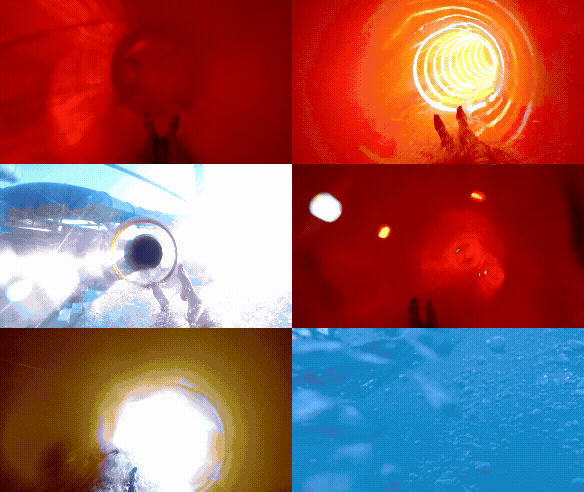
Welcome to the fun world of water slides, where excitement and water come together for a great time! Whether you love thrills or just want to cool off, water slides are fun for everyone. In this blog, we’ll take a behind-the-scenes look at how a water slide works using Simcenter Flomaster. I will explain how water slide hydraulic systems work using Simcenter Flomaster, from pump selection to transient simulation.
Imagine sliding down a twisty slide, feeling the cool water as you go through loops and drops, ready to splash into the pool below. Feeling refreshed now? Now, let’s think about how the water gets from the pool to the top of the slide.
A brief story to refresh the origins – From simple wooden slides to complex hydraulic systems
Water splash slides have a fun, refreshing history dating back to the early 20th century. The concept began with simple slides placed beside pools, allowing riders to glide directly into the water. Initially, these slides were dry, but by the 1920s and 1930s, when water parks began to emerge, one of the first documented water slides with continuously flowing water was built in the United States. This innovation added both speed and cooling, making it perfect for hot summer days.
Early slides were typically made of wood or metal and were often quite steep, offering thrilling rides but sometimes lacking safety features. As public swimming pools grew in popularity, designers started experimenting with taller and more elaborate slides to increase excitement. Over time, advances in materials like fiberglass allowed for smoother, more durable surfaces and more complex shapes.
The “splash” element became a defining feature of these slides, designed to send riders flying into shallow pools with a big, refreshing splash. Today, modern water splash slides incorporate twists, turns, and even enclosed tubes, combining engineering and entertainment to create unforgettable experiences for all ages.
The way water travels up the tower
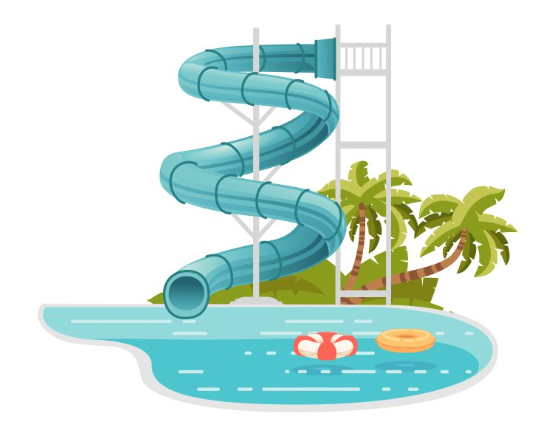
In a water slide, water is moved upward to the top of the slide using electric water pumps. Water cannot flow uphill on its own, so mechanical energy is needed to lift it against gravity. At the bottom of the slide or attraction, water collects in a swimming pool or reservoir. From there, powerful pumps push the water through a system of pipes that lead up to the top platform of the slide. This system includes also bends, valves and other components that allow the water to move around the circuit efficiently and help control its direction, pressure and flow.
The pumps create pressure that forces the water to rise vertically. The higher the slide, the more pressure the pump must produce. This process runs continuously while the slide is operating, ensuring a steady supply of water at the top.
Once the water reaches the top, gravity takes over. The water flows down the slide’s surface, creating a thin, fast-moving layer that reduces friction between the rider and the slide. This makes the ride smoother, faster, safer, and more fun. The flowing water also helps control speed and prevents riders from stopping halfway down.
After reaching the bottom again, the water is collected, filtered, and reused, making water slides efficient systems that recycle the same water repeatedly. In short, pumps lift the water up, and gravity brings it back down to create the fun experience.
Interesting fact: A waterpark can take a million gallons of water to run! However, it reuses 97-98% of this initial fill of water. (17 Fascinating Water-Park Facts You Never Knew [2024])
Modeling the hydraulic system
In Simcenter Flomaster, we can model the entire hydraulic system of a water slide by adding components from the software’s available catalogues and defining the required input data. This information allows us to fully describe the system and run accurate simulations.
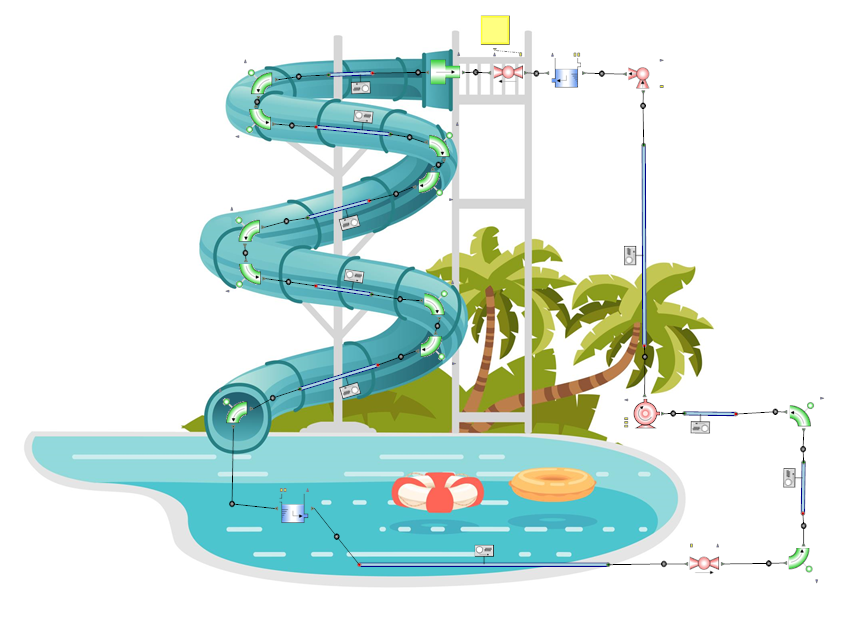
Finding the right pump – Flow balancing
[Flow balancing is a powerful analysis option within Simcenter Flomaster. It allows us to specify the desired flow rates in a system and then calculates the necessary input data necessary to achieve them. This feature is incredibly useful for optimizing components like orifices, valves, or pumps to ensure precise and efficient fluid distribution.]
One of the most important components of a hydraulic network is the pump. By using the flow‑balancing capability in Simcenter Flomaster, we can calculate the required pump head for the system. This helps us determine how much energy is needed to overcome elevation differences and hydraulic losses within the network. Based on these results, we can select the most appropriate pump for the application, ensuring that it meets system requirements while operating efficiently and reliably.
The volumetric flow rate of water slides can vary significantly depending on their size and type. For our calculations, we will assume a flow rate of 7.5 L/s, which is equivalent to 0.0075 m³/s. With this established volumetric flow rate, we will then calculate the necessary pump head to maintain a powerful water flow, ensuring both high adrenaline for swimmers and stable system pressure and flow.

Steady-state simulation
[Steady-state simulation in Simcenter Flomaster provides a snapshot of a hydraulic network under normal, stabilized operating conditions, allowing us to understand the system’s behavior once it has reached equilibrium.]
From the results, we can analyze crucial parameters such as pressures across the entire network, flow rates in various branches, and other vital hydraulic variables. These insights are essential for identifying potential issues like excessive pressure losses or insufficient flow, and for verifying that all components are operating within their specified limits.
By leveraging this information, we can make informed design decisions and optimize the layout of all hydraulic elements present in the system. Ultimately, steady-state simulations provide a robust foundation for designing an efficient and reliable hydraulic system, paving the way for more advanced analyses.
To analyze the results in steady-state, we can use various available analysis features, such as labels. These provide an easy way to visualize the most relevant results directly in the network, for example, total pressures on the nodes.

Transient simulation
[A transient simulation is used when we want to observe how the system behaves over a period of time, usually during specific operations. These operations can include opening or closing valves, increasing or decreasing pump speed, or starting and stopping equipment.]
Unlike steady‑state analysis, which represents a single operating point, transient analysis allows us to capture the dynamic response of the system and understand how pressures, flow rates, and other variables evolve with time.
In this case, we will simulate the closing of a flow control valve and analyze how the system responds. This will allow us to determine how much time is required for the system to reach its normal operating conditions and to identify any transient effects, such as pressure surges or delays, that may occur during the process.
The system result display feature is invaluable for analyzing transient results. It allows us to visualize various physical values and their evolution over time across the system’s nodes and components. Additionally, it clearly indicates flow direction with arrows and value intensity through a color map. A result sensor has also been integrated to show the valve’s fraction of opening.
Fun in the water, even in Winter
Nowadays, water slides can be enjoyed year-round. Many indoor parks heat the water to maintain a constant and comfortable temperature for swimmers. This heated water also flows through the slides, making the experience enjoyable even during the cold months.
In this blog, we are not exploring how water is heated in a swimming pool, but this topic could be covered in a future extension. Meanwhile, you can check out my colleague, Bob Ransljn’s blog How much does it cost to heat up my Hot Tub?, where he explores water heating in a hot tub using Simcenter Amesim.