How to train a robot: Why combining simulation with real-world testing is the future of robot training
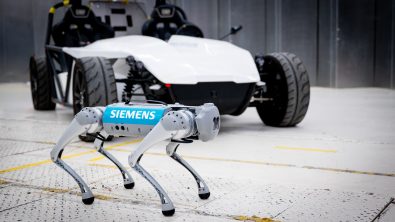
In the future, robots will be doing everything for us, right?
Well, maybe not quite everything. But they’ll most likely be doing a lot. In this blog, we’ll explore how combining simulation with real-world testing will revolutionize robot training and development.
Many factories already have robots performing a wide range of automated tasks that boost productivity. At CES 2026, Siemens and NVIDIA announced that the Siemens Xcelerator platform will be used to design and simulate factory digital twins. Some manufacturers have four legged robots that walk the factory floor checking systems and ensuring no malfunctions are imminent. For example, a brewery in Leuven uses a robot to check for mechanical issues and air leaks. It carries out 1,800 inspections per week and detected 150 anomalies in the first six months. This works because the robot follows a pre-programmed route on a flat surface with no obstacles.
What about autonomous robots that can freely move around and carry out more complex activities?
These could be used in all sorts of scenarios such as defense or rescue missions where they can scan areas that would be dangerous for humans to enter. They could ensure that any potential problems are identified and dealt with to guarantee safety.
But sending a robot out “into the wild” presents a new challenge: How does it navigate unknown terrain? This is where advanced robot training methods become critical.
In an enclosed site with a defined route you know exactly where it will be going, what the surface is made of, where there are steps or ramps. To be useful in a wider unmapped area it needs to be able to cope with unexpected obstacles and surface changes, stay on its feet, and reach its target.
The role of data in robot training
The answer to this problem is effective robot training. Modern, intelligent robots are designed to learn from their experiences and adjust their behavior accordingly.
So, all they need is data to learn from. The trouble is, they need a lot of data.
Capturing this data purely through real-world testing would take an incredibly long time. And it would also be dangerous and very costly. Just like humans, robots learn from making mistakes. But in this scenario, a mistake will often lead to the robot falling over and damaging itself, incurring expensive repairs and adding further delays to an already lengthy timeline.
Accelerating robot training with Simcenter Amesim
Simcenter Engineering Services Research Engineer Jean Pierre Allamaa and Research and Development Manager Son Tong are using simulation to speed up and reduce the risk of robot training. In collaboration with Professor Colin Jones at EPFL University’s Automatic Control Laboratory, they built a digital twin of a robot using Simcenter Amesim and simulated it in all kinds of different scenarios such as variable weather, terrain, and lighting to gather a ‘prior training’ dataset which forms the basis of the robot’s understanding.
However, once they had generated this data they found that there would always be a gap between simulation and reality as systems and the environment change over time. So, they came up with the idea of combining simulation data with real-world data to fine tune the robot’s decision-making module.
How much data?
That sounds great, but now we’re back to the original problem of real-world data being time-consuming and costly to collect aren’t we?
This is about not reinventing the wheel. The robot is already programmed with everything it needs to know about physics. It’s about how the robot deals with the uncertainties of the environment, different slopes of roads and paths, different friction of different materials.
So, in fact, the robot needs just 10 seconds of real-world data to learn and optimize its behavior, a significant breakthrough in efficient robot training.
It’s a bit like creating a reduced order model, but not quite.
Our researchers used matrices to couple the input commands to the output response then linked this to the existing control data. As the functionality of the robot is based on physics, it only needs a small amount of real-world data to fine-tune its behavior across all its actions.
Instead of relying on a perfect mathematical model, the controller learns directly from the robot’s own experience – like watching thousands of past steps and calculating the best way to take the next one. To do this in real time, model identification and prediction are processed in one step using past data of input-output trajectories, or using past input-output trajectories data stored in the form of matrices to build a picture of how the robot will behave and optimize accordingly.
This is part of the team’s vision of simultaneously using simulation with real data to improve autonomy. The decision-making module does not remain fixed once data is collected. As the system evolves and more real-world data is recorded, performance is continually enhanced.
The best of both worlds
Many companies around the globe have built and are building robots capable of carrying out a wide range of tasks. This step of making them able to adjust to their surroundings is perhaps the most difficult and time-consuming aspect of robot trainining. Combining simulation and real-world testing enables scalability as it allows engineers to re-use existing data and add the new variables.
AI tools, such as Simcenter Studio Reinforcement Learning will also play a big part in developing the robots of the future.
Without these methods, manufacturers have to expose their robots to significant risks in testing as they gather all the necessary data. They will almost certainly suffer falls as they learn how to cope with different terrain which will cause costly damage that takes time to repair.
To learn how Simcenter Engineering Services can help you speed up robot training, email us at engineeringservices.sisw@siemens.com.


Comments
Leave a Reply
You must be logged in to post a comment.
Ciekawe, jak technologia robotów rozwija się w szybkim tempie i jak wpływa na naszą codzienność. Warto zwrócić uwagę na to, że firmy takie jak Siemens współpracują z NVIDIA, aby stworzyć cyfrowe bliźniaki fabryk i rozwijać roboty, które mogą wykonywać prace w trudnych warunkach. spin mama W przyszłości autonomiczne roboty będą miały jeszcze większe zastosowanie, zwłaszcza w sytuacjach kryzysowych, gdzie będą mogły oceniać sytuację w niebezpiecznych miejscach. Cały ten postęp z pewnością zmieni rodzaj pracy, jaką będziemy wykonywać, i pozwoli nam skupić się na bardziej kreatywnych zadaniach.