Award-winning innovation: Simcenter M-Star and partners take home 2026 HPCwire Readers’ Choice Award
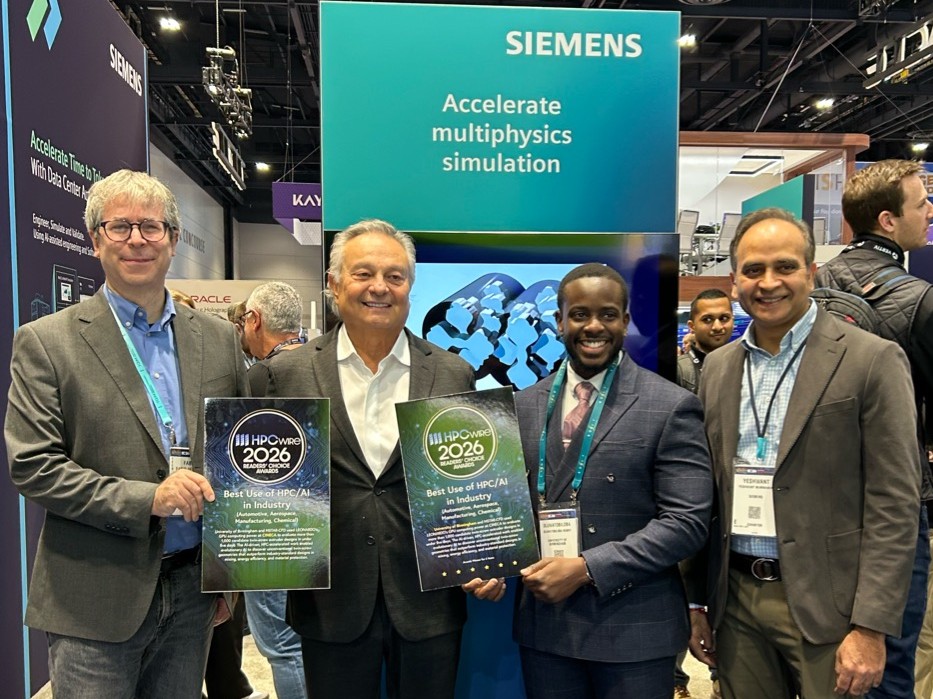
We’re thrilled to share that the University of Birmingham, Simcenter M-Star, and CINECA have won the 2026 HPCwire Readers’ Choice Award for Best Use of HPC/AI in Industry. Winners were announced at Supercomputing 2026 (SC26) this week in Chicago, IL. The award honors outstanding real-world breakthroughs in high-performance computing and artificial intelligence.
The winning project featured an AI-driven, GPU-accelerated workflow that evaluated over 1,000 candidate twin-screw extruder designs in under five days on CINECA’s LEONARDO supercomputer. Using evolutionary AI, the collaboration discovered unconventional screw geometries that outperformed industry standards in mixing, energy efficiency, and material protection. This recognition demonstrates what is possible when AI, advanced simulation, and high-performance computing come together to solve complex engineering challenges.
The challenge: Twin-screw extruders are a black box
Twin-screw extruders sit at the heart of polymer compounding, pharmaceutical manufacturing, and a growing number of sustainable-materials processes. They’re also notoriously difficult to design. The inputs and outputs are well understood, but what happens inside the intermeshing screws—in the realm of conveying, kneading, shearing—is not. Screw element geometries have largely followed the same established design families for decades, and improving on them has traditionally meant slow, expensive physical trials.
The question Oluwatobiloba “Tobi” Henry and researchers at the University of Birmingham set out to answer: if you let AI freely explore the design space using a fast, trustworthy physics engine, what does it find?
Key results and impact
The evolutionary search uncovered non-intuitive twin-screw geometries that outperform current industry standards. By combining evolutionary AI, GPU supercomputing, and Simcenter M-Star, this workflow creates a repeatable template for equipment design across mixers, reactors, and other process equipment.
Simcenter M-Star Product Manager Eric Janz explains, “Process equipment development has always been limited by how many ideas you can afford to test—experimentally or computationally. Tobi’s work shows what happens when we can remove that constraint. When a simulation tool can evaluate a new geometry in hours with a completely automated setup workflow and no manual meshing, AI can explore designs that an engineer would never think to try.”
Video courtesy of Daniel Rhymer, University of Birmingham.
Interview with Tobi Henry, lead researcher
Tell us about the motivation behind this project and why it matters.
Plastic waste imposes detrimental effects on the environment. The majority of solutions are post-production focused, dealing with plastic waste issues after the fact. The use of bio-derived polymer products provides an avenue for maintaining plastic-type functionality while eliminating adverse environmental impacts. By adopting AI-driven methods for polymer production, we can accelerate the redesign of twin-screw extruders like never before, optimizing industrial-scale manufacturing while preserving a future for the next generation.
What surprised you most once you started building your Digital Twin and running simulations on the GPU?
How complex simulating twin-screw extruders is! We had to develop a complex mathematical/parametric geometry framework that gives us virtually complete 3-dimensional control of the geometrical properties of the twin screw for the discovery of non-intuitive and novel designs. It took two years of my PhD to develop this framework. Furthermore, because polymer melts are expensive to simulate with the lattice Boltzmann method, we had to replicate the flow regime while reducing computational expense and develop a standardized performance metric to compare designs on the same scale.
Evaluating over 1,000 candidate twin-screw designs in under five days is incredible. What made traditional testing impossible at that scale, and how did leveraging LEONARDO’s GPUs and Simcenter M-Star change the game?
Traditional testing relies on manual CAD adjustments or time-consuming parameter sweeps, making unconventional designs virtually impossible to find. HARPPP (Highly-Autonomous Rapid Prototyping for Particulate Processes)—developed by EvoPhase (Leonard Andrew Nicusan, Kit Windows-Yule, Dominik Werner, and Jack Sykes)—intelligently learns from exploration history. Coupled with Simcenter M-Star and CINECA’s ~3,500 GPUs on LEONARDO, we achieved a design exploration rate of 1,000 candidates in less than 5 days!
What was your reaction when the AI surfaced a design humans wouldn’t normally think of?
Blown away! We never thought this optimization workflow would be achievable. Getting physics-informed, non-trivial, never-before-seen designs with significant quantifiable performance improvements is mind-blowing.
How do you think these optimized designs change the future of manufacturing?
They are truly game-changing. The AI optimization accounts for fluid rheology and screw size, tailoring designs to fit existing physical twin-screw systems. The shift from conventional DoE to evolutionary AI is as profound as the shift from paper design to CAD, or from manual experimentation to CFD.
How does it feel to see this research win a Readers’ Choice Award?
This is a very competitive international award won previously by NASA, Argonne National Laboratory, GE Aerospace, and others. We are therefore in strong company. I feel extremely lucky to be part of a collaboration showcasing industry-academia synergy. This was a group effort. I’d like to acknowledge everyone involved: Kit Windows-Yule, Dominik Werner, Eric Janz, Alberto VilarinoTarrio, Jack Sykes, Francesco Fiusco, Leonard Nicusan, Joseph Wood, and Daniel Rhymer.
On a personal level? I am truly humbled and blown away. I never expected to win when I saw the names we were going up against. I’m just a PhD student at the University of Birmingham in England who was given a rare opportunity to showcase his work.