Simcenter Culgi meets Simcenter STAR-CCM+: Bridging computational chemistry and CFD for holistic carbon capture simulations

Membrane separation for carbon capture and beyond
Membranes play key roles in a wide range of technologies, from water treatment and energy systems like electrolysis, fuel cells, and batteries, to critical medical applications. These engineered components act as semi-permeable barriers, enabling controlled separation of molecules which is fundamental for processes such as filtration and selective transport.
Membrane separation processes are highly energy efficient and have small physical and chemical footprints – this makes them particularly promising for carbon capture applications. For effective performance, membranes also must fulfill additional critical criteria, including high permeance and selectivity, thinness and stability under chemical, thermal, and mechanical stress.
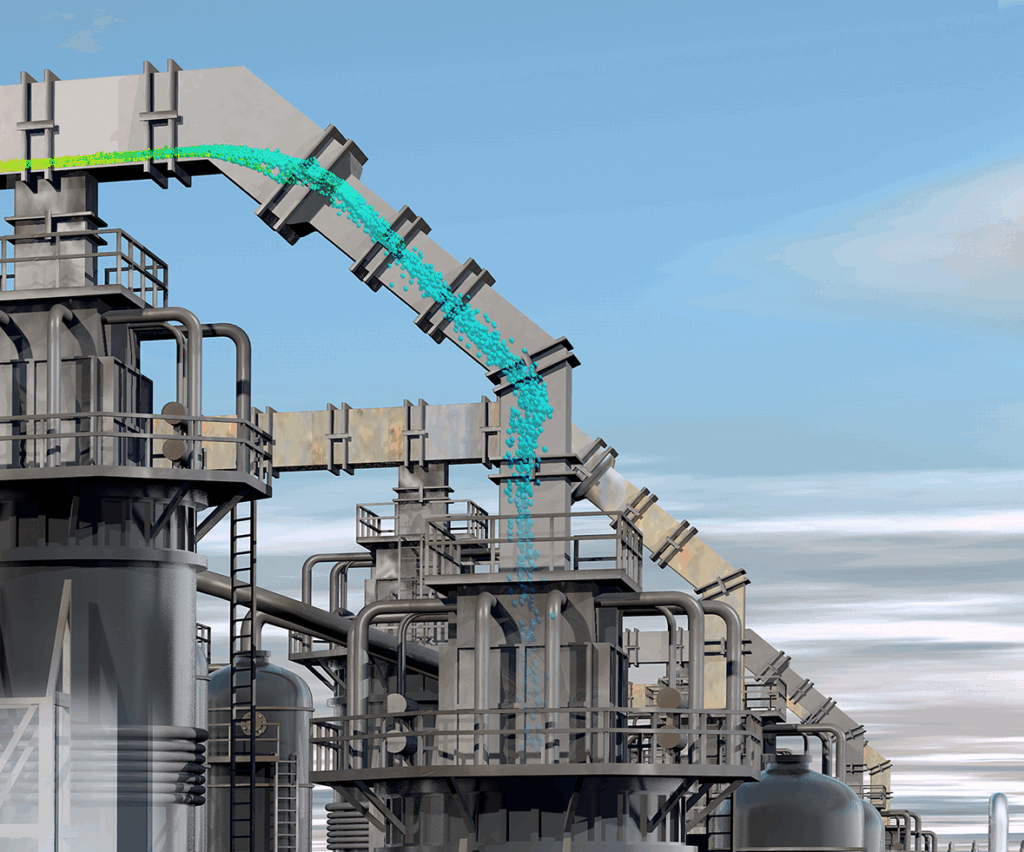
Carbon capture technologies in general aim to reduce greenhouse gas emissions by removing CO₂ from industrial flue gases or process gases, such as those generated in power plants and chemical manufacturing facilities. This approach is especially interesting for the decarbonization of hard-to-abate industrial sectors, including cement, steel, and glass production.
Simulating membranes with Simcenter STAR-CCM+
In membrane-based CO₂ separation, the process is driven by the difference in partial pressure across the membrane, enabling the selective transport of CO₂ from the gas mixture through the membrane material. The underlying flow dynamics can be simulated using Simcenter STAR-CCM+ to analyze performance and identify opportunities for optimization. Within CFD (Computational Fluid Dynamics), membranes are typically modeled as having zero geometric thickness to simplify mass transfer calculations for specific species.
To perform such calculations, permeability values are required for the membrane materials. And this is a challenge that every engineer dealing with complex material behavior is likely familiar with: producing accurate CFD or FEM (Finite Element Method) simulation results requires precise information about the relevant material properties.
Adding microscopic information to enhance CFD
Material properties are typically found in literature, manufacturer data sheets, or through direct communication with manufacturers. Alternatively, they can be determined from test bench experiments. However, gathering the necessary information can often be cumbersome.
Simcenter Culgi, a simulation software for designing and optimizing advanced materials at the molecular level, provides an alternative approach. Not only can existing material properties be retrieved based on their composition, but new materials can also be explored. An example for a carbon capture membrane material this is shown here:

Investigate emerging materials with Simcenter Culgi
In recent years, several innovative and emerging membrane materials have been investigated. One particularly interesting example for CO2 separation is a microporous polymer called PIM-1 (Polymer of intrinsic microporosity). PIM-1, as the name indicates, is noteable for its intrinsic microporosity, which has been discovered only in the year 2004 and arises directly from its molecular, ladder-like, contorted structure. The molecule structure and the ball-stick image illustrate this. When connected, the irregular packing of the rigid macromolecules lead to the characteristic microporosity, providing pathways for molecular diffusion through the polymer matrix. Additionally, PIM-1 can be processed into arbitrary forms, making it very suitable for membrane fabrication.
Simcenter Culgi can be used to analyze the structure and properties of PIM-1 as well as the transport of CO2 gas through the membrane. The separation process mechanism is primarily diffusion, enhanced by selective solubility effects.


For CFD practitioners, this provides an intriguing example of how molecular structure directly impacts transport properties at the continuum scale. By incorporating diffusion and solubility data for PIM-1 into CFD models, it is possible to simulate its performance in applications such as CO₂ capture, where membrane-based separation plays a critical role.
Naturally, this approach can be applied to many other membranes or material applications.
What to read next