How Siemens and ESA are helping European space startups scale faster

Global space economy’s inflection point
European space startups are scaling into a fast-expanding global market. The global space economy reached an unprecedented $613 billion in 2024 and is projected to cross $1 trillion by 2032, with 78 percent driven by the commercial sector. Venture capital funding hit $9.1 billion last year, and Europe’s share of global private investment surged from 3 percent in 2019 to 22 percent in 2024, with Germany alone accounting for 71 percent of European capital raised. The momentum is visible on the launchpad too: 2025 saw a liftoff to orbit every 28 hours from January to June, six hours faster than the 2024 record. Launch economics have fundamentally shifted as SpaceX’s reusable rockets slashed costs by 75 percent. Meanwhile, maturing commercial applications like Starlink (7,500+ satellites, $7.7B revenue) and rising geopolitical demand for secure infrastructure continue to fuel investment.
Why so much interest in space?
There are several factors that have unlocked these possibilities. Key drivers include:
- Launch economics – SpaceX’s reusable rockets have slashed launch costs by 75 percent, from $10,000 to $2,500 per kilogram. According to NASA research, the Falcon 9 now delivers payloads to LEO at approximately $2,720 per kilogram. This has fundamentally changed the economics.
- Geopolitical uncertainty – Rising geopolitical uncertainty, accelerating defense budgets, and continued demand for secure communications and resilient infrastructure have anchored interest. Defense has become a major growth driver.
- Technology transfer – Space technologies are increasingly finding terrestrial applications, from materials science to communications infrastructure, creating multiple revenue streams and attracting broader investor interest.
- Commercial applications are maturing – Space technologies are gaining momentum and their applications are becoming more widespread. Starlink has over 7,500 satellites deployed and 4.6 million subscribers in 2024, generating $7.7 billion in revenue.
The risks remain real
However, even with so much momentum and breakthroughs, the risks associated with space tech can’t be ignored.
Long development cycles and capital intensity. Space companies remain high risk investments, requiring massive upfront capital while many have not yet generated revenue. Reducing these barriers has the potential to propel more breakthrough technologies toward commercialization.
Launch failures mean total loss. Unlike other industries, a single launch failure can result in complete asset destruction and significant reputational damage. The inherent complexity of space systems, with thousands of critical components and multiple potential failure points, compounds this risk.
Supply chain fragility. Peter Beck, CEO of Rocket Lab, cites supply chain as the industry’s “Achilles’ heel,” noting how large projects can disappear for years, creating fragility and lack of scale within the supplier ecosystem. Advancement in development tools has the potential to lower barriers to entry, level the playing field, and build ecosystem resilience.
Competitive and regulatory pressure. As the industry matures, government space policies continue to evolve, and market leaders like SpaceX exert competitive pressure. The space startup ecosystem has entered a disciplined growth phase, and industry incumbents and the broader ecosystem must play their part to sustain its development.
Siemens’ decades-long commitment to space innovation
Advanced simulation and digital twin technology have become critical enablers in this environment. Siemens has decades of experience supporting aerospace industry players, and the comprehensive digital twin, spanning product, production, performance, and digital risk twins, is essential for organizations developing complex systems with thousands of components. The digital risk twin, powered by the MADE solution addressing Reliability, Availability, Maintainability and Safety (RAMS), is particularly relevant as digital transformation reshapes how space organizations manage product complexity, support distributed teams, digitize domain knowledge, and reduce total cost of ownership. These capabilities support a “Shift Left” strategy to mitigate risk and reduce costs by enabling virtual testing and simulation early in the lifecycle.
For this reason, and many others, Siemens Digital Industries Software has been a trusted partner to the space industry for decades, from the Ariane 5 program whose technology traces back to the early 1970s, to today’s most ambitious lunar exploration initiatives. Industry leaders like Northrop Grumman rely on the Simcenter portfolio for NASA’s Lunar Gateway and Artemis missions, leveraging Simcenter 3D, Simcenter Testlab, and Simcenter Amesim to create high fidelity digital twins of spacecraft and space robotics systems. As Dr. Tom Stoumbos, Simulation & Test Leader at Northrop Grumman, observes: “In a decade or two, we have gone from designing communication satellites to developing complex robotic systems for servicing missions up in space.” Similarly, SABCA uses Simcenter Testlab and SCADAS for ESA’s Vega launcher thrust vectoring systems, while Airbus Defence and Space, with over €11.5 million invested in their testing facilities since 2000, validates multimillion dollar satellites like ESA’s Gaia spacecraft using Simcenter environmental testing solutions. SpaceX, which revolutionized commercial spaceflight, standardized on Siemens’ Designcenter NX, Simcenter Femap, and Teamcenter early in its journey, achieving a 50 percent productivity improvement that helped accelerate development of its Falcon rockets.
Empowering the next generation of space innovators
But the space industry’s future isn’t being shaped by established primes alone. A new generation of startups is driving innovation at unprecedented speed, and they’re using the same professional grade simulation tools. Reaction Dynamics in Canada is reinventing hybrid rocket propulsion using Simcenter 3D and Simcenter NASTRAN. Astroscale in Japan is tackling space debris removal with Simcenter Femap. Space Machines Company in Australia is building orbital servicing vehicles with Simcenter thermo-mechanical simulation. Hypersonix is developing scramjet powered launch systems using Simcenter STAR-CCM+ for hypersonic CFD analysis. Even student teams like Greece’s SpaceDot, part of ESA’s “Fly Your Satellite!” program, achieved a 30% mass reduction in their CubeSat payload structure using Simcenter 3D. As Hypersonix co-founder David Waterhouse puts it: “Software has levelled the playing field in what was previously an inaccessible space industry.”
The message is clear: simulation isn’t optional in space, it’s existential. You can’t fully test space systems on the ground before launch; you can’t iterate through physical prototypes when each failure costs millions. Digital twins and virtual testing have become the foundation upon which mission success is built. Talented teams with breakthrough ideas shouldn’t be limited by tool access, and Siemens is committed to ensuring that the next SpaceX, the next Rocket Lab, the next game changing space startup has the same simulation capabilities that have powered humanity’s greatest space achievements for over five decades.
The ESA partnership: a new chapter
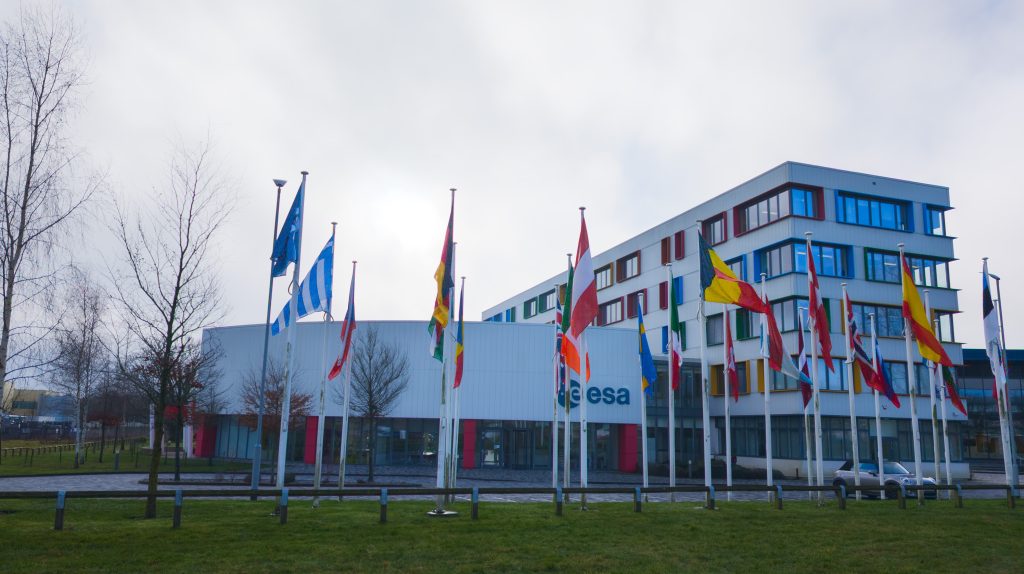
Today, we’re announcing a partnership with the European Space Agency (ESA) that takes this commitment to European space startups to the next level. Through ESA’s Business Incubation Centres (ESA BICs), which operate across Europe to support early stage space ventures, startups will gain access to Siemens’ world-class Simcenter simulation portfolio.
This partnership reflects a shared vision: that Europe’s space future will be built not only by established players but by the startups that bring fresh thinking, agility, and entrepreneurial energy to the sector. By combining ESA’s deep expertise in space technology and commercialization support with Siemens’ industrial-strength simulation capabilities, we’re creating a pathway for the next generation of European space companies to compete on the global stage.
The Siemens-ESA Partnership for European Space Startups
ESA BIC startups and projects supported by the ESA Technology Brokers and ESA-PhiLabNET, will receive access to Simcenter’s comprehensive simulation portfolio, including high fidelity structural, thermal, and fluid dynamics simulation; multiphysics analysis for complex system interactions; acoustics and vibration testing capabilities; and digital twin technology for virtual validation. Beyond software access, startups will benefit from technical enablement sessions and training, direct engagement with Siemens aerospace experts, and connection to Siemens’ broader ecosystem of partners and customers.
What European Space Startups Gain from the Partnership

As part of the partnership, Siemens offers access to enterprise grade tools (Simcenter portfolio), with terms and conditions that are far more favorable than standard commercial terms. The intent is to support space tech ventures in the most critical development phase and taper the plan over a course of two to three years, so they are supported throughout the product commercialization journey.
Training and Skill Development
In addition to advanced tools and technologies, Siemens also offers access to the Siemens Xcelerator Academy, an on demand training platform which offers self paced learning modules. The program for startups includes training on Simcenter solutions relevant for space systems, helping startups become productive quickly, aiming to reduce the learning curve from months to weeks.
Expert support and mentorship
Startups enrolled in the program and opting for Simcenter solutions receive expert support and mentorship offered by subject matter experts (SMEs) and seasoned industry experts with aerospace simulation experience. During the mentorship sessions, the SMEs can offer application specific guidance, explain best practices for aerospace simulation, advise on validation methodology, or provide other types of tailored guidance.
Networking and visibility opportunities
Moreover, early stage startups often struggle to get the word out about their innovation and the impact they can make with additional resources. As part of the partnership, Siemens also plans to offer networking and visibility opportunities. Startups enrolled in the program can be invited to Siemens customer facing events, extending access to the broader engineering community across Europe; to technical workshops; or to speak at larger format events such as Realize LIVE Europe. Additionally, Siemens also offers to collaborate and support startups by working on joint marketing initiatives such as case studies (both text based and video), promotions across Siemens channels, as well as amplification through its and its employees’ social media channels.
How European Space Startups Can Get Started
If everything you’re reading is relevant for you and your organization, here are the next steps:
- Find your ESA BIC – Locate your ESA BIC based on your country or region on the ESA BIC network page
- Review eligibility criteria – Check the requirements listed for your region
- Submit your application – Apply to get an ESA BIC manager or coordinator involved who will guide you through the process
- Share your company information – Provide details so ESA BIC and the local Siemens team can understand your needs
- Joint review – ESA BIC and the local Siemens team will jointly review the application, verify eligibility, and make the necessary assessment
- Onboarding – For successful applicants, the onboarding process will be initiated, and access to tools, technologies, training, and other resources will be provided
Looking Forward
The space economy is at an inflection point. The barriers that once made space the exclusive domain of governments and aerospace giants are falling. A new generation of entrepreneurs is emerging with ambitious visions for sustainable launch systems, orbital services, satellite constellations, and technologies we haven’t yet imagined.
But vision alone isn’t enough. Success in space requires rigorous engineering, validated designs, and the ability to get things right the first time. Through this partnership with ESA, Siemens is committed to ensuring that European startups have access to the same simulation capabilities that power the world’s most successful aerospace programs.
The future of European space will be written by the startups that can combine bold ambition with disciplined execution. We’re proud to be part of that journey.
The Bottom Line
The combined value proposition of the partnership between Siemens and ESA aims to address both the business and technical needs of space startups in Europe. Through this partnership, space tech startups increase the likelihood of commercial success while leveraging top of the line tools, mentorship, and networks, democratizing access to the same capabilities that have powered the industry’s most successful missions and helping to ensure that the next generation of space innovators can turn their breakthrough ideas into reality.