Solar eclipse: Moon switches off Spain’s solar farms!
This post draws from our recent engineering simulation study on the impact of solar eclipses on renewable energy systems.
On the evening of 12 August 2026, millions of people across Spain will look up and watch one of nature’s rarest spectacles. For a few precious minutes, the Moon will slide directly in front of the Sun, turning daylight into twilight and revealing a glimpse of the solar corona. It will be the first total solar eclipse visible from mainland Spain in more than a century.
But while astronomers prepare their telescopes and tourists flood into the path of totality, another community has been watching the eclipse very differently.
Engineers.
Because when the Sun disappears, even briefly, something else happens: one of Europe’s largest renewable energy fleets loses its fuel source.
That simple question sparked an intriguing project. What happens to solar energy production when the Moon’s shadow sweeps across a country powered increasingly by photovoltaics? And can engineering simulation predict the impact before the eclipse even begins?
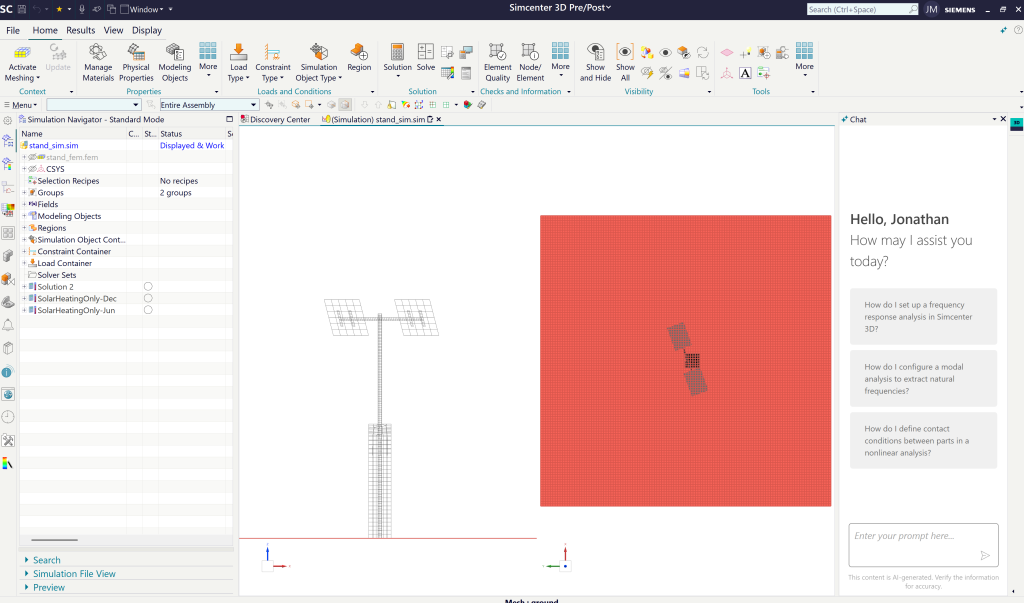
To find out, engineers at Maya HTT used Simcenter 3D Space Systems Thermal capabilities, which are designed to model solar radiation, orbital heating, shadowing and radiative heat transfer. The technology is commonly used for spacecraft and satellites, where understanding changing exposure to the Sun is critical.
Simulating an artificial sunset
The eclipse crossing Spain on 12 August is unusual because it occurs in the evening, with the Sun already low on the horizon. The path of totality enters north-western Spain and exits over the Balearic Islands, with totality lasting around one to two minutes depending on location.
For the simulation, engineers created a simplified thermal model to track how incoming solar radiation, or heat flux, changes as the Moon progressively obscures the Sun.
The results are visually striking.
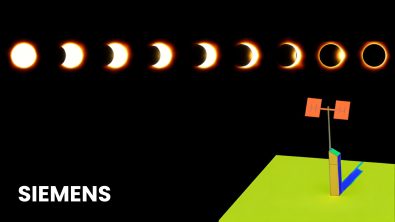
In the first animation, representing a normal August day, solar irradiation follows its familiar pattern, rising in the morning and gradually declining towards sunset. There is a blip due to the eclipse but its so fast its hard to see unless you look at the plot.
In the second animation, we focus in on the time of the eclipse. What should have been a smooth descent becomes a dramatic period of darkness before the light returns, as if somebody briefly dimmed the Sun.
The simulation does not predict the exact national power output of Spain’s solar fleet. That would require modelling thousands of installations, weather conditions and local grid behaviour. Something that may be more suited to a simulation in Simcenter Amesim, something akin to the study in this blog. Instead, it demonstrates the fundamental physics driving the event: a rapid reduction in incoming solar radiation caused by the Moon’s shadow.
And unlike clouds, which are unpredictable, an eclipse is one of the few energy events engineers can forecast with remarkable precision decades in advance.
A test for Europe’s energy system
The timing of this eclipse is particularly interesting because Europe’s electricity grid now contains far more solar generation than during previous eclipses.
Grid operators across Europe have spent months preparing.
According to the European Network of Transmission System Operators for Electricity (ENTSO-E), photovoltaic generation across continental Europe could temporarily fall by as much as 9.7 GW under clear-sky conditions during the eclipse.
Spain is expected to experience one of the largest effects.
Spanish grid operator Red Eléctrica estimates that solar generation across the Iberian Peninsula could temporarily decrease by approximately 5 GW as the eclipse accelerates the normal evening decline in solar production. However, the operator has also stated that the impact will be limited and temporary, with no expected threat to electricity supply.
That prediction highlights something remarkable about today’s energy infrastructure.
An eclipse used to be primarily an astronomical event.
Now it is also an energy event.
Where space technology meets earthly challenges
Tools originally developed to model spacecraft moving through cycles of sunlight and shadow can also help us understand what happens when Earth’s own power infrastructure briefly experiences the same phenomenon.
The same physics that determines how a satellite heats and cools in orbit can be used to explore how a solar panel on the ground responds when the Moon blocks the Sun.
And on 12 August, as observers across Spain look skyward, those simulations will be playing out in real time above them.
Astronomers will celebrate the spectacle.
Engineers will watch the data.
And both will be witnessing exactly the same thing: the extraordinary influence of a celestial shadow moving across a modern technological society.