Industrializing component characterization for virtual NVH development: Automated component model extraction (AutoCMX)
What’s new in Simcenter Testlab 2606
Simcenter Testlab 2606 introduces Automated Component Model Extraction (AutoCMX), an integrated hardware-and-software solution that automatically extracts ISO 20270-compliant component models for virtual NVH development. By automating blocked-force characterization and model generation, AutoCMX transforms component characterization from a slow, expert-driven process into a fast, repeatable workflow that produces virtual-prototype-ready models in minutes rather than days.
There is a moment in every electrified vehicle program where the NVH team is asked to guarantee how the car will sound before a single drivable prototype exists. The answer is virtual prototyping: predicting interior sound and vibration by digitally assembling independently characterized components. The prediction mathematics, Component-based Transfer Path Analysis (C-TPA), Frequency-Based Substructuring (FBS), and Virtual Prototype Assembly (VPA), are mature and well proven. Acquiring the high-quality component data that feeds it is not.
Automated Component Model Extraction (AutoCMX) closes exactly that gap. It is an integrated hardware-and-software solution, built on patented technology developed jointly with Bosch, that automatically extracts invariant component models in full compliance with ISO 20270 and is ready to drop straight into a Simcenter Testlab virtual prototype. It turns component characterization from a slow, expert-only exercise into a fast, repeatable, technician-ready bench process.
The heart of the matter is the blocked forces: the invariant descriptor that makes virtual assembly possible, but conventional testing struggles to deliver it quickly or reliably enough to scale. AutoCMX makes blocked forces you can actually trust, in minutes rather than days. Here is what changes for your workflow.
Why does this matter now?
Compressed cycles, exposed noise
The automotive industry is compressing vehicle development from the traditional three-to-four-year cycle down to eighteen to twenty-four months, while simultaneously electrifying the powertrain. Both trends put NVH engineering under pressure. Shorter cycles mean fewer physical prototypes and far less time for the late-stage troubleshooting loops that used to absorb NVH problems. Electrification removes the broadband masking of the combustion engine, so tonal whine, gear orders, and structure-borne inputs that were once hidden are now clearly audible to the customer.
The business case for virtual development
Physical prototype builds are expensive, and the late-stage troubleshooting they invite is even more so, in both engineering hours and schedule risk. Every NVH problem caught in a virtual prototype is a problem that never has to be chased on hardware. Yet a virtual prototype is only as trustworthy as the component models within it, so the return on a virtual-development strategy is capped by the quality and throughput of component characterization. By making that characterization fast, repeatable, and operator-independent, AutoCMX frees expensive bench capacity, reduces the secondary costs spent reconciling data-quality and correlation disputes, and lets an organization invest its NVH specialists in engineering decisions rather than in data collection.
The real problem: Trustworthy blocked forces?
Why are blocked forces the right descriptor
For structure-borne sources, the invariant descriptor that makes virtual assembly possible is the blocked force. Measured in situ according to ISO 20270:2019, a blocked force depends only on the source component itself, not on the receiver to which it is attached, which is exactly what allows a component to be characterized once and then coupled to any vehicle model. Major OEMs increasingly specify blocked-force limits as the contractual NVH interface between supplier and OEM, so the descriptor is no longer academic; it is becoming a deliverable.
Why conventional practice fails to scale
The difficulty has never been the theory. It has been obtaining blocked forces you can actually trust. Conventional in-situ TPA yields accurate results only when executed by a highly skilled engineer, because experimental errors propagate directly through the inverse problem into the result. Published studies are therefore typically based on a handful of samples, and the effort is considerable. That creates four chronic weaknesses: poor repeatability across engineers and sites, uncertain precision, slow execution that can block a test bench for hours, and an inability to see production spread, because with only one or two samples, you cannot separate genuine part-to-part variation from measurement error. Scaled blocked-force testing simply is not the industry standard today: the tests are too slow, and the quality is too often unreliable.
What is AutoCMX?
A self-measuring fixture
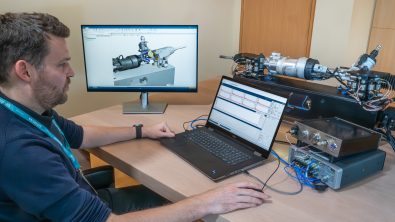
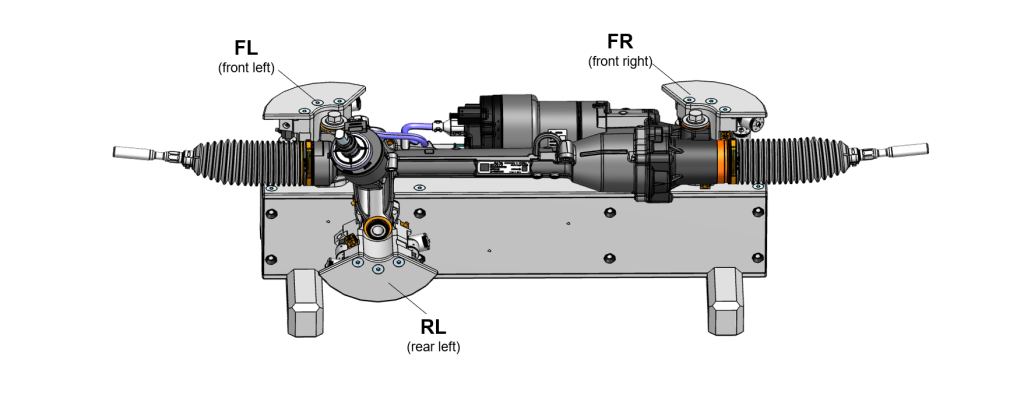
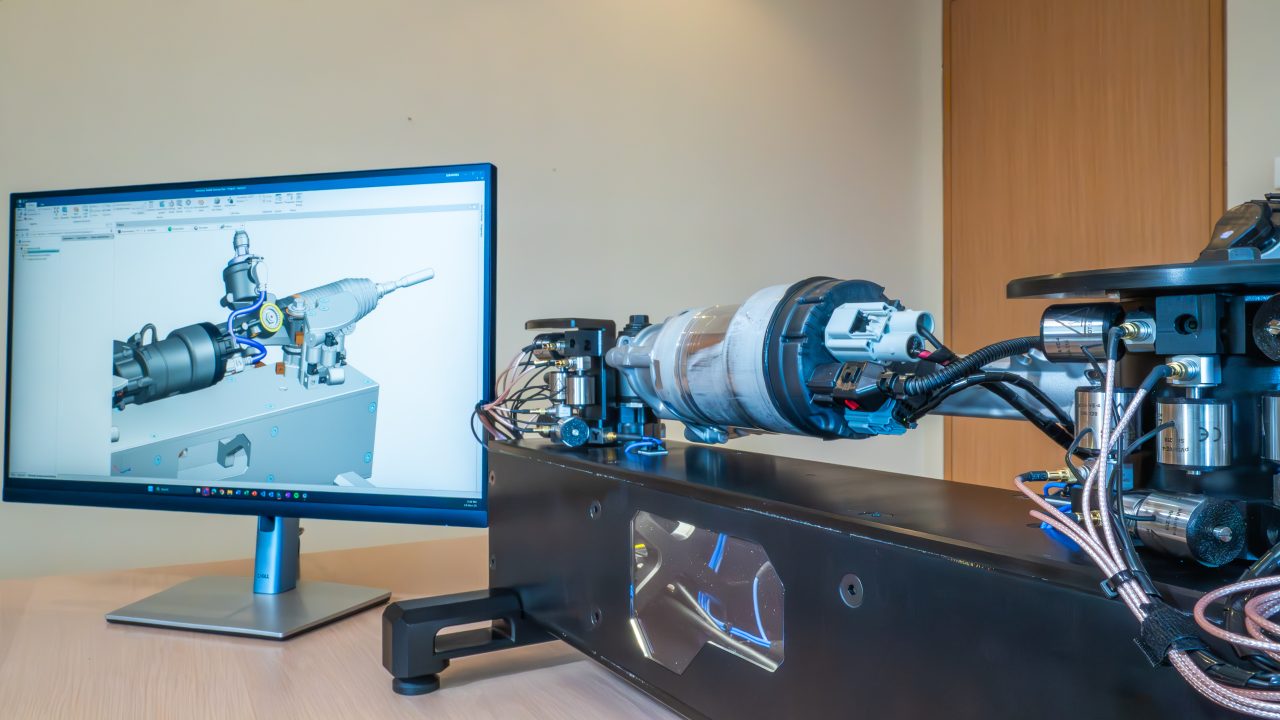
AutoCMX automates ISO 20270 end-to-end. At its heart is a self-measuring fixture: rigid virtual-point adapters carry a permanently mounted set of shakers and accelerometers, an automation control Unit, wired through an amplifier and a Simcenter SCADAS frontend to a laptop running Simcenter Testlab. Because all instrumentation lives on the fixture, nothing is attached to the component under test. Swapping a part means unbolting the previous unit and bolting on the next, enabling genuine batch throughput.
The two-stage ISO 20270 workflow
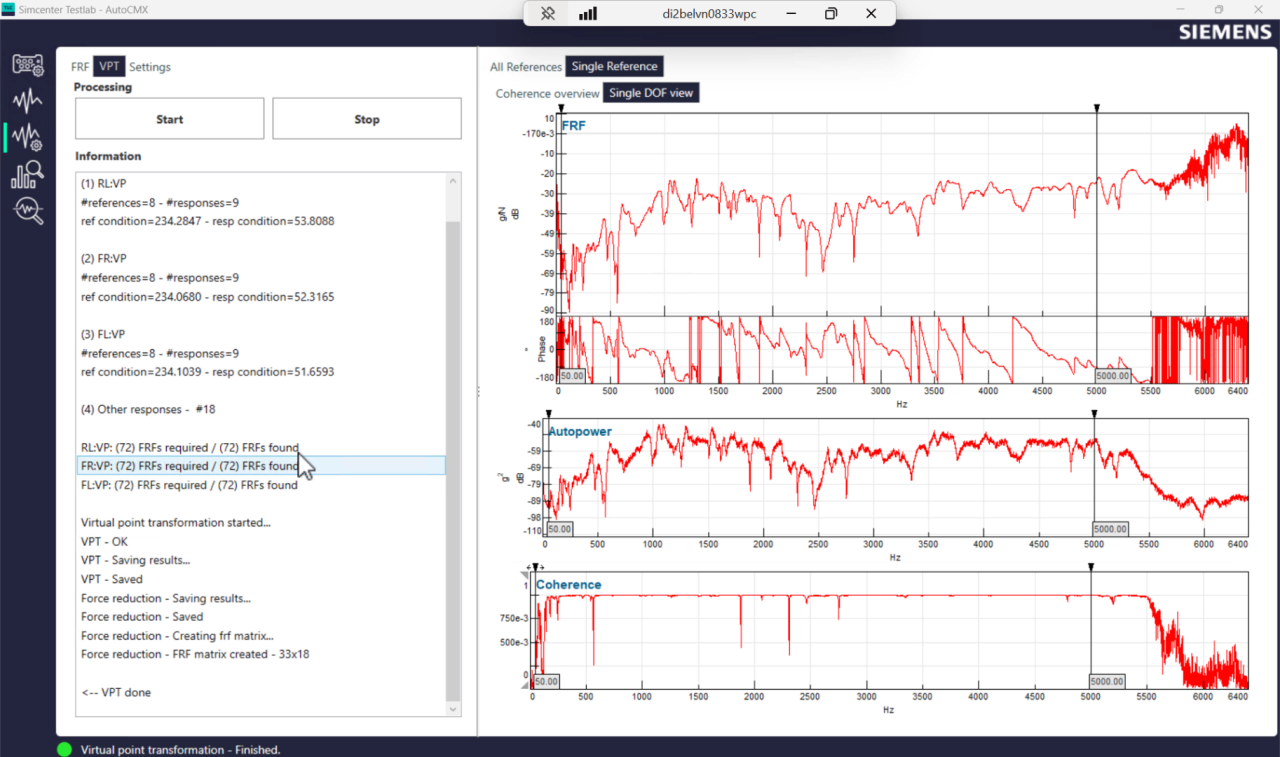
First, the coupled indicator FRF matrix is measured by sequentially firing each shaker and is transformed onto the inaccessible source–receiver interface using Virtual Point Transformation (VPT), giving a full six-degree-of-freedom description at each connection point. Then the operational responses are recorded while the component runs, and the blocked forces at the virtual connection points are estimated by solving the in-situ inverse problem:
f2,bl = H42AB + a4
where f2,bl are the blocked forces at the source contact DOFs, a4 the measured indicator accelerations, and H42AB+ the Moore–Penrose pseudo-inverse of the coupled accelerance FRF matrix. A separate one-time bench calibration allows FBS decoupling to recover the uncoupled impedance FRFs, thereby completing the invariant component model. The result drops straight into Virtual Prototype Assembly for KPI prediction and, ultimately, auralisation in the Simcenter Testlab NVH Simulator.
Why are the results reliable?
Reliability engineered, not hoped for
Low variability and high repeatability rest on six pillars: the rigidity of the virtual-point transformation; on-board validation of the bench; a high signal-to-noise ratio; coherence-based quality control at both the overall and the individual-FRF level; consistent indicator FRF measurements, since the shakers never move once positioned; and consistent measurement conditions across experiments. In practice, the operational response is more than 10 dB above the sensor noise floor across the frequency range of interest, and the indicator FRFs exhibit such high, uniform coherence that the FRF matrices require no filtering or regularization; the pseudo-inverse is applied directly to clean, measured data.
The rigid virtual point is the quiet key
Because the shaker excitation is introduced through a geometrically exact, rigid path into the connection point, the virtual-point transformation is well-conditioned, and the reconstructed interface behaves as a genuine rigid body, as is typically confirmed by coherence of 0.9 or higher between measured and transformed data across all six degrees of freedom. Crucially, any local reinforcement needed to guarantee that rigidity is applied to the receiver-side fixture, never to the source, so that the blocked forces remain invariant. And because a full measurement takes minutes rather than hours, a questionable setup can simply be rerun and improved on the spot, rather than patched with post-processing assumptions that would otherwise have to be documented and defended. On-board validation closes the loop: a target accelerometer excluded from the force calculation is used to compare the predicted response with the measured one, providing an immediate, objective confidence check for every measurement.
Proof: An electric power steering case study
Minutes instead of hours
The published SAE study (Technical Paper 2026-01-0704) applied AutoCMX to an Electric Power Steering (EPS) system characterized at its three mounts, quantifying both speed and quality. Acquiring the 24 indicator-FRF sets required for the blocked-force calculation took 16 minutes on AutoCMX, compared with roughly 4 hours 48 minutes for a manual roving-shaker approach and about 4 hours for roving-hammer testing. At the component level, what previously took days or weeks of a specialist’s time now takes roughly 20 minutes for a lab technician.
Invariant, yet sharp enough to catch a bad part
Speed means nothing without fidelity, and this is where the reliability story lands. Testing three steering units, a baseline prototype, a refined production part, and a deliberately defective outlier, AutoCMX produced blocked forces that were simultaneously invariant and sensitive: consistent enough to be trusted, yet sharp enough to clearly distinguish the faulty unit from the good ones. In other words, the method captures true production spread rather than measurement scatter. When those measured blocked forces were propagated through a compatible vehicle model, the predicted interior noise at the driver’s ear and the predicted subframe vibrations showed excellent agreement with in-vehicle measurements, and the setup supported rapid what-if studies, for example, comparing rigid, 60-Shore, and 50-Shore isolator variants directly at the mount.
Bringing it together
AutoCMX changes who can create component models and how those models flow through an organization. Measurement execution shifts from scarce senior engineers to lab technicians, freeing expert capacity for engineering rather than data collection. Suppliers can characterize ten or more samples per year to audit production variability and negotiate blocked-force targets with OEMs on a common, ISO 20270-compliant footing, while model users leverage Simcenter Testlab for centralized model management, virtual-assembly KPI prediction, and full NVH performance simulation.
Reducing the time per component from days to hours, with quality you can defend, is what finally makes digital NVH engineering with virtual prototypes a scalable, everyday reality rather than a one-off research exercise. If your team is carrying interior-noise targets against an electrified program with no drivable prototype, trustworthy blocked forces at scale are no longer the bottleneck.
That is the difference AutoCMX makes: characterize once, assemble anywhere, and engineer sound up front instead of chasing it after the fact.
Want to read more about AutoCMX?


