Exciting enhancements in Simcenter Reduced Order Modeling 2510

In this release, we’re introducing updates designed to optimize Reduced Order Modeling (ROM) authoring workflows, ensuring enhanced efficiency and precision. At Siemens, we continually innovate to develop solutions that streamline engineering workflows, enhance accuracy, and address real-world challenges.
Simcenter Reduced Order Modeling 2510 includes new capabilities designed to enhance workflows, especially in 0D static samples and 1D time series projects.
Extreme Gradient Boosting: Advanced modeling for complex data challenges
We’re thrilled to introduce this release of one of the most widely used methods for data scientists, Extreme Gradient Boosting, a powerful machine learning algorithm widely utilized by organizations and researchers to solve real-world, large-scale data challenges. Often used as an alternative to neural networks, this method efficiently scales to complex engineering datasets, providing robust modeling solutions for Reduced Order Modeling. As a leading algorithm in numerous competitive machine learning contests, it has appeared as a winner on many occasions
Simcenter Reduced Order Modeling 2510 now includes it as a regression model for both 0D static samples and 1D time series projects. Known for its swift training capabilities and ability to capture intricate dependencies within high-dimensional feature spaces, it has become a top choice for evaluating and modeling accurate ROM dependencies.
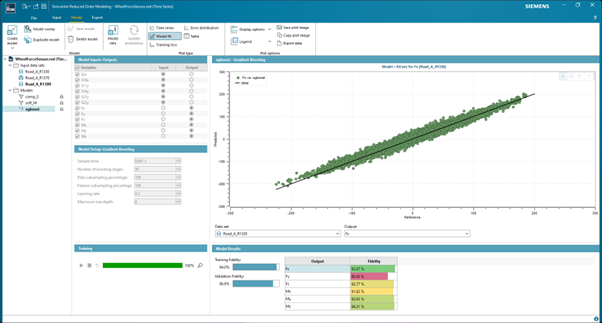
This method includes built-in multi-output regression support, so if you need to predict several output signals simultaneously, you can! Additionally, its efficient parallelization fully utilizes your available computing resources, ensuring accelerated training performance and reduced waiting time. You’ll also find your models more robust to overfitting thanks to L1 (Lasso) and L2 (Ridge) regularization, which helps your models generalize better to new, unseen data. When it’s time to deploy, flexible model export options include both ONNX and FMU formats.
Faster CSV imports
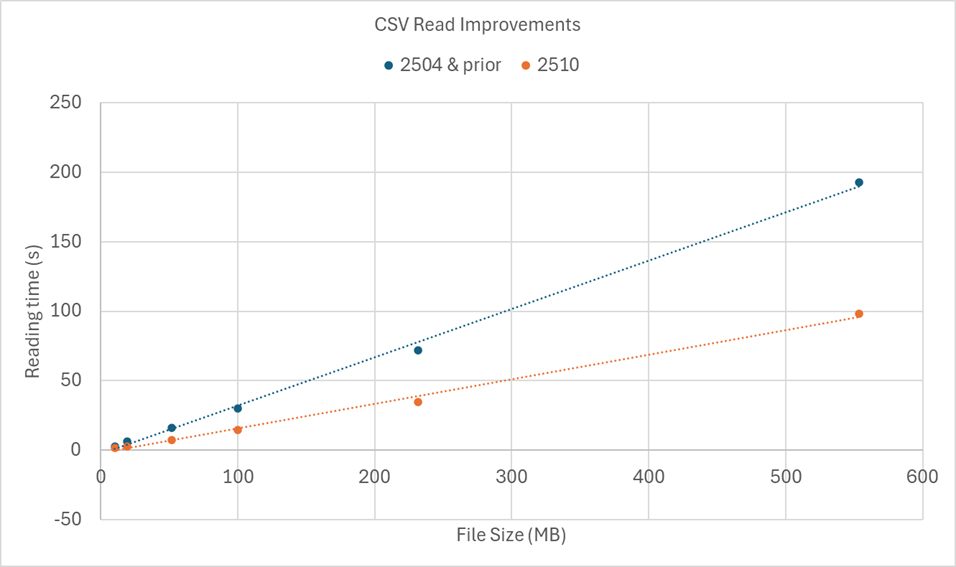
Integrating large datasets efficiently is crucial for engineering workflows. This release features significant performance enhancements for importing .csv data.
Additional signal processing capabilities for improved ROM accuracy
Time-series data can often be noisy, containing simulation artifacts or high-frequency content that can obscure the actual trends and make it difficult to learn by a ROM methodology. This release introduces a simple low-pass filtering operator, allowing you to easily eliminate unwanted noise from formula variables.
The operator filters out unwanted high-frequency content, which boosts ROM training efficiency. It utilizes a Butterworth design to provide a maximally flat passband response, thereby optimizing signal conditioning. This design preserves the original signal’s shape and amplitude, maintaining signal fidelity with minimal ripples or distortion. Removing detrimental noise enhances prediction accuracy and robustness of ROM towards unseen data signals.
We’ve also introduced this release a new delay operator to incorporate past values of signal quantities as additional features for regression, thereby giving your non-recurrent regression models for time-series a better understanding of temporal relationships.
This provides improved feature representation, giving your static models a basic form of short-term memory, which aids in current time-step prediction accuracy.
Dive deeper with a new Time Series Vehicle Sensor Prediction tutorial
A new tutorial, ‘Vehicle Sensor Prediction,’ has also been added, offering hands-on guidance for building predictive models. This example demonstrates constructing robust predictive models directly from test data, highlighting the tangible benefits of recent updates.
In this tutorial, you’ll learn how to create a Reduced Order Model (ROM) to predict the intake manifold pressure (MAP) within an engine, using signal data acquired from an OBD-II vehicle sensing interface. Predicting MAP is crucial for an Engine Control Unit (ECU) to calculate air mass and ensure optimal engine performance. Imagine the possibilities: not only can you use these ROMs in 1D system simulation tools, but they can also serve as a reliable backup system for failed sensor hardware!
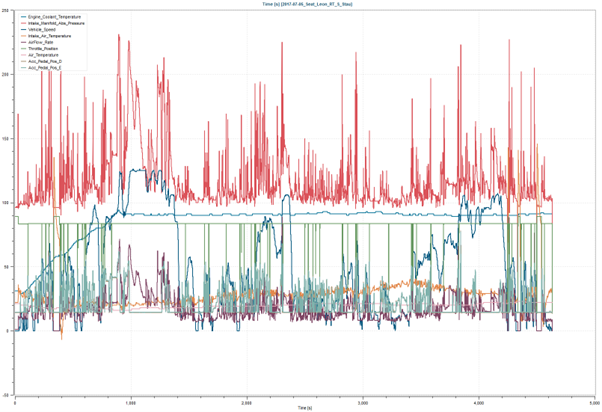
This tutorial is a fantastic way to experience firsthand how our enhanced capabilities, efficient data handling, and new product capabilities can dramatically improve your time series modeling projects.
Summary
These new features in Simcenter Reduced Order Modeling 2510 enhance analytical accuracy, speed up data integration, and improve ROM-based project efficiency. Explore the updates today!