ABET CFO and COO Jessica Silwick shares how credentials are shaping the future of engineering education
To keep pace with digital transformation, lifelong learning has transformed from an asset to a necessity for engineers and other technical professionals.
Professionals across all sectors are seeking ways to upskill and reskill to stay relevant, especially those in technical roles. But how can learners and employers alike ensure the quality and relevance of these new educational pathways?
Recent research from Accredible shows that 94 percent of human resources and talent leaders want to see credentials with third-party endorsements, yet only 31 percent of issuers currently provide them. Meanwhile, Coursera shares that 61 percent of students prioritize accreditation and quality assurance when choosing microcredentials.
Enter ABET, a long-standing guardian of excellence in STEM education that is now expanding into the credentials space.
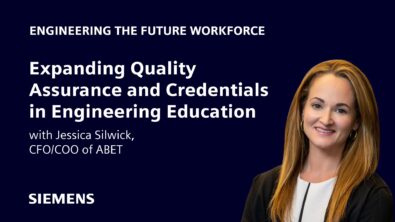
We recently had the pleasure of speaking with Jessica Silwick, CFO and COO of ABET, on the latest episode of Engineering the Future Workforce. Her insights shed light on ABET’s pivotal role in adapting to the evolving educational landscape and their recent commitment to assuring the quality of credentials.
Listen on Spotify
Listen on Apple
ABET: A legacy of assuring quality in engineering education
Founded in 1932, ABET has a rich history of assuring confidence in STEM education. With an impressive reach, they currently accredit 4,863 programs at 950 colleges and universities in 42 countries. Each year, 2,200 experts from 34 member societies contribute to their mission.
While historically focused on traditional degree programs, ABET is now extending its rigorous quality assurance processes to the burgeoning world of credentials.
In May 2025, ABET recognized Siemens’ Design for the Circular Economy credential created in collaboration with the University of Colorado Boulder, making Siemens the world’s first industrial software company to offer ABET-recognized credentials.
“We have a long history of working together and partnering with Siemens on a global scale to promote quality education,” said Silwick. “We’ve seen Siemens in these spaces doing the same work to recognize, encourage and help build quality education systems around the world.”
Learn more about Siemens’ credential program.
The rise of credentials and ABET’s crucial role
The demand for upskilling and reskilling has led to a proliferation of credentials. While these offer invaluable opportunities for learners, they often lack standardized quality assurance, making it challenging for industry to evaluate the skills or knowledge a learner truly gains. This is where ABET steps in, bringing its trusted framework to this new frontier.
“Ten years ago, we had an industry advisory council member come to us and say, ‘Hey, ABET, we need you. We’re not getting the same funnel of applicants from degreed programs. We are starting now to hire individuals from credentialed learning opportunities,” said Silwick.
“’But there’s so many out there and we are having a hard time assessing quality. Our talent acquisition teams are overwhelmed. Hiring managers are overwhelmed, and we’re also wondering where to send employees when we need them to upskill or reskill.’”
This urgent call to action spurred ABET to dig deeper and start researching the credential market more thoroughly. They understood the need to adapt without compromising their reputation for quality.
Silwick outlined the key pillars that ABET identified for ensuring quality in credentials:
- Clearly defined learning outcomes: These must align directly with industry needs and be assessable.
- Robust assessment methods: It’s vital to validate that learners truly achieve these outcomes.
- Engaging industry stakeholders: This ensures that credentials reflect real workforce expectations.
- Transparency: Lastly, educational goals and validation processes must be clear for both learners and employers.
“Together these elements ensure the credential is not just a participatory certificate, but a meaningful marker of quality and relevance,” said Jessica.
Dynamic processes for a dynamic world
To ensure credentials stay relevant and effectively meet the evolving needs of industry, ABET purposefully designs its processes to be dynamic rather than static. They understand that lifelong learning is no longer a luxury but a necessity.
“Beyond compliance checklists, we’ve embedded cycles of feedback and reflection in every stage of both recognition and accreditation. Programs and credential offers are expected to collect data, analyze outcomes and demonstrate how they’ve acted on the evidence to improve,” Silwick stated.
This continuous improvement cycle, combined with insights from peer reviewers from academia and industry, ensures that credential providers are not just meeting minimum standards but are actively innovating and raising the bar.
Furthermore, Jessica emphasized that industry involvement must be an ongoing process.
“As part of our accreditation process, our programs have to demonstrate that they are engaging industry all the time, not just around your accreditation review cycle. This is a continuous relationship. You’re providing one another with feedback and input and you’re using that feedback or input to make sure that your program is meeting the needs of industry.”
Broadening talent pipelines and fostering durable skill development
The shift towards credentials and modular learning has a variety of benefits for industrial organizations and society at large.
“I love, love, love the fact that credentials are gaining popularity and acceptance as real learning opportunities, and that this is an opportunity for learners to be able to gain the skills that they need, whether they have the resources or not to commit to a long-term education,” Silwick shared.
“I think credentials are great way for society as a whole to improve itself and for people around the world to be able to enter in the professions that they may not have otherwise had access to without credentials.”
This focus on persistent feedback and understanding diverse learning needs allows educators to better support students from all backgrounds, creating pathways for non-traditional learners to thrive and contribute to their communities.
Beyond technical expertise, ABET’s framework also emphasizes the importance of durable skills.
“When skills like communication, teamwork and adaptability are formally recognized, it validates their importance alongside the technical experience…together these elements cultivate a growth mindset,” Jessica Silwick emphasized.
Modularizing education for responsive, inclusive learning
The traditional “one size fits all” degree model is giving way to more flexible, modular pathways. This approach allows learners to build skills in smaller, stackable units, making education more responsive and relevant to the demands of a rapidly changing workforce.
“I think the traditional one-size-fits-all degree model is giving a way to more flexible pathways that reflect how people actually learn and work today. Modular structures allow learners to build skills and smaller stackable units; whereas, iterative approaches and programs or credential offers can adapt quickly to industry needs,” Silwick concluded.
ABET: A catalyst for learning experiences that drive digital transformation
ABET’s commitment to quality assurance is a vital component for ensuring that today’s learners are equipped with the skills they need to lead digital transformation in industry. By embracing dynamic processes, prioritizing industry involvement and championing a modular, inclusive approach to learning, ABET continues to be a vital force in shaping the future of engineering education for the benefit of individuals, industries and society as a whole.
Learn more about how Siemens supports educators with industry-recognized credentials, software access and more.
Watch on YouTube
Engineering the Future Workforce
Engineering the Future Workforce explores emerging and best practices that are empowering the next generation of engineering talent. The series will showcase conversations with leading voices from academia and industry who are committed to improving learners’ digital skillset and mindset to accelerate innovation.
Listen on: