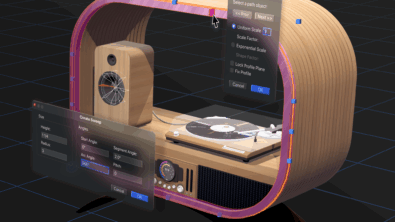
QUICKSURFACE integrates Siemens Parasolid – 3D scan to CAD, and beyond
Discovering “How it’s made”
Clicks of gears, flow of molten metal, dance of robotic arms assembling the objects that populate our lives – for many, the popular TV program “How It’s Made” offers a captivating glimpse behind the curtain of modern manufacturing. It reveals the processes and machinery that bring those artifacts to our homes, with the guidance of expert commentary and the transparency of a factory tour.
This is all well for general knowledge, but if all you have is a finished physical item that you critically need to replace, reproduce or modify – a vehicle body panel, a power turbine component, a press machine tool – with no design geometry or knowledge of the original manufacturing methods, then how would you be able to complete this challenge?
This is the realm of 3D reverse engineering, and while it shares a similar spirit of inquiry with “How It’s Made,” it operates on an entirely different plane of complexity and sophistication.
Reverse engineering – from physical object to CAD model
In product development and manufacturing, reverse engineering can be seen as the process of ‘digitally deconstructing’ a 3D physical object to obtain design and manufacturing information from it, understanding its components, functions and behaviors. This intelligence can be then used to recreate legacy parts, perform competitive analysis, improve and optimize designs and rapidly create and iterate prototypes.
3D scanning – optical, contact or even in some cases ‘x-ray’ based – is a crucial element in the 3D reverse engineering workflow. A plethora of 3D scanning tools are available, that capture the 3D geometry of physical objects with almost unimaginable accuracy and efficiency. This data is referred to as a digital 3D model, but more specifically would be described as a point cloud or mesh.
While the raw 3D scan represents the original part to incredibly high levels of precision, there are inherent limitations with this data, that prevent it from being useable directly as a true ‘digital twin’ from which further manufacturing can be performed.
The critical transition from the physical object to its editable and manufacturable digital blueprint is the 3D scan to CAD model ‘conversion’.
Equipped with the object’s underlying geometric primitives and features, parametric attributes and connectivity information between surfaces and volumes, CAD models allow engineers to understand, analyze and ultimately recreate and improve the design in the digital realm, ready for reproduction in the physical realm, thus completing the reverse engineering process.
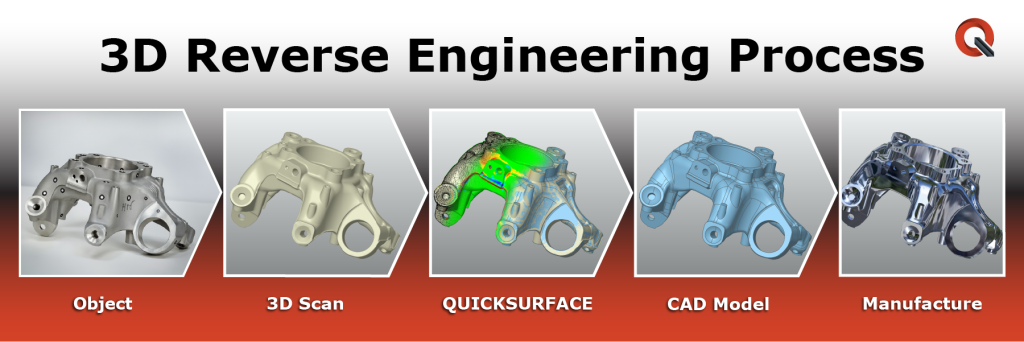
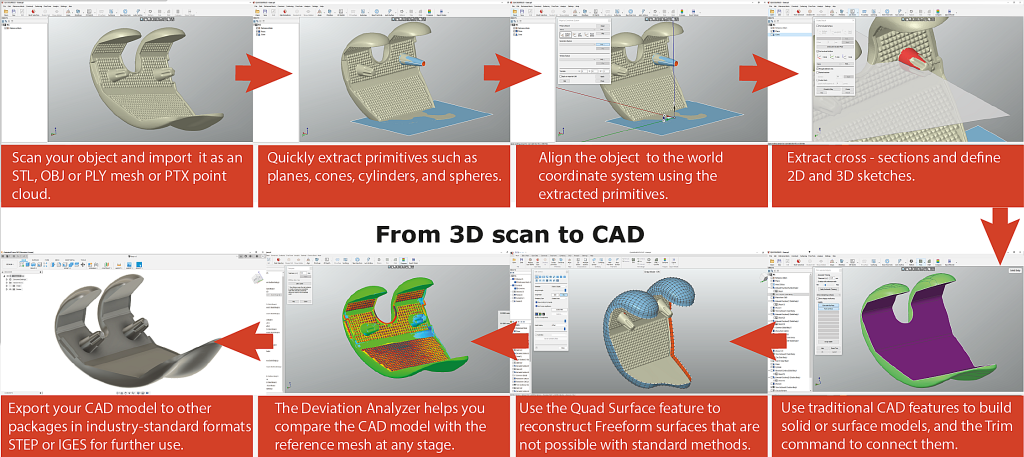
Converting 3D scans into CAD models is often misunderstood as a simple data conversion task, but it is far more involved than that. Even with the rise of generative AI, this process cannot be easily automated. It is time-consuming and skill-intensive, requiring the reverse engineer to think deeply about the original engineer’s design intent, while also considering any modifications needed for the new production process. This makes it a demanding exercise that truly tests a reverse engineer’s analytical ability and mastery of their tools.
Leveraging decades of experience and industry-leading knowledge in 3D scanning and reverse engineering workflows, the engineering team at QUICKSURFACE have developed a solution to streamline and perfect scan-to-CAD conversion.
QUICKSURFACE – scan to CAD, and beyond
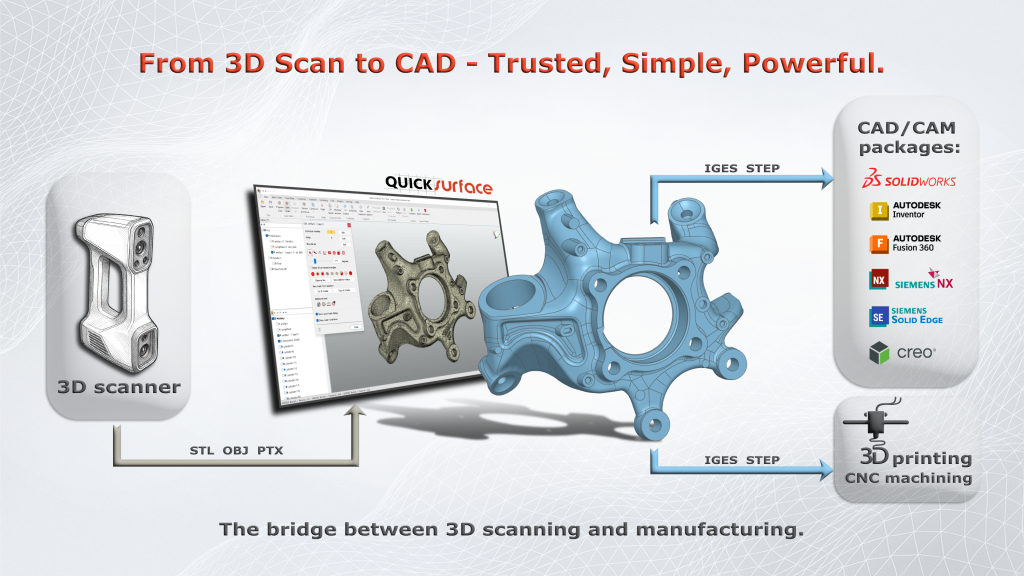
QUICKSURFACE is a professional, powerful, and intuitive reverse engineering software that transforms 3D scan data into precise, manufacturable CAD models. Created for engineers and designers, it delivers the speed and accuracy demanded by industry leaders – without unnecessary complexity.
QUICKSURFACE efficiently handles complex, large scan datasets, both in mesh format as STL/OBJ/PLY files and in point clouds format as PTX files. It allows to easily reduce the size of data and simplify it, filling holes and removing mesh outliers.
Unlike other reverse engineering tools, QUICKSURFACE is a complete CAD modeler, tailored to the needs of scan to CAD conversion. It does not only recover the accurate, production-ready CAD structure of the scanned object, but corrects and reinforces the design intent.
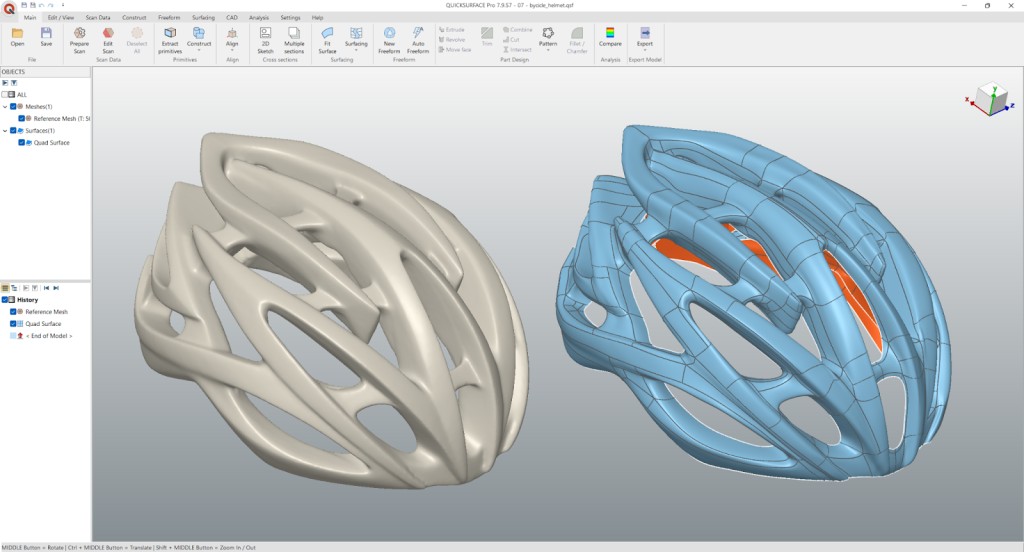
In addition to fast primitive extraction from meshes and point clouds, QUICKSURFACE allows to perform 2D and 3D sketching on scan data and advanced, parametric modeling operations such as lofting, sweeping, shelling, thickening, drafting and more.
AI powered features like automatic surfacing make the scan to CAD conversion even more streamlined.
One of the most powerful functionalities offered by QUICKSURFACE is real-time deviation control.
The CAD model and original scan map are superimposed, and users can dynamically fit the former on the latter with a real-time distance color map, quickly validating the intent before releasing the design while preserving its exact, parametric underpinning structure.
Converted models are ready for further optimization in any CAD solution or can be sent directly to additive and CNC manufacturing software systems with export in IGES and STEP file formats.
Partnering with Siemens Parasolid – enabling best-in-class 3D geometric modeling
At the heart of QUICKSURFACE’s CAD modeling capabilities sits Parasolid, the market leading geometry kernel from Siemens.
The engineers at QUICKSURFACE wanted to deliver an innovative solution for reverse engineering professionals, focusing resources on the specialized challenges of scan-to-CAD conversion – feature recognition, automated surface fitting, seamless integration of scan data into a parametric workflow – rather than building a geometric engine from scratch.
They therefore made the strategic choice of developing QUICKSURFACE atop Parasolid, leveraging decades of development in solid and surface modeling operations. Being the “golden standard” of geometry kernels, Parasolid offers the most comprehensive set of industry-proven functionality in the market, supporting state-of-the-art industrial and technological standards.
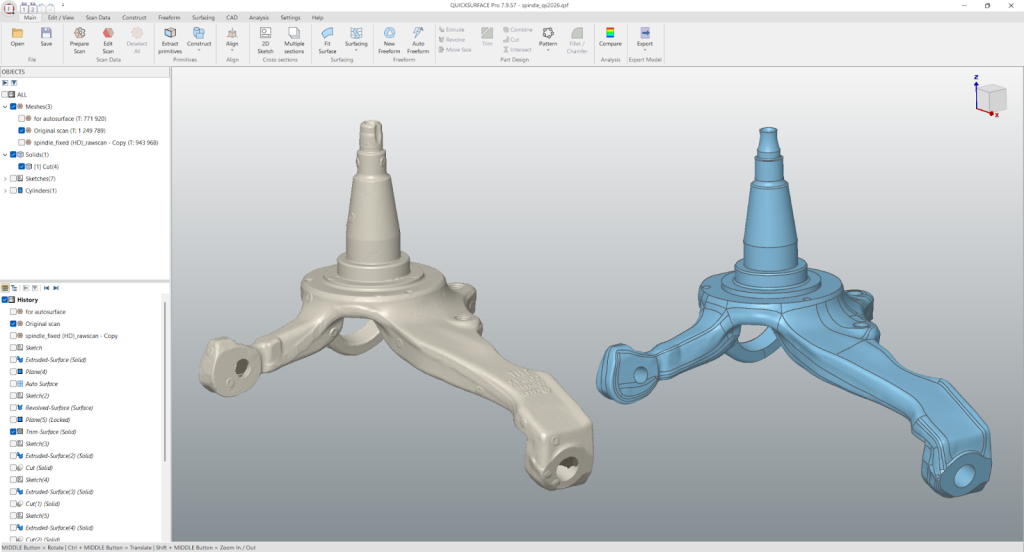
With Parasolid, QUICKSURFACE can offer the full CAD modeling experience, a powerful differentiator in the reverse engineering software landscape.
Kostadin Vrantzaliev, Founder and Head of Product, QUICKSURFACE
QUICKSURFACE provides excellent scan to CAD conversion to a range of diverse industries, from automotive and aerospace to fashion, medical, consumer goods and arts.
This exceptional versatility would not be possible without a mature and proven kernel. Whether dealing with complex mechanical assemblies, ergonomic surfaces, or highly aesthetic forms, Parasolid’s proven ability to accurately represent, manipulate, and analyze geometries ensures that QUICKSURFACE can serve as a universal tool, adaptable to the unique demands of nearly every vertical market.
Parasolid can handle thousands of components, always providing excellent performance. When you need to deliver robust software, you must go for Parasolid. It just works!
Kostadin Vrantzaliev, Founder and Head of Product, QUICKSURFACE
A very important part of the successful integration of Parasolid was the fruitful and efficient interaction between the engineers at QUICKSURFACE and the Parasolid technical support team. With extensive documentation, invaluable knowledge and centralized development and support functions in Cambridge, the Siemens Parasolid team supported QUICKSURFACE to update their existing software with the Parasolid kernel within only 12 months.
QUICKSURFACE is an innovator in the field of 3D reverse engineering to CAD and we are highly excited by the potential that their integration of Parasolid brings to the market, truly bridging the gap between the physical and digital worlds.
Graeme McBean, Director of Open Tools, Siemens Digital Industries Software
.
Learn more
If you’d like to know more about Quicksurface by KVS Ltd., visit their website https://www.quicksurface.com/ or connect on Instagram https://www.instagram.com/quicksurface3d/, Facebook https://www.facebook.com/quicksurface and LinkedIn https://www.linkedin.com/company/quicksurface.
To know more about Parasolid, visit Parasolid 3D Geometric Modeling | Siemens Software or request a free 60 days trial at Request your free 60-day evaluation of Parasolid | Siemens Software.
Parasolid is part of the Siemens PLM Components portfolio, a set of advanced, industry-proven Software Development Kits integrated by 3D applications in product design, simulation and manufacturing. To know more, visit PLM Components | Siemens Software.