Parasolid v39.0: Advancing the Future of Geometry Modeling

New capabilities in core modeling, mesh processing, implicit geometry, and application performance expand what developers can achieve with Parasolid.
Parasolid has long been recognized as the industry’s leading geometric modeling kernel, enabling software developers to deliver precise, scalable, and reliable 3D modeling applications. Its ability to support boundary representations (B-reps), facets, and implicit geometry within the same 3D model enables a true mixed modeling environment for applications across design, simulation, and manufacturing.
With the release of version 39.0, Parasolid continues to push the boundaries of what modern geometric modeling can achieve. The new release introduces significant enhancements across core modeling, Convergent Modeling, implicit geometry support, multithreaded execution, and platform compatibility. Together, these improvements help software developers build more capable, efficient, and future-ready applications.
Core modeling: extended control for advanced modeling workflows
Complex industrial products demand increasingly sophisticated surface and solid modeling capabilities. Parasolid v39.0 introduces several enhancements designed to give applications finer control over modeling operations and improved support for demanding design scenarios.
- More powerful reblending: Applications can now change the size, shape and type of a blend when reblending. These improvements support more refined workflows for complex, aesthetically critical designs.
- Enhanced surface analysis tools: Perspective silhouettes can be imprinted onto a collection of topologies and isoclines can be generated as construction geometry. These additions help with visualization, manufacturability analysis, and surface quality assessment.
- More control in local editing for edges: Developers can decide whether new edge geometry should create new curves instead of reusing existing ones, giving applications more flexibility during face modification operations.
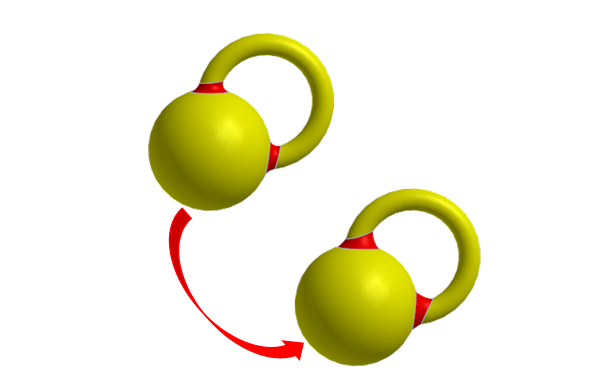
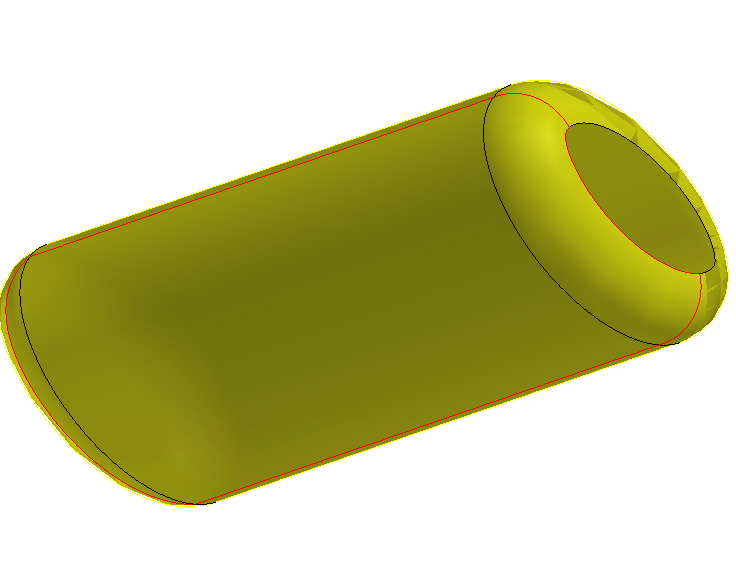
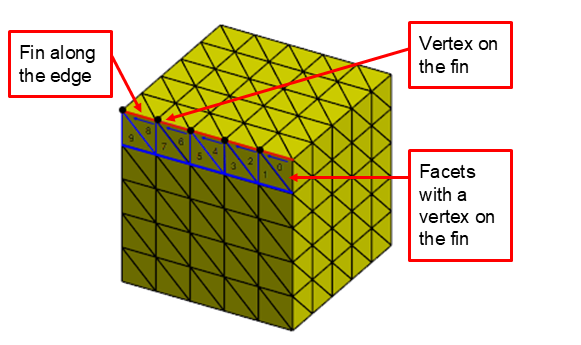
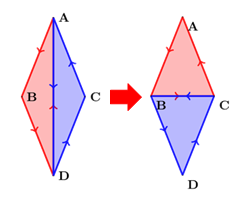
re-triangulation of a pair of facets
Strengthened Convergent Modeling
A key highlight of Parasolid v39.0 is the continued evolution of Convergent Modeling, Siemens’ technology for seamlessly combining precise and faceted representations in a single modeling workflow.
- New mesh utility functions: Applications can now find all mesh topologies associated with a B-rep topology and vice-versa. Developers can now also identify connected groups of mesh facets or fins in a set of mesh topologies, simplifying advanced mesh processing.
- New mesh Euler operations: Parasolid v39.0 enables direct mesh topology edits while maintaining geometric and topological consistency. New operations such as local re-triangulation, fin splitting, and facet subdivision increase editing flexibility.
- Enhanced mesh Boolean operations: Applications can control which mesh entities are preserved or modified when topology deformation is needed for watertight results.
- Custom mesh-to-B-rep fitting: Surfaces can now be fitted using mesh vertices alone, supporting higher-quality reconstruction for reverse engineering and scan-to-CAD workflows. Applications can also choose whether trimmed curves are returned during surface fitting.
Extending Support for Implicit Geometry and Lattices
As additive manufacturing continues to drive adoption of implicit and cellular structures, Parasolid is extending its support for implicit and lattice-based workflows.
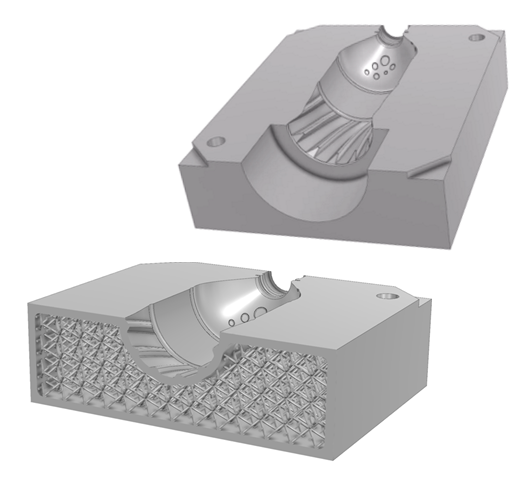
- Support for implicit lattices during a clash operation: version 39.0 enhances clash operations involving cellular bodies containing embedded lattices. Applications gain additional flexibility in determining how lattice-containing regions should be treated during these operations, improving support for highly complex implicit structures.
- Extended support for mass properties and slicing: the release expands support for mass property calculations and slicing operations. Applications can optionally exclude lattice and frame contributions from mass property calculations when computational efficiency should be favored. Furthermore, slicing operations now generate geometrically matched polylines in overlap regions, helping ensure clean and precise downstream manufacturing data.
Improved Performance and Scalability
Beyond geometry enhancements, Parasolid v39.0 continues to improve application performance and scalability through expanded multithreading support. Additional enquiry functions can now execute concurrently with other Parasolid operations, while parts and partitions may be transmitted simultaneously in appropriately locked application threads. These improvements help applications process larger and more complex models more efficiently.
The release also introduces new enquiry capabilities for Parasolid system attributes, allowing applications to access information previously managed internally by the modeler.
Broader Support Across Modeling, Rendering, and Platforms
Parasolid’s support for general topology continues to expand. New capabilities include embossing on general bodies as well as extended support for instancing, knitting, and hollowing in cellular-body workflows.
Rendering functionality has also been refined, giving applications more control over the treatment of partially solid and partially void regions and over whether internal faces between solid regions should be displayed.
In version 39.0, developers can specify exact positions along edges that must be respected in the faceted rendering output.
To further improve reliability, Parasolid has enhanced integrity checking capabilities for imported and exported data alongside more accurate diagnostic information for modeling operations.
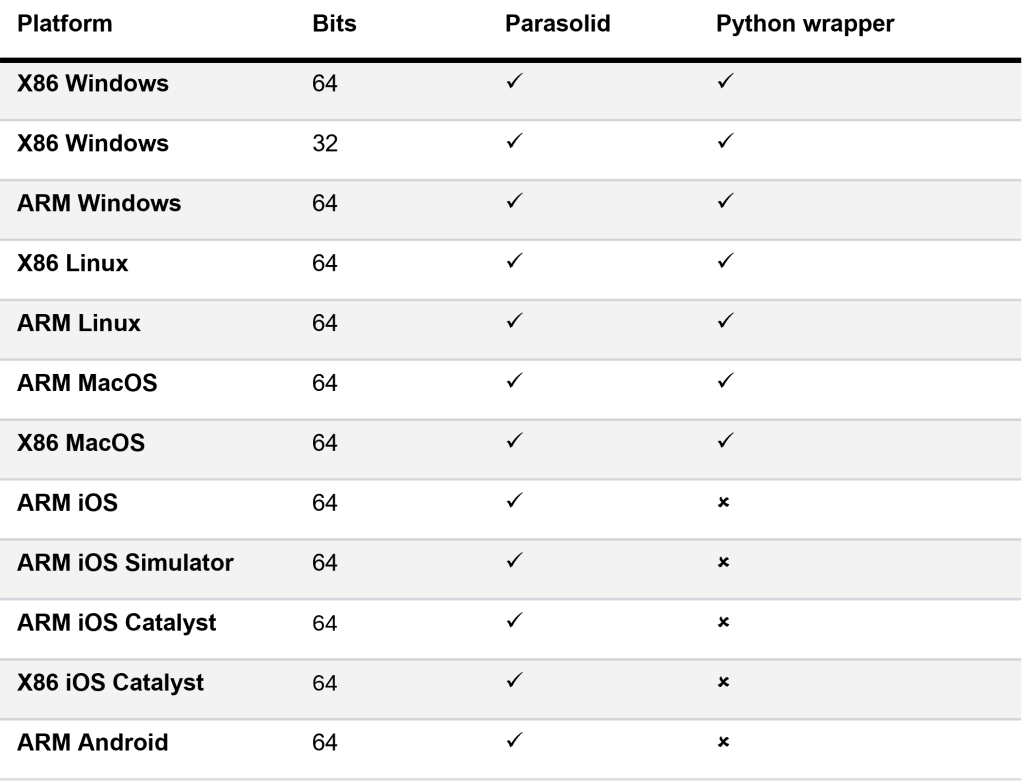
Finally, Parasolid broadens its platform reach with support for ARM and x86 iOS Catalyst environments and introduces Python bindings, helping developers integrate Parasolid into a wider variety of modern software architectures.
Looking Ahead
Parasolid v39.0 demonstrates a continued commitment to supporting the realities of modern engineering workflows, where B-rep geometry, meshes, implicit representations coexist within a single digital model. From advanced reblending and surface analysis to mesh editing, lattice-aware operations, and expanded platform support, this release strengthens Parasolid’s position as a foundation for the next generation of engineering software.
Want to know more?
To know more about Parasolid, visit Parasolid 3D Geometric Modeling | Siemens
If are interested in integrating Parasolid in your software application, request a 60-days free trial by using this form> Request your free 60-day evaluation of Parasolid | Siemens