D-Cubed 2D Components version 79 release

D-Cubed 2D Components sit at the core of cutting-edge CAD/CAM/CAE and AEC software applications, enabling advanced sketching capabilities and transforming how products are conceived and built. These applications are used to design, analyze, visualize, and manufacture products from consumer goods to aircraft engines and commercial buildings.
D-Cubed 2D DCM version 79.0
D-Cubed 2D DCM (2D Dimensional Constraint Manager) is widely acknowledged as the leading 2D geometric constraint solver. In addition to driving the sketcher in many CAD products, 2D DCM is used in CAM, CAE and other geometry-based applications.
Enhancements introduced in version 79.0 of D-Cubed 2D DCM are described below.
Equal value between length dimensions of different types
In 2D DCM models, it is frequently the case that applications wish to constrain two measured quantities to be same without specifying a particular value.
Until now, equal value was only supported for pairs of dimensions of the same type, limited to distance and radius. It was therefore necessary to use equations to establish equality between more complex dimensions, such as directed distances.
With version 79.0, applications integrating 2D DCM can quickly and effectively constrain multiple length dimensions of different types to have equal value.
The new equal value constraint supports any number of length dimensions and any combination of length dimension types, including directed distances, curve lengths, radii and linear pattern values.
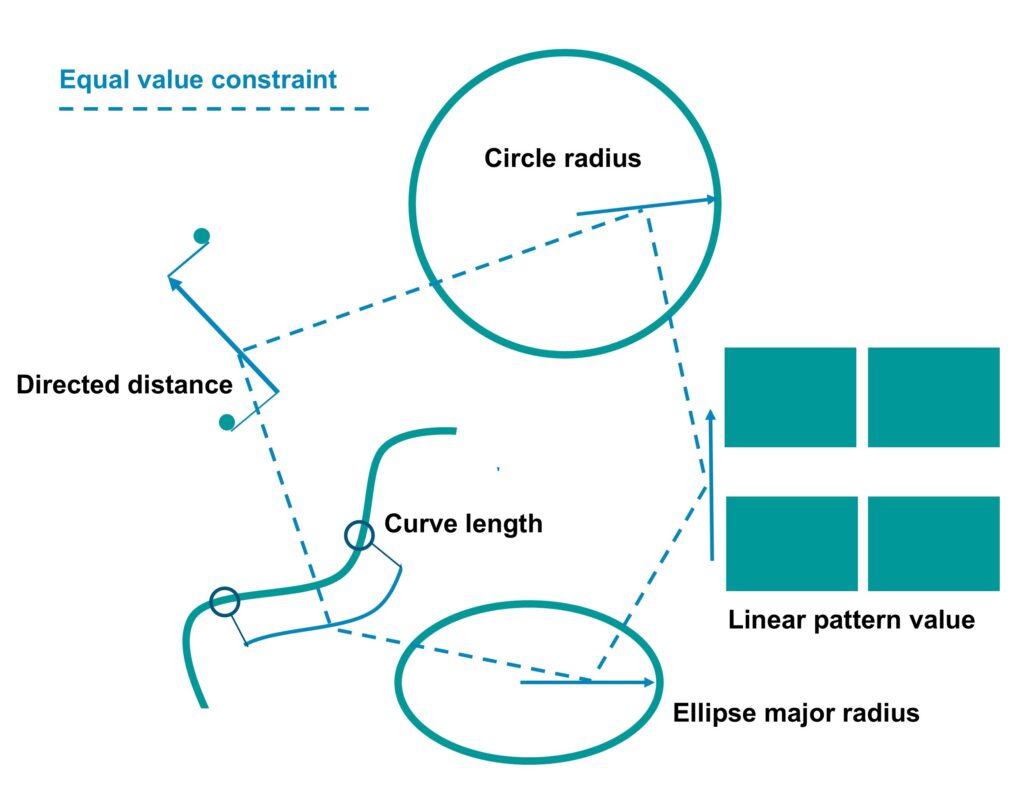
The new equal value constraint is equipped with a full set of solution control tools, that can be used by applications to further detail the design intent and guide 2D DCM when multiple solutions are available.
The shared value for the new equal constraint is treated as a separate object and applications can either specify its starting value, fix or dimension it.
Equal value constraints can be added like direct dimensions, supporting all dimension properties like alignment, half-spaces, help points or parameters. Applications can add or remove individual dimensions from the equal value constraint, without breaking the equality of other nodes.
2D DCM will solve each of the length dimensions involved in the equal value constraint and assign individual solving statuses. If any of the length dimensions in the equal value constraint is also involved in an invalid configuration, its individual status will reflect this. Applications can therefore act on the specific problematic length dimension, without affecting the others in the equal value constraint.
Half-space support for dimensions from parametric curves to lines
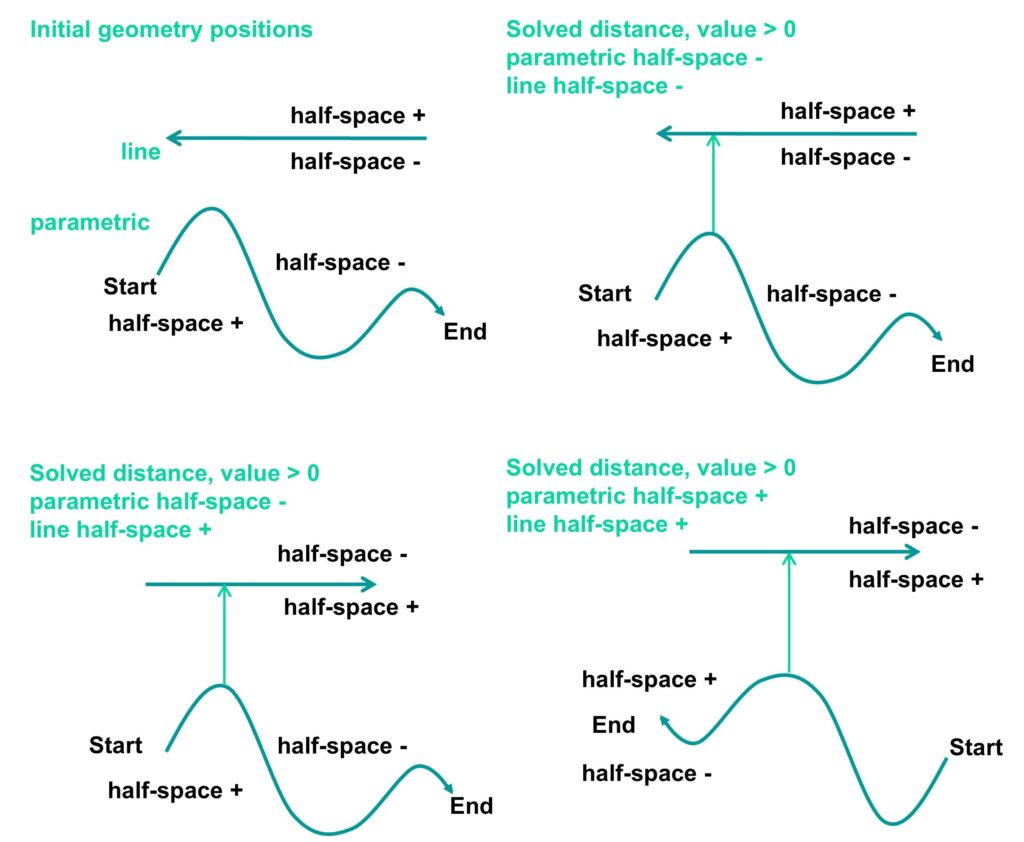
For dimensions from curves, 2D DCM supports the concept of signed dimension values using a half-space definition.
An infinite line can be considered to divide space into two halves. As a line is defined in 2D DCM using a signed vector, it has a positive direction and therefore we can say that one half of space is on the right side of the line, facing in the line direction and the other half space is on the left side.
This concept can be generalised for a position on any curve, given a sign for the direction. Whilst the curve may be bounded or even periodic, locally from the position being measured the solution space is either on the left or the right side.
Previous versions of 2D DCM have limited the combinations of geometries and dimensions for which a half-space can be defined. In version 79.0, the supported combinations have been increased to include a distance or an equal distance from a parametric curve to a line. This includes splines, conics, ellipses and evaluated parametrics.
Python wrapper
With version 79.0, a Python wrapper interface is also available as part of the 2D DCM deliverables, allowing to integrate it within applications developed in Python.
D-Cubed PGM version 79.0
D-Cubed PGM (Profile Geometry Manager) enhances the productivity of sketchers. It does this by working with higher level geometric data and not individual curves. Examples include offsetting loops while inserting, extending and trimming edges, adding constraints to loops rather than to individual curves, and solving the shape of loops while maintaining their perimeter length or area. PGM is often used to add capabilities to a 2D DCM-based sketcher.
Enhancements introduced in version 79.0 of D-Cubed PGM (Profile Geometry Manager) are described below.
Improved Find intersections functionality
The PGM Find intersections functionality allows applications to calculate intersections between loops in a sketch.
An initial prototype of this functionality was introduced in version 78.0, limited to simple crossings, with basic control options and minimal reported information.
With version 79.0, Find intersections is complete.
All types of intersections can be detected, providing applications granular control on the calculation’s scope and delivering a comprehensive set of reported intersection properties.

Supported types of intersections between two loops:
Crossing – crossing at a single position in space
Tangent crossing – loops are tangent but cross at a unique position
Tangent
End touching – loops touch at the end of one or both
Overlap – overlapping region with no crossing over
Overlap crossing – overlapping region, crossing over
Applications can control the scope of the intersections calculation. It is possible to specify which loops in the sketch should be included in the calculation – one loop, for self-intersections, one loop against all other loops in the model, two loops against each other or all loops against all other loops in the model.
It is also possible to specify the types of intersection that PGM will detect among all the supported ones.
Detailed information is returned on the intersections found – the position of the intersection on specific loop and edge, the type of intersection and the relationship between the intersecting loops.
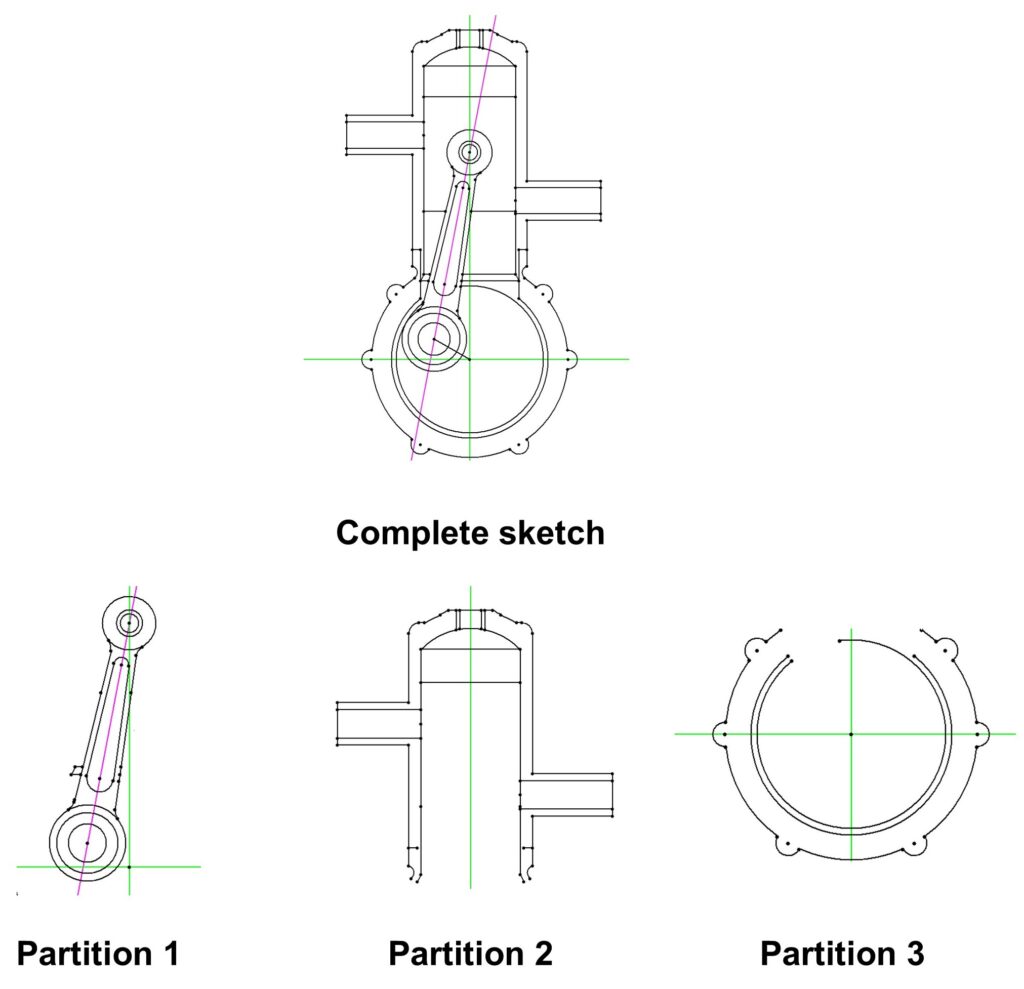
Partitioned 2D DCM evaluate
Applications integrating both 2D DCM and PGM can solve dimensions and constraints between PGM sketch entities such as edges and profiles
Partitioning is the automatic division of the model added to 2D DCM into distinct sub-models which can be processed individually
With version 79.0, 2D DCM supports partitioning of PGM models for DCM evaluate. This can result in more efficient solving as the algorithms must process a smaller model for each function
Support for Web Assembly
In addition to the existing C, C++ and .NET interfaces, with version 79.0 both 2D DCM and PGM are available as object releases for the Web Assembly platform, allowing developers to use the component directly within web applications.
All the complex, powerful parametric sketching capabilities of 2D DCM and PGM can be leveraged in a web environment at near-native speeds, without needing server-side processing.
Learn more
To know more about D-Cubed, visit the product page D-Cubed | Siemens Software or request a free 60 days trial at Request your free 60-day evaluation of D-Cubed Components | Siemens Software .
D-Cubed components are part of the Siemens PLM Components portfolio, a set of advanced, industry-proven Software Development Kits integrated by 3D applications in product design, simulation and manufacturing. To know more, visit PLM Components | Siemens Software.
2026 PLM Components Innovation Conference
If you are developing next-generation software for 3D product design, simulation or manufacturing, join us in Cambridge, UK, on April 28-29, 2026, for the fourth PLM Components Innovation Conference. This is a unique opportunity to understand the value of PLM Components and joining Siemens’ open software vendor ecosystem.
To know more and register for the free event, visit PLM Components Innovation Conference 2026 | Siemens Software.