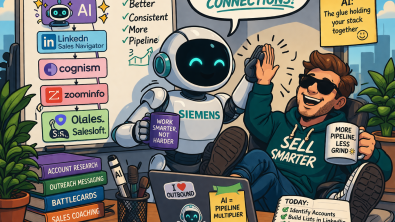
Sales engagement platforms are transforming GTM execution across revenue teams
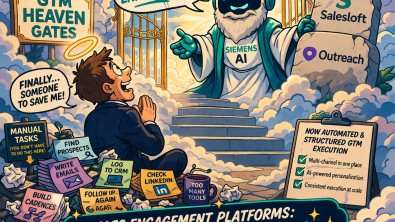
The problem with how GTM execution actually works
The problem isn’t that sellers don’t have tools.
It’s that none of those tools actually run the motion.
CRM tracks. Marketing automates campaigns. Customer success manages retention. But execution still depends on individuals remembering what to do next, across multiple disconnected tools.
That gap is where deals slow down, follow-ups get missed, and pipeline becomes unpredictable.
Sales engagement platforms like Salesloft and Outreach.io were initially positioned as productivity tools for SDRs.
That positioning is now outdated.
What’s emerging is something much more important. These platforms are becoming the system that actually executes your go-to-market motion.
What’s happening today across GTM teams
Most GTM organizations still operate in silos and across too many tools.
Each function runs its own workflow
Each team defines its own cadence
Each seller jumps between email, CRM, and LinkedIn to execute outreach
The result is predictable:
Inconsistent messaging
Channel fragmentation across email, calls, and LinkedIn
Duplicate outreach across teams
Poor visibility into what actually drives engagement
Even when automation exists, it’s fragmented:
Marketing automates campaigns but lacks sales context
Sales automates outreach but lacks lifecycle visibility
Customer success engages reactively, not systematically
So the stack grows, but execution becomes more complex, not more scalable.
Why the current approach breaks down
Automation has been treated as a layer, not as the operating model.
Most organizations build cadences as static templates.
Generic emails
Fixed step sequences
Manual switching between tools to execute each step
Minimal adaptation to account context
That might increase activity.
It doesn’t increase effectiveness.
Activity without relevance does not convert.
And complexity without structure slows sellers down.
What sales engagement platforms actually are
At their core, platforms like Salesloft and Outreach are structured GTM execution engines.
They don’t just automate outreach.
They orchestrate how go-to-market actually happens.
They sit between strategy and action, turning GTM plays into executable workflows.
In practical terms, they enable:
Multi-channel execution in one place
Email, calls, and LinkedIn tasks managed within a single workflow
Role-based orchestration
Coordinated execution across SDR, AE, customer success, and renewals
Sequenced engagement
Defined timing, prioritization, and next-best actions
Centralized visibility
Clear insight into what is being executed and what is working
Instead of switching between tools, the seller operates from one system.
The platform becomes the workspace for execution, not just a tracker of activity.
Inputs into these systems now include:
- Account prioritization signals
- Customer lifecycle stage (land, adopt, expand, renew)
- Marketing engagement data
- Deal context and buying signals
The output is not just activity.
It’s coordinated, structured execution at scale.
Why this matters for sellers and GTM teams
For sellers, this fundamentally changes how work gets done.
Instead of managing tools, they execute within a system.
That drives:
- Less time lost switching between platforms
- More consistent multi-channel engagement
- Clear guidance on what to do next
- Higher quality interactions through better preparation
It also reduces execution variance.
Top performers naturally structure outreach across channels.
Others don’t.
Sales engagement platforms standardize that behavior.
For GTM teams, this creates alignment.
Sales, marketing, customer success, and renewals are no longer operating in isolation.
They are executing within the same system, against the same motion.
Practical ways teams can use it
This is not about adding more sequences.
It’s about embedding structured GTM plays into execution.
High-impact use cases include:
Account-based land motions
Coordinated outreach across email, calls, and LinkedIn within a single sequence
Adoption and onboarding
Customer success driving product usage through structured engagement steps
Expansion plays
Trigger-based, multi-channel outreach based on account signals
Renewal management
Proactive sequences ensuring consistent engagement leading up to renewal
The key shift is this:
- The playbook is no longer a document.
- It is executed directly within the platform.
How AI fits into this shift
AI enhances the system, it doesn’t replace it.
Instead of generic messaging, AI enables:
More tailored emails within structured cadences
Faster account research before engagement
Continuous improvement based on response data
The platform provides structure.
AI provides relevance.
Together, they improve both efficiency and effectiveness.
A simple way to get started
Most teams overcomplicate this.
Start with one motion.
Define a single high-value use case
For example, a land motion into a priority segment
Map the engagement flow
Include email, calls, and LinkedIn touchpoints
Build it into the platform
Create a structured, multi-channel sequence
Introduce light personalization
Use AI to enhance messaging
Track execution
Measure adherence and outcomes
Then iterate.
The objective is not perfection.
It’s consistent, structured execution.
Where this is going
Sales engagement platforms will not sit under sales for long.
They will become shared infrastructure across sales, marketing, customer success, and renewals.
More importantly, they will define how go-to-market execution actually happens.
The organizations that win will not just have better tools.
They will have a structured system that connects channels, teams, and actions into one motion.
Because in enterprise sales, strategy is rarely the constraint.
Execution is.
And the teams that remove friction from execution will move faster than everyone else.
About the author
Benedict Russell is a Global Partner Development Executive responsible for scaling global GTM programs across all motions. He helps shape Siemens’ digital selling and AI strategy, embedding best practices that accelerate SaaS adoption and recurring revenue. Previously, he drove partner coverage and expansion, adding 300+ partners to the Siemens ecosystem. Read Benedict’s most recent blog here.